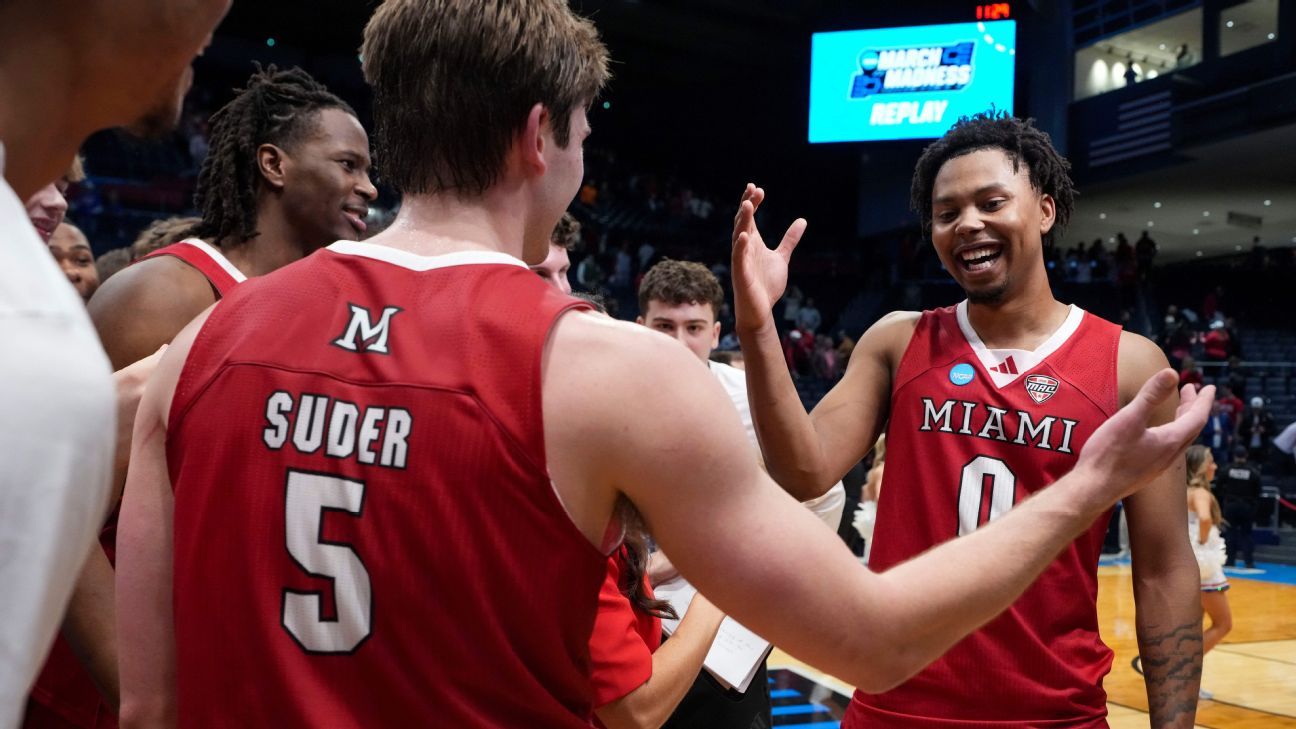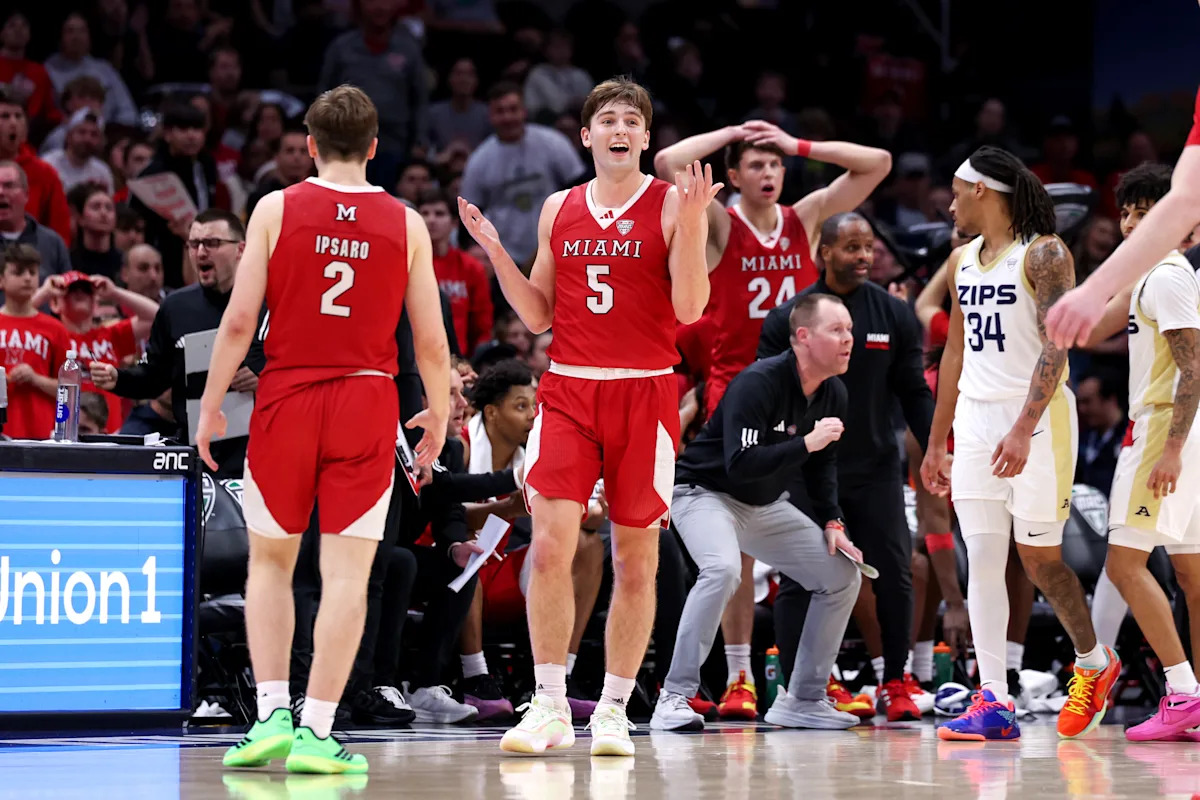
The Miami (Ohio) RedHawks’ dramatic run, culminating in a First Four victory following a 31-win regular season and a controversial at-large bid, serves as a crucial case study exposing the inherent structural tension between the NCAA Selection Committee’s evaluation criteria and the predictive efficiency of the modern sports betting market.
Selection Committee Paradox and Market Arbitrage
Miami (Ohio) secured an 11-seed despite lacking a Quad 1 victory, an outcome heavily weighted by their 31-win total. This imbalance created an immediate informational arbitrage opportunity exploited by the betting market ahead of their First Four game against SMU.
Oddsmakers initially established Miami as a +6.5 underdog. However, concentrated capital demonstrated profound confidence in Miami’s underlying performance metrics, forcing a significant line erosion. At BetMGM, 71% of tickets and 63% of handle backed Miami to cover, driving the spread down from an opening +8.5. This sharp money indicated sophisticated analysis perceived the initial line as substantially mispriced relative to the team’s demonstrated efficiency metrics, irrespective of schedule strength limitations.
Incentives Driving Concentrated Wagering
The public’s aggressive backing was fueled by the romanticized narrative of March Madness and the sheer dominance of Miami’s 31-0 start. For bettors, supporting a team with such an inflated win count offered psychological validation, leading to concentrated capital deployment against the implied skepticism of the initial point spread.
Sportsbooks faced an immediate exposure challenge: high-volume concentration on one side, particularly when validated by performance, necessitates costly hedging strategies if the underlying efficiency proves sustainable across rounds.
Operational Validation in the First Four
Miami’s decisive 89-79 First Four win, highlighted by a record 16 made three-pointers in an NCAA Tournament game, instantly validated the capital flow onto their side of the ledger. This offensive explosion—securing the largest margin of victory in program tournament history—forces an aggressive recalibration of perceived team strength before facing No. 6 seed Tennessee.
Implications for Future Seeding Methodology
The Committee’s decision to reward a 31-win total without a Quad 1 victory establishes a precedent that elevates raw win volume over strength-of-schedule metrics for borderline at-large candidates. The subsequent success validates this risk tolerance, potentially encouraging future panels to rely more heavily on win totals, thereby influencing Power Five scheduling strategies.
Competitive Landscape: Transition to Tennessee
The victory shifts Miami from a localized Dayton venue to a primary bracket matchup against Tennessee in Philadelphia. Securing the program’s first tournament win since 1999 relieves significant institutional pressure, potentially unlocking further performance stability.
Key individual performances (Eian Elmer with 23 points, Brant Byers with 19) establish a high offensive baseline that Tennessee’s superior defensive structure must now counter specifically, moving beyond generalized scouting based on regular season data.
Post-Victory Market Re-evaluation
The market correction following the First Four win suggests that the narrative of Miami’s season (31-0 run followed by a conference tournament stumble) was largely interpreted as an anomaly, not a fundamental flaw. The line adjustment for the Tennessee game will likely reflect a higher implied probability for Miami’s offense, narrowing the spread disproportionately to historical seeding expectations.
Structural Analysis: Metrics vs. Environment
The Miami (Ohio) case centers on the limitations of current ranking systems in isolating genuine team quality from environmental factors inherent in non-Power Conference scheduling. The structure of these schedules constrains high-value win opportunities.
The Committee’s inclusion implies an unquantified weighting for high win totals, acting as a ‘narrative’ factor supplementing purely quantitative analysis. For mid-major programs, this provides a blueprint: maximize wins internally to create a high committee floor, even if the ceiling for quality wins is limited. This incentivizes prioritizing win maximization over strategic scheduling risks.
Venue Proximity and First Four Dynamics
The First Four game location, situated only 40 miles from Miami’s campus in Oxford, provided a significant, non-quantifiable home-court advantage. This proximity influenced public betting confidence and execution, creating an atmosphere mitigated the typical neutral-site disadvantage.
Sportsbooks must refine models to account for localized venue impact in the First Four, as initial spreads often fail to discount the logistical and psychological benefits of guaranteed local support, creating temporary, exploitable inefficiencies.
Forward Trajectory and Benchmarks
Miami’s progression against Tennessee is the definitive test of their offensive surge’s sustainability against a superior, tournament-seasoned opponent. Success here confirms a genuine structural threat; failure confirms the First Four win as a statistical outlier.
The program leveraging its historical 1999 success provides institutional capital for future recruiting. The operational challenge is now transitioning from proving tournament viability to demonstrating parity against a seeded Power Five program, testing depth and strategic adaptation under immediate, intense scrutiny.