
Structural Design and the Long-Form Arc of Book Two
The conclusion of Avatar: Seven Havens Book 1, titled Survival, redefines the franchise’s structural framework across its final four installments, spanning episodes 10 through 13. While creative leadership has officially slated Book 2 as part of an overarching four-book architecture, the production team has yet to announce a formal release date. Rather than resolving its introductory conflicts, the finale deliberately establishes an unspooling geopolitical crisis and systemic disruption designed for extended serialized development.
By concluding on a sobering note balanced by intermittent optimism and character-driven humor, the initial season deliberately avoids episodic self-containment. It instead operates as an institutional prologue, positioning the central conflicts—militarized municipal governance, environmental degradation, and fractured spiritual heritage—as foundational variables that will govern the narrative pacing across subsequent installments.
Institutional Paranoia and Civic Retaliation in Ellora
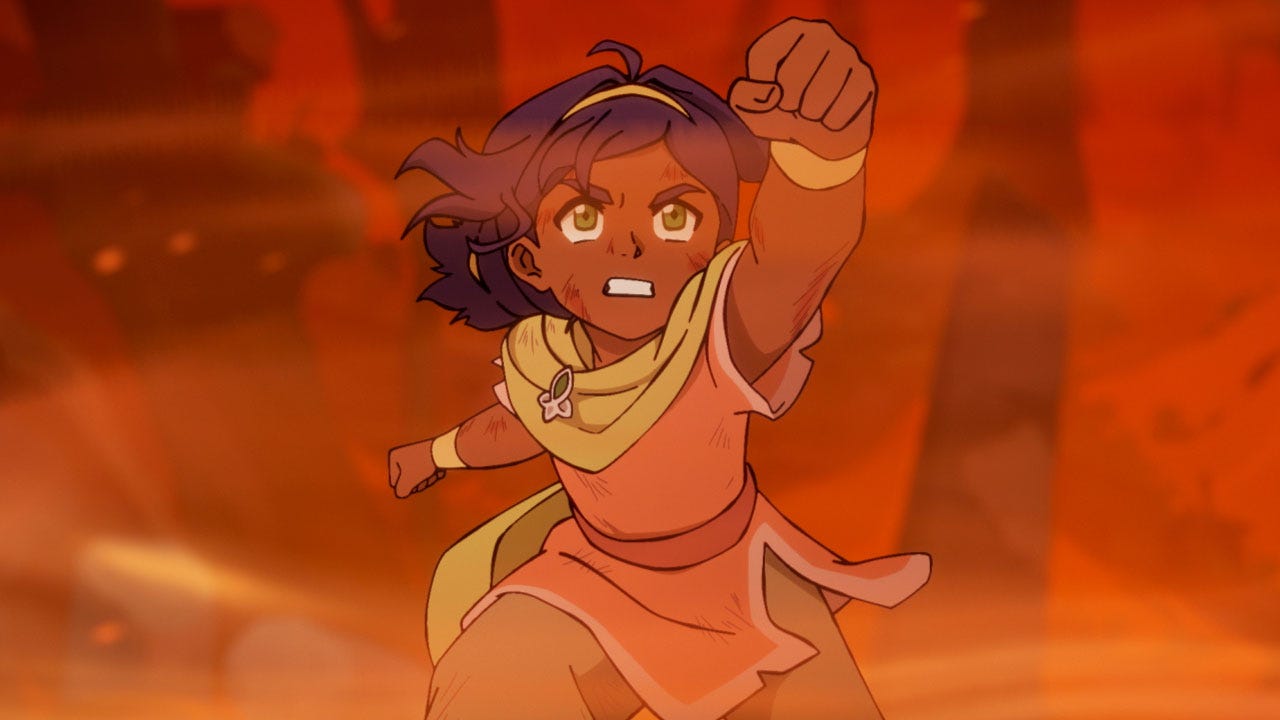
The sociopolitical stability of Ellora ruptures irrevocably in episode 10, “Ghosts and Spirits.” When Nisha (Aishu Devan) discloses her status as the Avatar, the disclosure prompts immediate institutional and civilian antagonism rather than social cohesion. Repudiated by the populace, Nisha is expelled from the settlement into the perimeter of the Harshlands alongside her cat monkey companion, Ruhi.
Her exile sparks an aggressive security escalation orchestrated by Ellora’s administrative head, Chancellor Kayoko (Jennifer Sun Bell). The civil government establishes checkpoints across the urban grid, broadcasts continuous loudspeaker decrees mandating curfews, and distributes wanted posters bearing Nisha’s likeness. This administrative posture fundamentally subverts the Avatar’s traditional franchise function: rather than serving as an accepted arbiter of balance, the spiritual protector is treated by Kayoko’s regime as an existential threat to civic order.
Bifurcated Protagonists and the Dual Avatar Dynamic
The foundational mythic departure in Seven Havens is the simultaneous manifestation of twin Avatars. With Nisha isolated in the ecological wasteland of the Harshlands, her twin sister Pavi (Saheli Khan) remains clandestine within Ellora’s surveillance perimeter. This geographical divide splits the storytelling into parallel operational modes: survival against harsh external elements versus tactical evasion under an active police state.
Pavi’s urban containment requires absolute discretion beneath continuous security scrutiny, anchored by familiar ties such as her reunion with the crystal beetle Sang, whom she rescued early in the season. Consequently, the primary dramatic tension pivots from external martial conflict toward the emotional and functional resilience of the twin protagonists, testing whether spiritual stewardship can endure ideological divergence and geopolitical partition.
Metaphysical Architecture and Unresolved Continuity
Beyond municipal power struggles, episodes 10 through 13 establish several core mysteries that serve as structural pillars for the four-book roadmap. Foremost is the unexplained metaphysical mechanism behind two Avatars manifesting simultaneously. This anomaly operates in tandem with broader historical dilemmas: the precise actions of Avatar Korra that precipitated the Cataclysm, and the unresolved disappearance of Pavi and Nisha’s parents.
Concurrently, the finale delineates the precise mechanics required for global restoration. The narrative establishes an operative correspondence linking the Seven Chakras directly to the Seven Havens, mediated exclusively through Pavi. Uncovered during a spiritual alignment overseen by the Faceless Queen Agam (Sakina Jaffrey), this metaphysical alignment confirms that regional territorial renewal remains inextricably contingent upon interior spiritual equilibrium.