Macro Spending Milestones and Indexation Dynamics
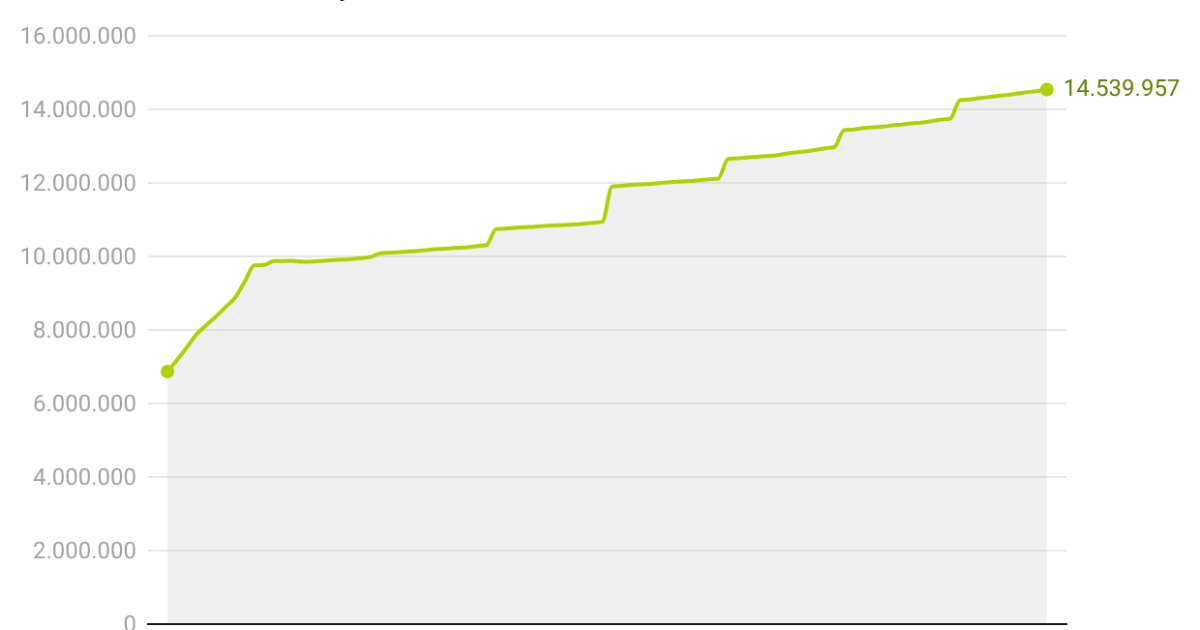
Data from the Ministry of Inclusion, Social Security and Migration show national contributory pension expenditure reached an unprecedented 14,539.9 million euros in October. This represents a 6.3 percent year-over-year expansion relative to October 2025 and marks the first time monthly disbursements have breached the 14,500 million euro threshold. The increase is underpinned by statutory indexation rules and structural drift in career earnings baselines.
The administrative system processed 10,565,782 individual pensions across Spain in October, representing a 1.6 percent annual increase in payment volume. Beneficiary headcount expanded at an identical 1.6 percent rate to 9,554,384 individuals, reflecting multiple concurrent entitlements among select recipients. The systemic average pension across all statutory modalities rose 4.6 percent year-over-year to 1,376.14 euros per month.
Current obligations are governed by the 2026 statutory revaluation framework, which enacted a 2.7 percent general adjustment benchmarked to the average Consumer Price Index measured between December 2024 and November. The 6.3 percent rise in aggregate outlays against a 1.6 percent beneficiary expansion indicates that benefit valorization—compounded by higher historical wage inputs—serves as the primary driver of spending acceleration.
Disbursement Breakdown by Contributory Modality
Old-age retirement protections comprise the predominant share of the social security portfolio, absorbing 10,692 million euros in October—nearly three-quarters of the total monthly contributory budget. Expanding 6.9 percent year-over-year, this category represents both the largest and fastest-growing statutory commitment, funding approximately 6.8 million pensions nationwide.
Surviving spouse and disability provisions constitute the next largest fiscal allocations. Widowhood pensions required 2,289.8 million euros, solidifying their standing as the system’s second-largest liability. Permanent disability benefits accounted for 1,333.8 million euros during the same monthly cycle.
Ancillary familial protections accounted for the remainder of the monthly ledger. Orphanhood benefits totaled 184.6 million euros, while allowances designated for other family dependents absorbed 38.8 million euros, completing the statutory safety net.
The Substitution Effect: Cohort Divergence in Retirement Income
Administrative records indicate a structural gap between recent labor-market exits and historical registry averages. Workers registering new retirement claims in September entered the system with an average monthly entitlement of 1,757.97 euros. This intake level exceeds the aggregate retirement baseline—which reached 1,577.61 euros in October following a 4.5 percent annual rise—by roughly 180 euros.
This disparity illustrates a structural “substitution effect”: incoming cohorts possess longer contribution histories and higher base salaries than departing cohorts. Consequently, cohort replacement drives mechanical growth in aggregate spending that outpaces headline inflation indexation, embedding higher fixed commitments into future fiscal periods.
The Self-Employed Pension Deficit
In stark contrast to broader intake levels, retirees from the Special Regime for Self-Employed Workers (RETA) face a severe income contraction. Autonomous retirees received an average monthly pension of 1,063.53 euros in October, falling short of Spain’s statutory minimum wage (SMI), set at 1,221 euros per month across 14 distributions for 2026.
This shortfall reflects decades of minimal-base contribution strategies permitted within the autonomous regime, which heavily suppress calculated regulatory bases. Autonomous retirees receive more than 150 euros below statutory minimum compensation and roughly 694 euros less per month than newly registered retirees, highlighting an acute structural cleavage in income replacement capacity.
Territorial Asymmetries: Canary Islands
Regional disaggregation reveals entrenched territorial variances, with the Canary Islands trailing national baselines across every benefit class. The archipelago’s average overall pension stood at 1,256.3 euros in October. Despite expanding at an above-average annual clip of 4.8 percent, the regional mean remains nearly 120 euros below the national average of 1,376.14 euros.
The regional pensioner cohort expanded 2.7 percent year-over-year to 385,529 beneficiaries. Standard retirement accounts for 219,493 recipients, yielding an average payment of 1,460.42 euros per month—over 117 euros below the national retirement standard of 1,577.61 euros.
Secondary categories in the Canary Islands show parallel deficits: 84,082 widowhood pensioners averaged 919.88 euros; 63,086 permanent disability recipients averaged 1,202.02 euros; 16,171 orphanhood beneficiaries received 525.01 euros; and 2,697 dependents received family-member allowances averaging 800.15 euros. These outcomes reflect historical regional wage levels and lower contribution densities.
Fiscal Sustainability and Compositional Pressures
Surpassing 14.54 billion euros in monthly liabilities underlines the growing fiscal drag on the contributory apparatus. With aggregate spending expanding at 6.3 percent annually compared to a 1.6 percent increase in beneficiary volume, the system’s cost curve is driven primarily by entitlement value inflation rather than sheer demographic expansion.
While statutory adjustments guarantee purchasing power parity, the persistent drift toward elevated replacement costs for new entrants continuously elevates baseline commitments. Maintaining solvency under this framework will increasingly rely on sustained contribution growth and employment formality to bridge structural disparities across labor regimes and administrative regions.