
Operational Paradigm Shifts: The Sunan Saturation Doctrine
The March 14, 2026, deployment of approximately 10 ballistic missiles from the Sunan district marks a critical evolution in North Korea’s kinetic signaling. By leveraging Pyongyang’s primary international airport, the regime has signaled a commitment to a dual-use infrastructure strategy. This tactic complicates pre-emptive strike calculus for regional adversaries, as mobile Transporter Erector Launchers (TELs) utilize hardened civilian logistics hubs to mask deployment signatures and enhance survivability.
The simultaneous launch signifies a transition from developmental telemetry testing to the rehearsal of high-volume saturation strikes. This operational methodology is specifically engineered to overwhelm the engagement capacity of regional Integrated Air and Missile Defense (IAMD) systems, including Aegis-equipped destroyers, THAAD batteries, and Patriot (PAC-3) units. By flooding the sensor net with multiple simultaneous trajectories, Pyongyang seeks to degrade the ‘cost-to-kill’ ratio of defending forces, forcing an unfavorable expenditure of high-cost interceptors against lower-cost tactical projectiles.
Tactical Nuclear Integration and Threshold Lowering
Kim Jong Un’s presence at these tactical-nuclear launcher tests confirms an institutional pivot toward battlefield nuclear integration. This shift moves North Korea beyond a purely retaliatory strategic deterrent toward a proactive theater-level capability. By blurring the distinction between conventional and non-conventional artillery, the regime intentionally creates ‘escalation ambiguity,’ complicating the decision-making matrix for US-ROK commanders during a crisis.
The 350-kilometer (220-mile) flight path precisely targets ‘Second Line’ logistics nodes and maritime ports within South Korea. This range suggests a doctrinal focus on interdiction—disrupting the flow of reinforcements and material from the south to the frontline. The technical proficiency required to manage such a complex, multi-unit firing sequence indicates that command-and-control (C2) structures have been significantly hardened and streamlined for rapid-response scenarios.
Regional Security Implications and Japanese Maritime Response
Japanese Defense Minister Shinjiro Koizumi’s confirmation that the projectiles impacted outside Japan’s Exclusive Economic Zone (EEZ) highlights a persistent ‘gray-zone’ threat. While no immediate kinetic damage occurred, the recurring nature of these tests imposes a continuous economic and psychological burden on regional commerce. Insurance premiums for Sea of Japan maritime transit and the operational tempo of the Japanese Self-Defense Forces (JSDF) remain under constant strain from these high-frequency displays.
Furthermore, these launches serve as a real-world stress test for the trilateral surveillance framework between the US, South Korea, and Japan. Tracking 10 simultaneous ballistic trajectories requires high-fidelity radar integration and real-time data fusion. The Sunan event exposes potential latency gaps in regional sensor nets, emphasizing the need for enhanced autonomous tracking capabilities to counter high-volume, short-range ballistic threats originating from inland launch sites.
Counter-Signaling to US-ROK Joint Exercises
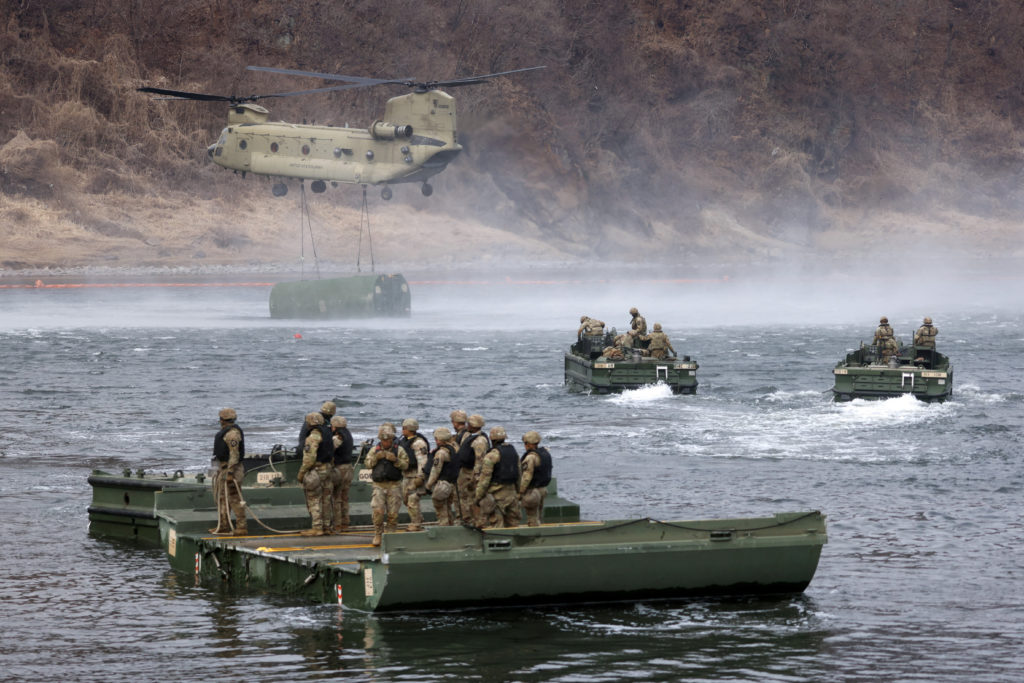
The timing of the Sunan salvo is a calculated counter-signal to ongoing US-ROK joint military drills. Pyongyang historically interprets these maneuvers as a precursor to decapitation strikes, and this ‘show of force’ serves to demonstrate kinetic parity. By transitioning from previous cruise missile tests to this ballistic salvo, North Korea is moving up the escalation ladder, utilizing the higher velocity and more challenging interception profiles of ballistic assets to maintain its deterrent relevance.
For South Korea’s Joint Chiefs of Staff (JCS), the 10-missile event increases the complexity of the ‘Kill Chain’ preemptive strategy. The ability to detect, track, and neutralize a dozen mobile launchers simultaneously, prior to ignition, requires an unprecedented level of persistent ISR (Intelligence, Surveillance, and Reconnaissance). This launch underscores that the regional arms race has moved beyond missile range into the realms of volume, precision, and operational density.
Conclusion: Institutionalizing the Nuclear Force
The Sunan tests reflect a broader strategy of institutionalizing nuclear assets within the regular army’s tactical framework. This makes future denuclearization dialogues fundamentally more difficult, as the capability is no longer centralized in strategic silos but distributed across mobile tactical units. The international community now faces a ‘new normal’ of saturation-based deterrence, where the risk of miscalculation remains high and the threshold for nuclear employment continues to lower in the face of advanced conventional military technology.

Photo by jeremy888 on Pixabay.