Almanac Predicts Widespread August Storms and Tropical Threats
The Old Farmer’s Almanac has issued its long-range August forecast, projecting substantial thunderstorm activity across much of the United States. The outlook also signals potential tropical storm or hurricane development in coastal and southern regions, suggesting an active end to the meteorological summer.
This regional forecast, based on analyzing solar patterns, historical data, and current solar activity, delineates expected temperature and precipitation deviations from historical averages. The Almanac claims an 80% accuracy rate, a figure it qualifies by acknowledging inherent weather unpredictability. While not independently verified by scientific bodies, this projection offers a traditional, albeit traditional, seasonal weather outlook for a segment of the public.
Specific to the Northeast, the forecast indicates scattered thunderstorms and warm conditions early in August, with heavier rainfall expected between August 7-10. This detailed regional projection highlights a dynamic pattern with potential impacts on agriculture and event planning.
The implications for coastal communities and weather-dependent industries include heightened risk management needs. The potential for tropical systems necessitates preparedness measures, influencing insurance markets, emergency services, and infrastructure resilience planning.
Debate Intensifies Over 2026 Global Temperature Record
A scientific discourse is ongoing regarding the likelihood of 2026 becoming the warmest year on record. Prominent climate researchers present diverging predictions rooted in differing interpretations of climate models and observational datasets, underscoring the complexities of long-term climate trend forecasting.
One prominent view, supported by analysis from Jim Hansen, contends that 2026 will definitively be the warmest year globally. This projection implies a continued acceleration of warming trends, potentially exceeding current scenarios and influencing policy responses.
Conversely, an alternative scientific perspective suggests that while 2026 will be exceptionally warm, it is more probable to rank as the second-warmest year globally. This nuanced stance acknowledges significant warming while maintaining a degree of uncertainty regarding the exact timing of record-breaking temperatures.
The scientific disagreement is characterized by contrasting analytical frameworks. Hansen’s prediction specifically relies on NASA’s GISTEMP record. The alternative forecast aggregates data from six major surface temperature datasets, suggesting a broader statistical basis for its conclusion.
This methodological divergence is critical as it impacts the aggregation of localized warming or cooling trends into a global average. The selection of specific datasets can introduce variations that influence the final global temperature assessment.
The potential for both researchers’ predictions to be validated by the end of 2026, depending on the specific metric used, illustrates the multifaceted nature of climate record-keeping and the ongoing refinement of climate monitoring techniques.
The scientific community’s engagement with these differing forecasts is crucial for refining climate models and improving the accuracy of future climate predictions. This debate serves to stress-test scientific hypotheses and strengthen the collective understanding of climate system dynamics.
The implications of 2026 potentially setting a new global temperature record are substantial, reinforcing concerns about the pace of climate change and the urgency for robust mitigation and adaptation strategies. Such an event would likely amplify calls for more aggressive climate action from governments and industries worldwide.
San Diego Faces Record Heat Amidst Shifting Weather Patterns
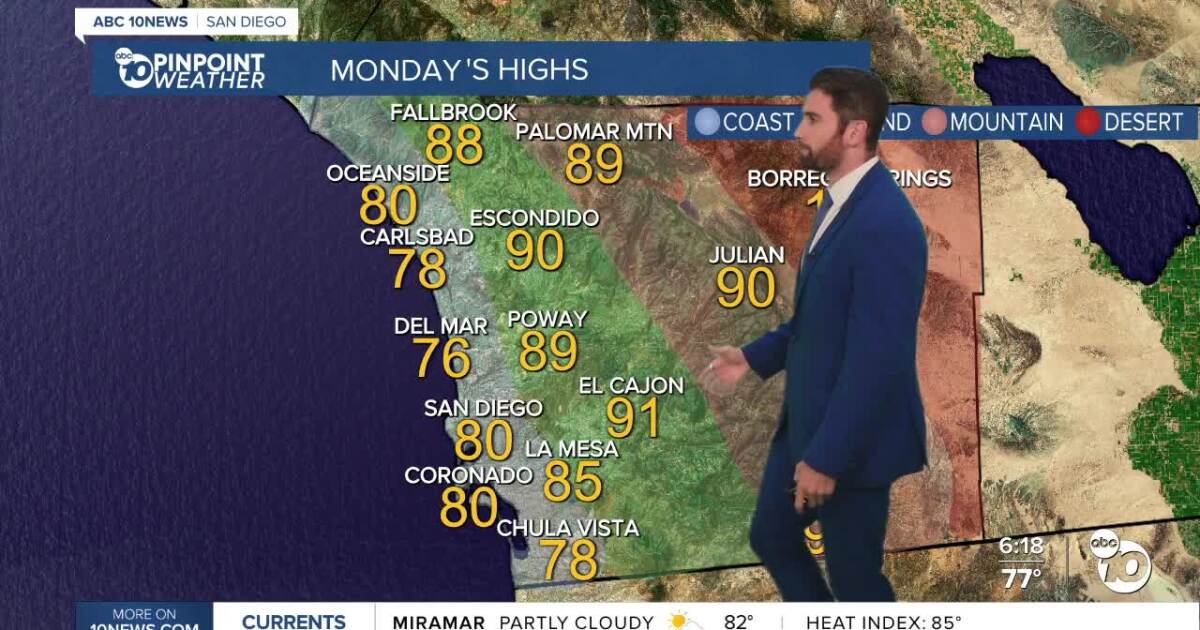
San Diego County is currently experiencing a significant heatwave, with forecasts predicting record-breaking temperatures in multiple locations. This localized extreme heat event highlights the inherent variability of weather patterns and the potential for intense, short-duration temperature spikes.
Temperatures are expected to remain consistently elevated, with daytime highs and overnight lows potentially exceeding historical averages by up to five degrees Fahrenheit. This sustained warmth offers minimal relief, particularly for inland areas and deserts where extreme temperatures are projected.
Coastal areas are forecast to reach highs in the mid-70s to mid-80s Fahrenheit. Inland valleys may see temperatures in the upper 80s to mid-90s Fahrenheit. Mountain regions are expected to experience highs in the upper 80s and low 90s Fahrenheit, while desert areas could surpass 110 degrees Fahrenheit.
A Heat Advisory is currently active for coastal, inland valley, and mountain regions. An Extreme Heat Warning is in effect for desert areas. These alerts are designed to inform the public and health officials about the risks associated with prolonged exposure to high temperatures.
While these advisories are noted to expire on Monday evening, meteorologists indicate a strong likelihood of extensions or new alerts being issued as the week progresses, suggesting a persistent high-pressure system is dominating the region’s weather.
The strengthening of this high-pressure system, anticipated to begin Thursday, is projected to drive temperatures upward again. This intensification suggests that Friday and the subsequent weekend could deliver the hottest weather San Diego has experienced this summer.
The operational impact of such extreme heat can be considerable, affecting outdoor labor, increasing energy consumption for cooling, and placing additional demands on public health services. Emergency responders and health agencies are likely to be on heightened alert to manage potential heat-related illnesses.
This localized heat event, while distinct from long-term climate trends, serves as a tangible indicator of the increasing frequency and intensity of extreme weather phenomena. Such occurrences inform public perception and underscore the importance of regional climate adaptation measures.