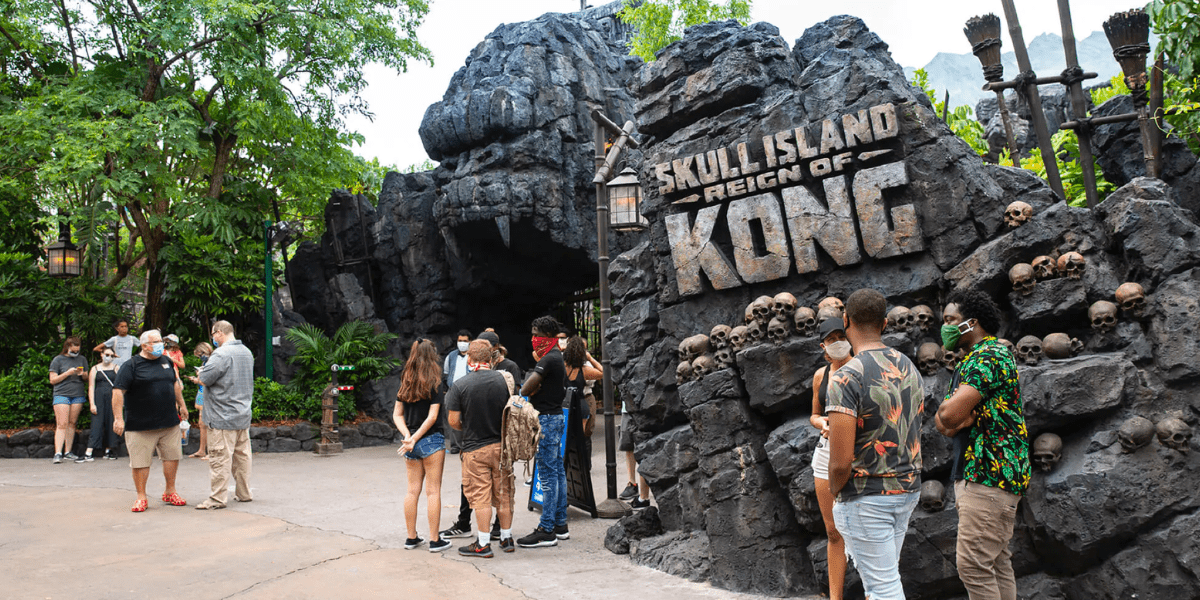
Systemic Disruption at Islands of Adventure
Universal Orlando Resort is navigating a significant operational bottleneck following the extended suspension of Skull Island: Reign of Kong. Inactive since August 26, the attraction’s absence has transitioned from a routine technical delay into a prolonged outage that disrupts the park’s overall capacity model. As an anchor installation at Universal’s Islands of Adventure, the continued dormancy of this high-throughput system creates a notable vacuum in guest distribution during a peak operational window.
This downtime is under intensified scrutiny due to its exclusion from Universal’s official refurbishment calendar. In the context of industrial amusement management, the lack of pre-scheduling suggests an unpredicted mechanical or structural failure. Such unplanned stoppages force an immediate reallocation of maintenance resources and complicate long-term capital utilization strategies, as the facility must manage a dormant asset without a defined recovery timeline.
Speculation regarding the cause centers on an alleged industrial incident. Unverified reports from enthusiast communities and digital forums suggest a thermal event involving the ride’s centerpiece animatronic during a technical maintenance cycle. Universal Orlando Resort has maintained a policy of administrative silence, providing no confirmation of a fire nor a projected reopening date, which has allowed third-party conjecture to dominate the narrative.
Engineering Criticality and Single-Point Vulnerability
Skull Island: Reign of Kong utilizes a sophisticated architecture involving 17-ton trackless expedition vehicles and massive 3D projections. The narrative climax relies entirely on a singular, 30-foot audio-animatronic King Kong. This figure represents a show-critical engineering node; its complex integration of pneumatic, hydraulic, and electrical systems means that a failure in the centerpiece renders the entire attraction commercially unviable.
Approaching a decade of high-cycle operation since its 2016 debut, the machinery has entered a predictable phase of mechanical fatigue. In environments requiring continuous motion, the friction and heat generated by specialized robotics elevate the risk of industrial safety incidents. The dependency on a single kinetic anchor illustrates the inherent vulnerability of attractions where no modular bypass exists for the primary show element.
Institutional Legacy and Strategic IP Management
King Kong remains a foundational pillar for Universal Orlando, dating back to the 1990 opening of Kongfrontation at Universal Studios Florida. Following that ride’s 2002 decommissioning, the 2015 announcement and 2016 opening of Skull Island signaled a strategic reinvestment in the franchise. Because the IP anchors guest attendance across multiple demographics, any extended downtime carries a higher reputational cost than failures at peripheral attractions.
The current outage tests the resilience of the resort’s secondary portfolio. When a headline asset is removed from the equation, the resulting data divergence between scheduled availability and physical reality creates friction in guest satisfaction. Universal’s administrative decision to withhold updates reflects a risk-management strategy designed to insulate technical assessments from external legal or consumer volatility, though it risks amplifying digital rumors in the absence of verified facts.
Safety Recertification and Logistical Displacement
Restoring a complex animatronic after a potential thermal incident requires exhaustive recertification. Technical teams must audit internal wiring looms, structural integrity, and adjacent fire suppression systems to meet industrial safety codes. Secondary damage from suppression agents—such as water or chemical contamination—can often be more extensive than the initial incident, necessitating component-level replacement of sensitive sensors and control interfaces.
Logistically, the closure of Skull Island redistributes massive guest volumes into neighboring queues and walkways. This systemic displacement increases wait times park-wide, potentially suppressing secondary spending in food and retail sectors due to corridor saturation. The indirect costs of managing guest expectations at the ride perimeter often exceed the direct costs of the mechanical repairs themselves, highlighting the broader economic impact of unplanned facility downtime.