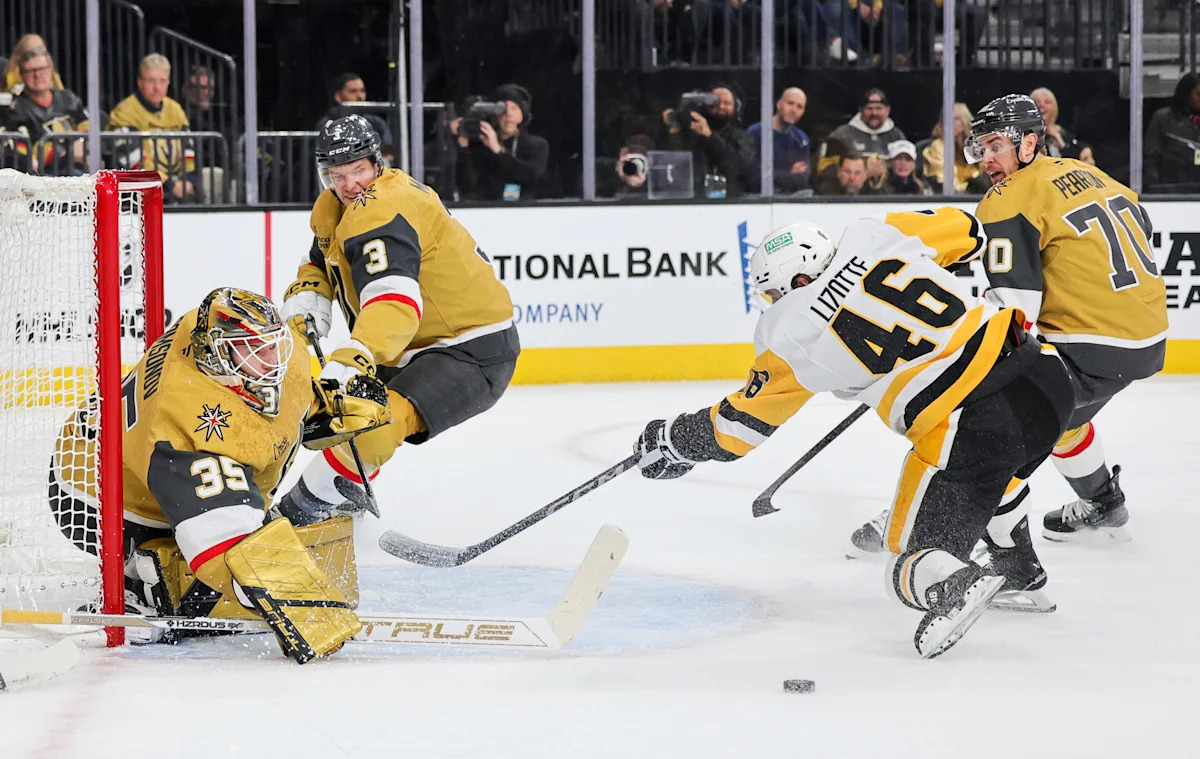
The upcoming confrontation between the Pittsburgh Penguins and the Vegas Golden Knights at T-Mobile Arena serves as a critical diagnostic of organizational depth. For Pittsburgh, the fixture represents a high-stakes stress test of a system operating without its foundational pivots, Sidney Crosby and Evgeni Malkin. This absence necessitates a comprehensive recalibration of offensive hierarchy and power-play dynamics, shifting the burden of production to a hybrid of mid-tier veterans and developmental assets.
Vegas enters this contest with a clear directive: avenge the 5-0 shutout suffered earlier this month. By leveraging superior health across their top-six forward group and significant home-ice advantages, the Golden Knights aim to exploit the defensive vulnerabilities inherent in a depleted Penguins lineup.
The Post-Superstar Tactical Pivot in Pittsburgh
The Penguins’ current deployment—featuring Egor Chinakhov, Rickard Rakell, and Bryan Rust on the top unit—signals a strategic transition toward a high-volume, low-complexity offensive model. Deprived of elite-level playmaking, the coaching staff has prioritized a linear, north-south transition game designed to bypass neutral-zone congestion. This adjustment caters to the skill sets of Anthony Mantha and Tommy Novak, who excel in heavy forechecking environments rather than puck-possession schemes.
The bottom-six, anchored by Connor Dewar, Blake Lizotte, and Noel Acciari, is tasked with a defensive containment role. Their efficacy in neutralizing Vegas’s elite scoring lines is the primary variable in Pittsburgh’s attempt to turn the game into a battle of marginal gains and opportunistic counters.
Defensive Structural Integrity and Transition Efficiency
On the blue line, Kris Letang and Erik Karlsson remain the primary engines of the transition game. The pairing of Ryan Shea with Letang reflects a tactical desire to balance offensive risk-taking with stay-at-home reliability. However, the injuries to Samuel Girard and Caleb Jones have forced Ilya Solovyov and Parker Wotherspoon into elevated roles, creating a depth deficit that the Golden Knights’ aggressive forecheck is engineered to exploit.
Karlsson’s role is particularly magnified; his ability to facilitate clean zone exits is the linchpin for a roster missing its primary puck-moving centers. Success hinges on the defensive corps’ ability to initiate the rush without committing the high-risk turnovers that typically plague shorthanded units.
Vegas Golden Knights: High-Cap Roster Resilience
The Golden Knights’ roster construction emphasizes concentrated star power, led by Ivan Barbashev, Jack Eichel, and Mark Stone. This trio provides a level of offensive density that few franchises can replicate. The integration of Mitch Marner alongside Tomas Hertl on the second line further complicates defensive assignments, offering a blend of elite vision and net-front presence that can dismantle structured defensive schemes.
Vegas’s third-line configuration of Brett Howden, Colton Sissons, and Braeden Bowman provides the necessary defensive versatility to maintain pressure while the top-six rests. This tiered scoring approach forces opponents to defend across all 200 feet of the ice, a daunting task for a thinned Penguins defensive rotation.
Goaltending Dynamics and Blue Line Stability
Defensively, the pairings of Brayden McNabb/Shea Theodore and Noah Hanifin/Rasmus Andersson offer a formidable mix of physical attrition and puck-moving capability. This allows Vegas to sustain offensive zone pressure for extended cycles. In the crease, Adin Hill looks to re-establish consistency following the previous shutout loss. With Carter Hart managing a lower-body injury, Hill’s performance is vital to ensuring that the Golden Knights do not concede high-danger opportunities to Pittsburgh’s opportunistic youth.
Institutional Depth and Pipeline Sustainability
The performance of the Wilkes-Barre/Scranton Penguins remains a leading indicator of the parent club’s sustainability. The second-place standing of the AHL affiliate in the Atlantic Division underscores a robust developmental pipeline. The promotion of Ben Kindel and Avery Hayes provides the NHL roster with cost-controlled energy and internal competition, which is essential for maintaining competitive parity during periods of significant veteran attrition.
Economic and Broadcast Implications
The 10:00 PM ET puck drop on Sportsnet Pittsburgh and Scripps highlights the nuanced market dynamics of regional sports networks (RSNs). For media partners, the Penguins’ ability to remain competitive without their marquee stars is paramount for maintaining advertising revenue and subscription value. Furthermore, the atmosphere at T-Mobile Arena continues to validate the NHL’s expansion strategy, showcasing a high-value market that blends commercial spectacle with elite athletic performance.