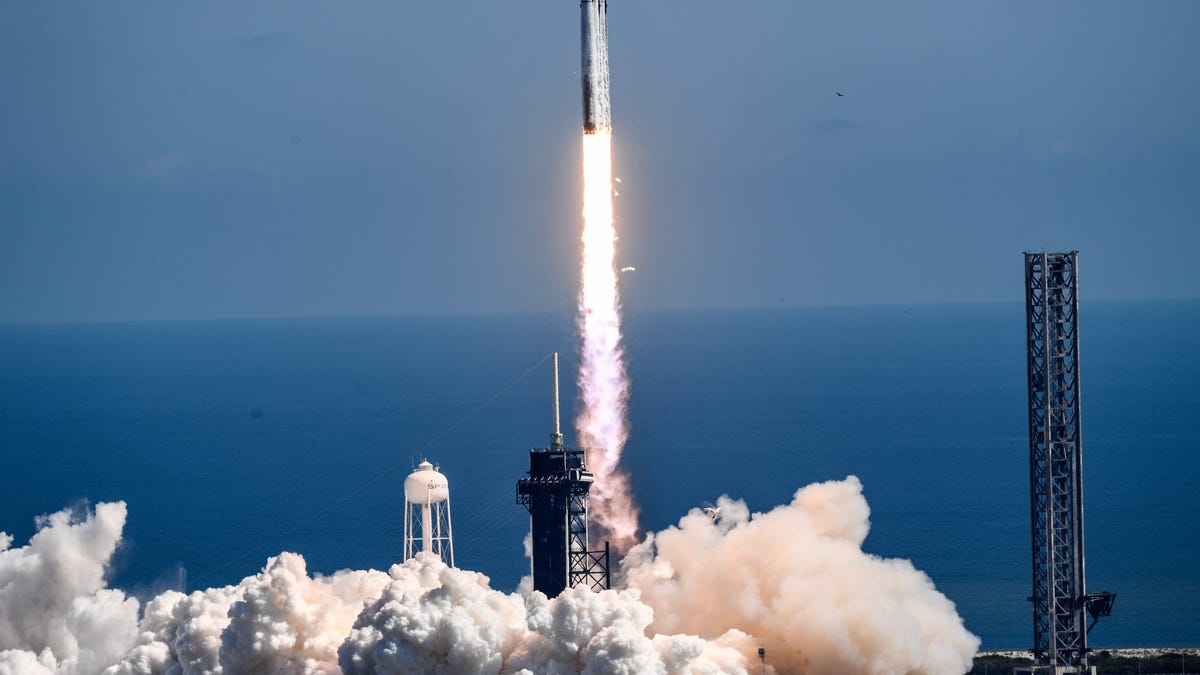
The postponement of the SpaceX Falcon Heavy mission to deploy the Viasat-3 Americas satellite serves as a case study in the operational friction inherent in modern spaceports. While meteorology often triggers the initial scrub, the subsequent rescheduling window is dictated by a complex matrix of federal administrative priorities and physical resource contention at the Eastern Range. This mission is a critical milestone for Viasat, representing the climax of a multi-billion dollar capital expenditure cycle aimed at maintaining geostationary (GEO) relevance in a market increasingly disrupted by low-Earth orbit (LEO) constellations.
Range Congestion and Institutional Deconfliction
The operational pause on April 27 was exacerbated by the logistical footprint of NASA’s Space Launch System (SLS). The movement of the Pegasus barge, essential for SLS core stage transport, creates a physical bottleneck that restricts launch window flexibility. For SpaceX, the Falcon Heavy—a vehicle requiring significant pad turn-around time and specialized recovery protocols—faces higher administrative hurdles than the standard Falcon 9. The necessity for specific regulatory clearances regarding the dual-booster return-to-launch-site (RTLS) maneuvers further complicates the synchronization between commercial providers and the U.S. Space Force.
Strategic Realignment: The GEO Bandwidth Density Play
The Viasat-3 Flight 3 mission represents a pivot toward extreme bandwidth density. As LEO providers like Starlink leverage low latency, legacy GEO operators are doubling down on total throughput capacity to secure high-value aviation and maritime contracts. This six-metric-ton Boeing-built asset is engineered to provide over 1 Terabit per second (Tbps) of capacity. Successfully deploying this payload is essential for Viasat to amortize its long-term R&D investments and establish a competitive foothold in the Asia-Pacific corridor, where terrestrial infrastructure remains fragmented.
Coopetition and Launch Provider Interdependency
The manifest at Kennedy Space Center reveals a paradoxical industry structure: SpaceX increasingly acts as the infrastructure provider for its direct competitors. While preparing the Falcon Heavy, the range was simultaneously managing United Launch Alliance’s (ULA) Atlas V preparations for Amazon’s Project Kuiper. This creates a scenario where SpaceX’s launch services facilitate the orbital build-out of a primary rival to its Starlink division. This divergence in strategy—Amazon’s massive LEO swarm versus Viasat’s concentrated GEO nodes—defines the current technological rift in global telecommunications.
Financial Exposure and the Risk of Opportunity Cost
For a launch vehicle of the Falcon Heavy’s class, every scrub entails massive recycling costs, including cryogenic propellant management and range fees. However, the greater risk lies in the opportunity cost for the payload owner. For Viasat, delays represent deferred revenue in a market where bandwidth demand is expanding exponentially. The mission’s five-hour deployment sequence to a high-energy geosynchronous transfer orbit (GTO) places extreme thermal and mechanical stress on the upper stage, leaving zero margin for error in a decade-long engineering project.
The Evolution of Autonomous Range Safety
The increasing launch cadence from Florida is forcing an evolution toward more autonomous range safety systems (AFTS) and streamlined regulatory deconfliction. The current mission delay underscores that the ‘New Space’ era is still beholden to ‘Old Space’ physical logistics. As launch providers move toward daily operations, the ability to rapidly recover from weather-related scrubs without colliding with civil space timelines will become a primary competitive differentiator. The Viasat-3 mission is not merely a satellite deployment; it is a stress test for the American launch infrastructure’s ability to handle high-value, high-complexity commercial payloads.