The 2026 Men’s NCAA Tournament’s Elite Eight field solidified with Arizona, Illinois, Purdue, and Iowa advancing, immediately shifting analytical focus to Friday’s Sweet 16 contests determining the final regional finalists.
Strategic Defensive Imperatives in Elite Eight Contention
Containment Calculus: Duke vs. St. John’s
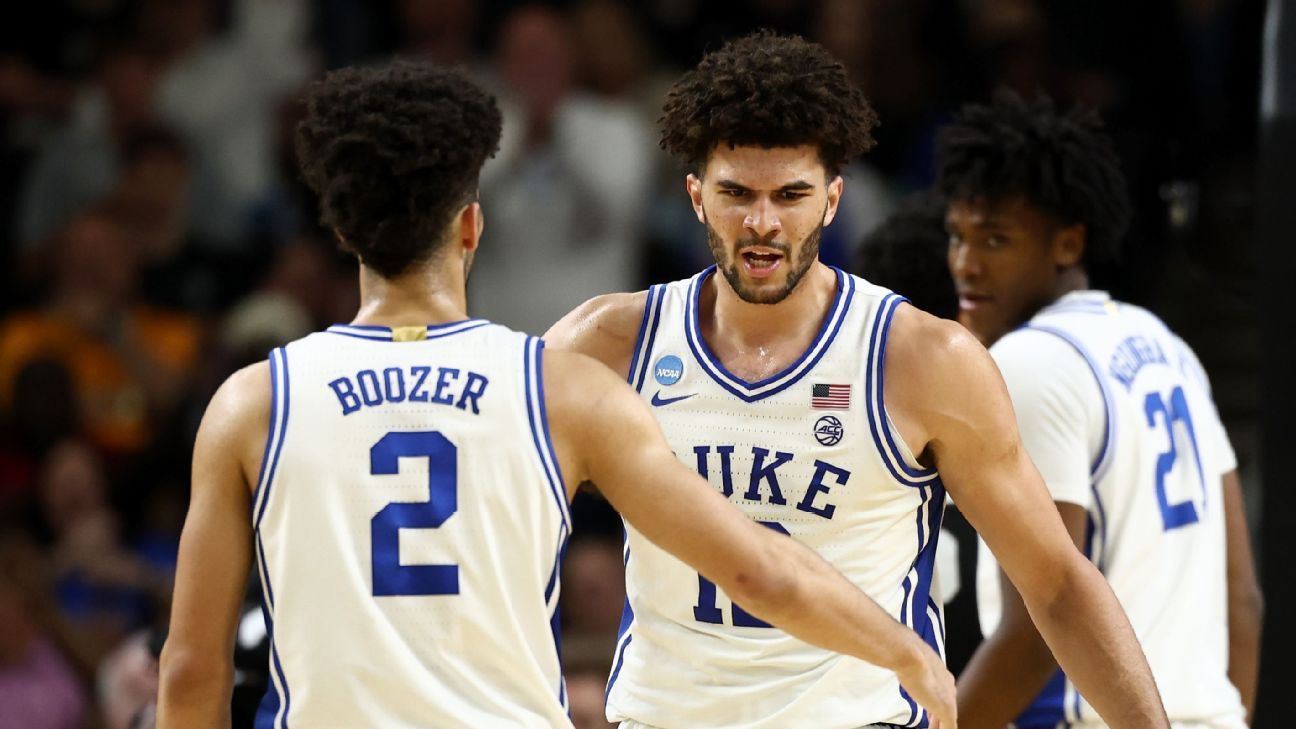
The anticipated matchup between (5) St. John’s and (1) Duke hinges on Rick Pitino’s scheme against presumptive top talent Cameron Boozer. This challenge is exacerbated by St. John’s relative deficit in elite defensive length compared to Duke’s primary personnel.
St. John’s institutional defensive prowess must now execute against specific, high-leverage individual talent. This places intense pressure on the one-on-one containment capabilities of Zuby Ejiofor and Dillon Mitchell against Boozer and Isaiah Evans in half-court scenarios.
Offensively, St. John’s necessity to sustain tournament-level perimeter production—demonstrated by consecutive games with double-digit three-pointers following a significant mid-season shooting drought—represents a non-negotiable operational pivot required to counter Duke’s tempo control.
Purdue’s Operational Dichotomy: Interior Force vs. Perimeter Volatility
Purdue’s narrow 79-77 victory over Texas, decided by a Trey Kaufman-Renn tip-in, confirms Matt Painter’s team dynamic: interior scoring consistently compensates for inconsistent three-point volume. The team’s low turnover count (4) confirms systemic ball security strength.
However, the 4-for-20 shooting from beyond the arc signals a critical vulnerability that subsequent opponents will aggressively exploit, forcing continued reliance on post-entry efficiency or offensive rebounding leverage. Texas, despite compromised personnel (Mark and Pope playing below full capacity), maintained competitiveness, illustrating how opponent injury status can temporarily inflate perceived competitive advantage.
Institutional Crossover and Psychological Benchmarks
The Alabama-Michigan Football Legacy Echo
The impending contest between (4) Alabama and (1) Michigan introduces an unusual institutional weight derived from recent, high-stakes College Football Playoff history, injecting a cross-sport narrative into the basketball bracket.
Alabama’s decisive 90-65 win over Texas Tech, featuring 19 three-pointers despite Aden Holloway’s absence due to an off-court incident, showcases immediate program capacity for strategic adaptation under duress.
The direct historical parallel—Michigan’s overtime victory over Alabama in the January 1, 2024, CFP semifinal coinciding with Nick Saban’s final game—establishes a unique psychological benchmark. The identical seeding symmetry (Basketball: ALA 4/MICH 1; CFP: ALA 4/MICH 1) frames the outcome as a required resolution of institutional rivalry, influencing media framing and fan perception.
Capital Flow and Performance Metrics
Tournament Success as Program Valuation Driver
Advancement through the Sweet 16 directly impacts the perceived market valuation of athletic departments, influencing donor engagement, sponsorship leverage, and capital authorization for facilities. Conversely, underperformance exposes administrative leadership to immediate accountability pressure.
For programs like St. John’s, navigating a challenging draw validates the trajectory under a high-profile coach, securing institutional buy-in for sustained, elite-level investment.
Defensive Length as Structural Determinant
The necessity for St. John’s length against Duke underscores a fundamental structural truth in elite basketball: the capacity to neutralize generational perimeter talent often supersedes offensive efficiency metrics in single-elimination play. Programs investing in versatile, long defensive wings gain a measurable, non-replicable advantage.
Duke’s length forces opponents into less efficient offensive zones, compressing the margin for error on every possession. St. John’s offensive improvement post-three-point drought will be rigorously tested to determine if it’s durable adaptation or a temporary statistical anomaly against high-tier defense.
Coaching Leverage and Execution Margins
The tight margin in the Purdue-Texas contest reaffirms that tournament success often rests on marginal execution—a missed box-out or a critical turnover—rather than systemic dominance. For Duke, failure to reach the Final Four triggers internal scrutiny of strategic rigidity; for Pitino, advancing validates immediate system efficacy, providing contract negotiation leverage.
Media commentary, characterized by visceral frustration, highlights the high-stakes performance review inherent in the NCAA Tournament, where outcomes drastically alter perceptions of administrative competence and long-term viability.