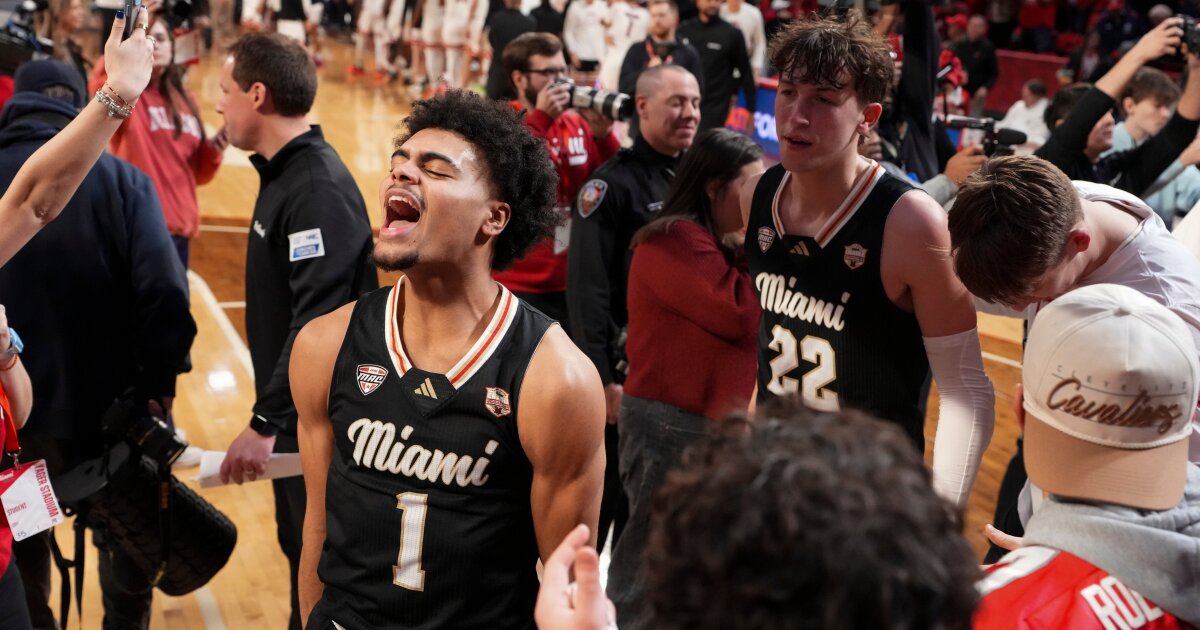
Metrics Conflict: Miami OH’s Perfect Season Meets Analytical Reality
The selection of the Miami RedHawks to the 2026 NCAA Tournament First Four, following a perfect 31-0 regular season, instantly crystallizes the inherent tension between empirical performance metrics and subjective resume evaluation in collegiate athletics governance.
Miami’s placement as an 11-seed facing SMU in Dayton, despite an unblemished record, underscores the selection committee’s reliance on predictive modeling, specifically the NCAA Evaluation Tool (NET), which ranked the program 344th nationally in Strength of Schedule (SOS).
Structural Disparity: Dominance vs. Competitive Exposure
The RedHawks’ status as only the fifth Division I program this century to achieve a perfect regular season, while simultaneously being analytically categorized near the bottom tier based on schedule difficulty, significantly challenges the perceived integrity of season-long dominance narratives.
The operational reality of the NET metric heavily penalizes programs lacking substantive results against Tier 1 opponents. This creates a structural barrier for successful mid-major teams whose scheduling autonomy is constrained by conference mandates, effectively limiting their analytical ceiling regardless of win total.
This situation forces the selection committee into a difficult calculus: rewarding absolute statistical achievement (31-0) or adhering strictly to the predictive modeling intended to prioritize competitive exposure against elite peer institutions—the explicit function of the NET ranking system.
The subsequent placement in the First Four highlights the fragility of an undefeated season when it lacks high-leverage competitive data points, differentiating Miami from past undefeated teams that secured higher seeding based on superior underlying analytics.
Cascading Effects on Conference Valuation and At-Large Integrity
The Mid-American Conference (MAC) securing a second bid for the first time since 1999 suggests a marginal, perhaps opportunistic, shift in committee valuation. However, Miami’s precarious at-large position—projected as the final team included by many models—demonstrates the analytical ceiling for non-automatic qualifiers from lower-resourced leagues.
The immediate consequence is intensified scrutiny on the First Four mechanism, which now serves not only as a play-in for automatic qualifiers but as a necessary staging ground for highly ranked, yet analytically suspect, at-large candidates requiring a preliminary validation test.
The program’s statistical resume—a 344th SOS ranking, zero games against Tier 1 opponents, and only two wins against Tier 2 squads—provides quantitative evidence that the competitive ceiling remains untested. For stakeholders invested in NET integrity, Miami’s inclusion signals a potential systemic failure where the sheer volume of wins overrides standardization protocols.
The Selection Philosophy Dilemma: Best vs. Deserving
The Miami case reignites the perennial debate: should the tournament strictly feature the 68 objectively “best” teams via comparative metrics, or must it integrate a narrative of “deserving” based on sustained, contextually limited, winning performance?
Criticism, exemplified by figures like Bruce Pearl, frames the process as a binary choice: meritocracy defined by schedule strength (NET adherence) versus meritocracy defined by win-loss accumulation (undefeated record).
Operational Implications for Future Scheduling
Institutions aiming for consistent national consideration must recalibrate scheduling strategy based on this outcome. The implication is clear: a 31-0 regular season is insufficient for secure at-large consideration without verifiable Tier 1 results, irrespective of conference affiliation.
This places financial and competitive pressure on mid-major athletic departments to aggressively pursue high-risk, high-payout matchups against Power Conference opponents, accepting decreased win probability in exchange for critical analytical validation points.
Historical Context and Performance Leverage
Miami’s 17th NCAA appearance frames this selection as a high-leverage re-entry point. Head Coach Travis Steele’s benchmark of advancing past the Round of 64 establishes a new internal standard that demands immediate on-court performance to justify the committee’s decision.
The team’s loss in the MAC Tournament quarterfinals, ending their unbeaten run, suggests a vulnerability to competitive stagnation when facing motivated conference opponents—a pattern seen historically when teams peak prematurely.
The structure of the First Four dictates unforgiving exposure. The single-elimination game against SMU is critical; a victory validates the inclusion despite the low NET, while a loss immediately validates critics who argued the team was not among the “best 68.”
Competitive Context for the MAC
The MAC securing two bids signifies a rare institutional validation, suggesting the committee prioritized narrative/record in Miami’s case over other bubble teams. This outlier status, however, does not indicate structural improvement for the conference relative to Power Conferences.
Advancement by Miami would provide immediate leverage for the MAC in future scheduling and media negotiations, demonstrating the league’s capacity to produce high-narrative participants. Conversely, an early exit reinforces the status quo of limited national competitive mobility.
The historical contrast with St. Joseph’s (2004), which earned a No. 1 seed despite a late conference tournament loss, shows that Miami’s analytical profile was fundamentally weaker, necessitating the First Four assignment. This precedent dictates that future undefeated teams must maintain a significantly higher baseline SOS to avoid severe seeding penalties.