Celestial Mechanics and Orbital Trajectory of the June 2026 Lunation
The June 2026 full moon, historically cataloged as the Strawberry Moon, represents a key astronomical event in the annual synodic calendar. According to astronomical data from the Royal Observatory Greenwich and the Old Farmer’s Almanac, this lunation reaches peak syzygy (maximum illumination) on June 29 and June 30, 2026, contingent upon the observer’s geographic longitude.
This event offers an ideal demonstration of how orbital inclination and Earth’s axial tilt influence terrestrial observation. Because this full moon occurs near the summer solstice, the Moon’s path across the northern hemisphere sky remains exceptionally low along the southern horizon, maximizing exposure to atmospheric refraction and the classic Moon illusion.
The Physics of the Moon Illusion and Nominal Origin
The “Moon illusion” is a well-documented optical and cognitive phenomenon. When the lunar disk is positioned close to the horizon, the human brain perceives it as significantly larger than when it is high near the zenith. This relative size perception is triggered by terrestrial landmarks serving as visual scale comparison points, rather than any physical alteration in lunar distance or diameter.
Observers should note that the term “Strawberry Moon” is strictly agronomic, originating from Native American agricultural practices tracking the ripening of wild strawberries. Despite the name, the physical moon does not naturally turn pink or red; however, its low altitude during this cycle can cause Rayleigh scattering, which filters out shorter wavelengths of light and imparts a natural warm, amber hue when near the horizon.
Comparative Calendars: May Blue Moon vs. June Synodic Cycle
The June 2026 lunar cycle marks a return to standard synodic intervals, contrasting with the preceding May 2026 cycle, which featured a calendrical “blue moon” (the second full moon within a single calendar month). This sequence highlights the structural divergence between the 29.53-day synodic month and the artificial Gregorian calendar construct.
While May required two full cycles to align with our solar calendar, June presents a single, highly focused lunation. This progression allows observers to track the steady shift of the ecliptic plane against the background stars of the summer sky.
Celestial Alignments: Antares, Arcturus, and Vega Coordinates
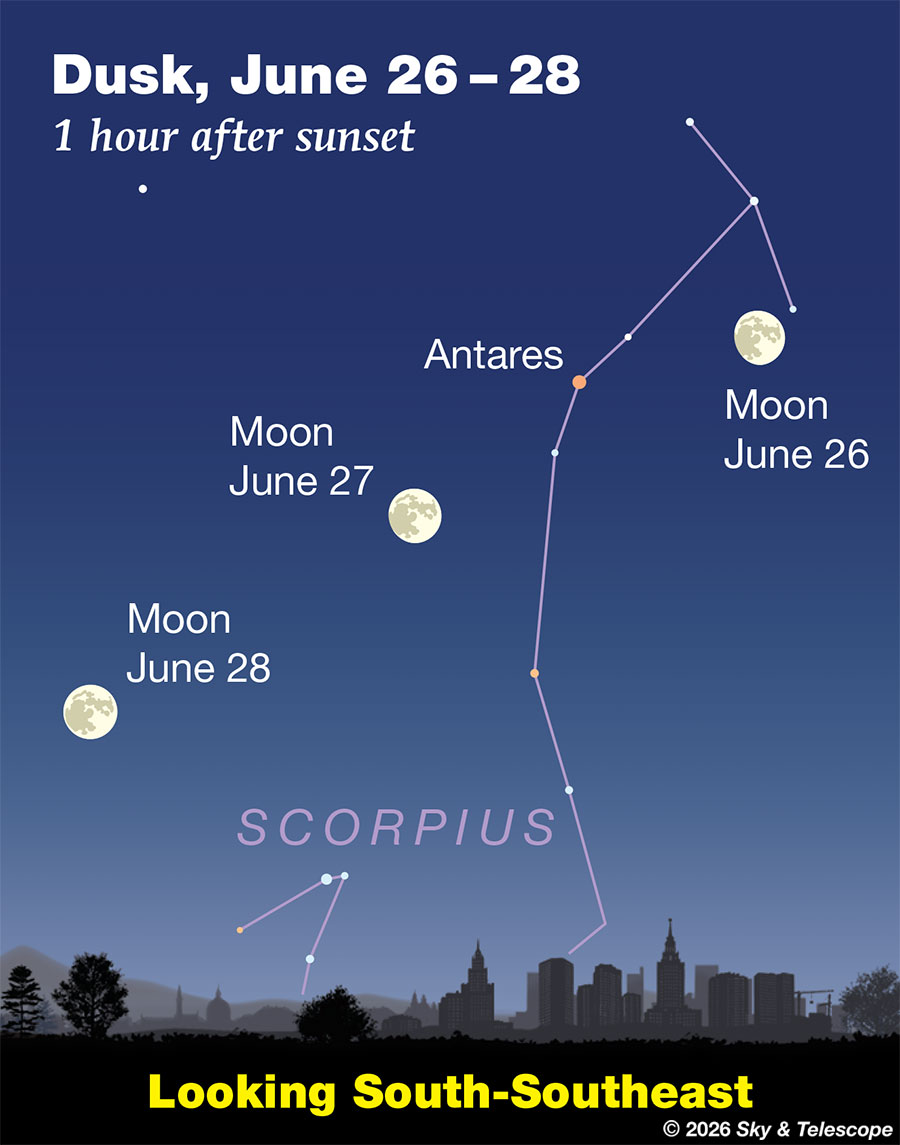
For observers in the northern hemisphere, the dates surrounding June 29 provide an exceptional opportunity to track the Moon’s passage near major celestial markers. During peak illumination, the Moon traverses the constellation Scorpius, passing in close angular proximity to the red supergiant star Antares (Alpha Scorpii).
Additionally, on the evening of June 27, the waxing gibbous moon will align strategically with two of the brightest stars in the northern hemisphere: Arcturus (a K-type orange giant located 37 light-years away) and Vega (an A-type main-sequence star located 25 light-years away). Using these stellar coordinates as reference points, amateur and professional astronomers can map the Moon’s orbital progression across the local galactic neighborhood.