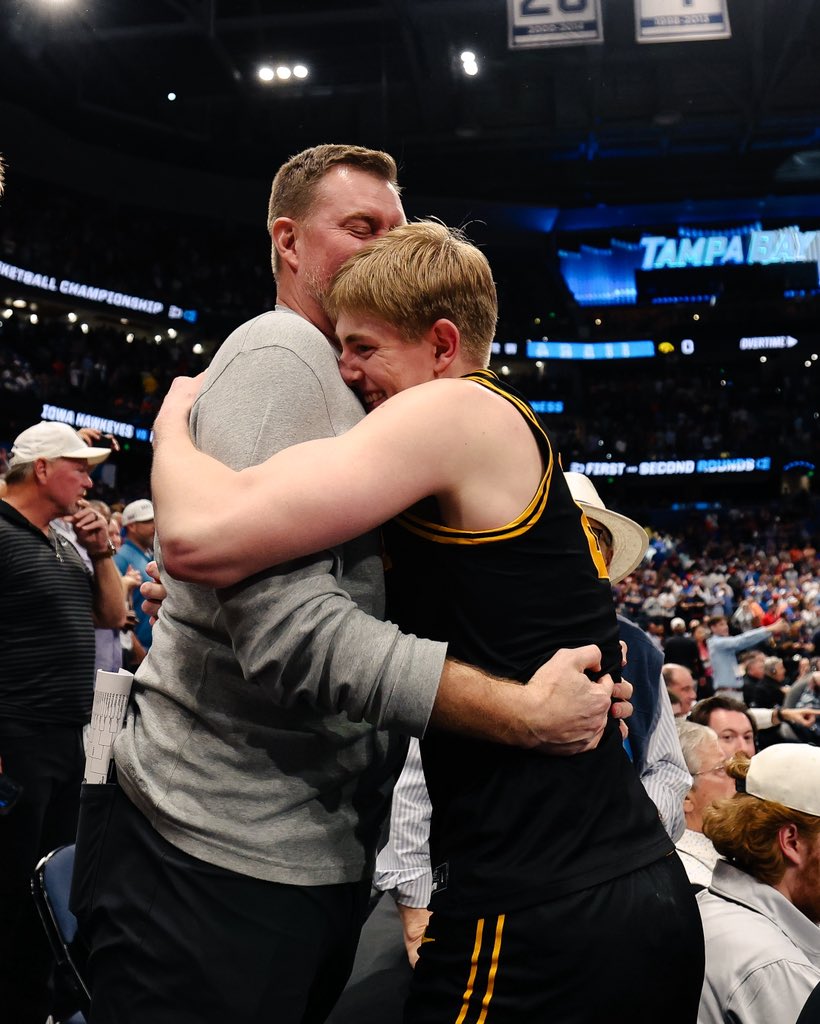
The Iowa men’s basketball program has formally achieved a critical benchmark by advancing to the Sweet Sixteen, concluding a 27-year span since their last appearance in 1999 under then-head coach Tom Davis.
This breakthrough is intrinsically linked to a compelling generational symmetry: sophomore forward Cooper Koch replicated a specific statistical contribution made by his father, J.R. Koch, who was a senior forward on the 1999 squad.
Generational Statistical Parallel and Historical Benchmarks
J.R. Koch scored 12 points in the 1999 Sweet Sixteen-clinching victory over Arkansas. Cooper Koch precisely mirrored this 12-point output in the team’s 73-72 second-round upset of Florida, establishing a direct, tangible link between the program’s historical high-water mark and its present iteration.
J.R. Koch’s reflection that achieving the 1999 milestone was simultaneously gratifying and burdensome highlights the inherent structural tension in elite collegiate athletics: reaching a regional semi-final often fails to satisfy internal objectives framed by ultimate championship aspirations.
Operational Leverage and Player Trajectory Analysis
Cooper Koch’s status as a foundational piece—starting all 35 games in his second year—demonstrates significant early career performance leverage. His season averages (7.8 PPG, 40.4% 3PT on 151 attempts) indicate rapid statistical evolution under high-stakes competition.
Crucially, Koch’s recent surge—hitting 55.8% from deep (24-of-43) over the last seven contests, contrasting sharply with a mid-season February slump—signals a vital inflection point in his shot selection and confidence management under duress. His 4-of-6 performance from distance against Florida confirms an immediate capacity to elevate output when required by the tournament bracket structure.
Strategic Implications: Perception, Capital Flow, and Ceiling Redefinition
Ending the drought immediately recalibrates external perception of Iowa’s competitive ceiling, influencing future recruiting capital and donor engagement metrics. Sustained NCAA Tournament success is now a key component in the value proposition offered to prospective high-caliber athletes, particularly amid high player mobility and NIL considerations.
The 1999 run concluded with a loss to Connecticut in the Sweet Sixteen, effectively defining the ceiling for that specific Tom Davis tenure. The current team’s ability to advance further will determine if this appearance represents a structural breakthrough or merely resets the program’s baseline expectation to the 1999 standard.
Program Inertia and Coaching Transition Context
The 1999 Sweet Sixteen appearance coincided with Tom Davis’ final year, marking it as a capstone achievement rather than the genesis of sustained advancement. The subsequent two decades suggest systemic challenges in translating regular-season success into deep postseason progression, implying bottlenecks in tactical execution or roster construction under subsequent leadership.
The current team’s success under new leadership severs the direct operational link to the Davis era, establishing a new, independent performance benchmark. This shift is vital for the current administration to claim ownership over the program’s renewed ceiling, rather than perpetually chasing the previous regime’s best finish.
The Significance of the Upset Mechanism and Margin of Victory
The 73-72 final score against Florida implies a razor-thin margin, suggesting advancement was secured through decisive execution in critical late possessions rather than sheer dominance. Such a high-leverage, one-possession victory is a superior indicator of a team’s clutch capacity and coaching staff’s late-game management acumen than a blowout win.
For a program emerging from a prolonged drought, securing advancement via a narrow victory against a seemingly favored opponent validates operational resilience. The reliance on Cooper Koch’s elevated efficiency underscores the strategic necessity of developing players capable of providing decisive contributions when conventional offensive schemes falter.
Alumni Network Activation and Narrative Leverage
The public endorsement and commentary from alumnus J.R. Koch activate the broader alumni network, amplifying institutional loyalty underpinning collegiate sports funding. The intergenerational connection transforms the athletic achievement into a shared community event.
This narrative structure—father’s legacy met by son’s achievement—is a potent tool for galvanizing support, providing immediate, high-value media content that validates the current team’s relevance while temporarily insulating the program from broader consistency critiques.