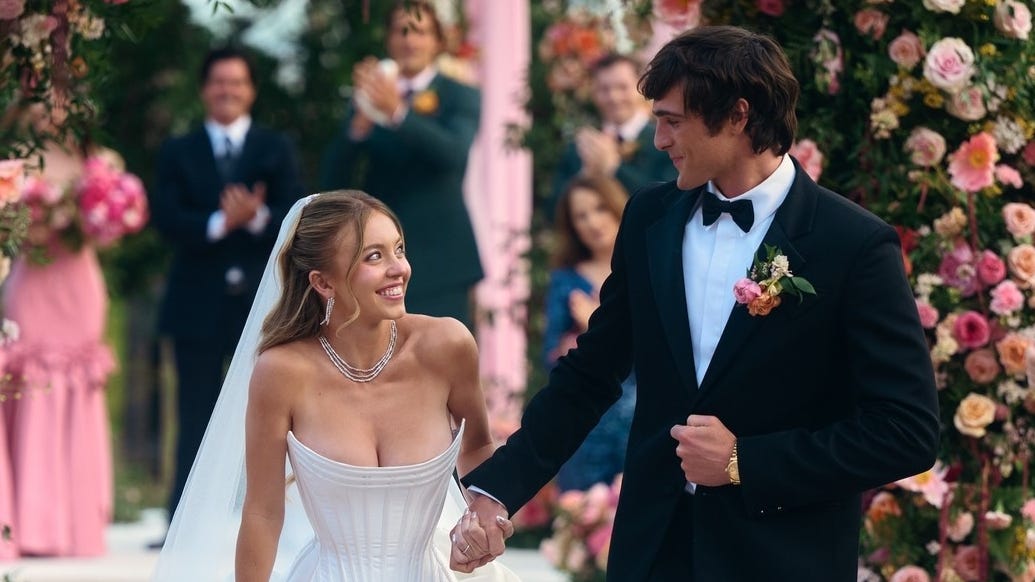
The narrative architecture of Sam Levinson’s Euphoria has undergone a fundamental pivot in its third season, transitioning from the localized volatility of adolescent social dynamics to the systemic risks of early-adult insolvency. By implementing a five-year temporal leap, the series recalibrates its stakes, replacing reputational damage with the permanent consequences of federal legal exposure and financial overextension. This shift is exemplified by the union of Cassie Howard and Nate Jacobs—a case study in the monetization of personal desperation and the failure of aesthetic capital.
The Financialization of Obsession and Performative Consumption
The nuptials of Cassie and Nate represent a significant escalation in the series’ exploration of performative consumption. The documented $50,000 floral expenditure, leveraged through Cassie’s digital labor on OnlyFans, highlights a critical intersection between gig-economy monetization and the pursuit of regressive domestic fantasies. This capital allocation reflects a profound disconnect from long-term stability; the characters liquidate their digital presence to fund a high-cost, fleeting aesthetic event, signaling a preference for visual validation over structural security.
Cassie’s decision to maintain a 1950s “trad-wife” interior while engaging in contemporary digital sex work creates a jarring juxtaposition. This branding strategy attempts to reconcile a desire for traditionalist protection with the high-risk nature of the modern attention economy. The resulting wedding serves as the logical conclusion of a relationship built on the fragile foundation of performative identity and unsustainable financial leverage.
The Strategic Design of the Wiederhoeft Collaboration
The collaboration with designer Jackson Wiederhoeft introduces a layer of meta-commentary on the nature of viral fashion. The wedding dress—characterized by its high slit, low-cut corset, and intentional touch of tackiness—was engineered to articulate Cassie’s psychological fragmentation rather than serve as genuine luxury. By leaning into a “bridezilla” aesthetic, the design team utilizes costume as a diagnostic tool for character regression.
This aesthetic choice marks a departure from the aspirational wardrobes of previous seasons. The dress functions as a narrative anchor, signaling that despite the five-year gap, the protagonists remain trapped in cycles of excess that prioritize immediate visual impact over substance. For the fashion industry, this demonstrates how high-concept design can be leveraged to communicate complex character pathology within prestige television.
Operational Shifts: From Local Narcotic Distribution to Federal Scrutiny
While the wedding occupies the aesthetic foreground, Rue Bennett’s arc signals a shift into dangerous institutional territory. Her transition from a street-level addict to an “indentured servant” for the dealer Laurie represents the move toward organized labor exploitation within illicit markets. Under the oversight of Alamo, Rue’s survival is now contingent upon her utility within a criminal enterprise rather than her individual recovery efforts.
The introduction of a Drug Enforcement Administration (DEA) agent marks a critical escalation. By shifting oversight from local law enforcement to federal agencies, the narrative introduces the potential for long-term incarceration and the systemic dismantling of the local drug trade. This development suggests that the “adult” era of Euphoria will focus on the institutional consequences of past actions, as the federal government begins to close in on the operations managed by Laurie and Alamo.
Permanent Consequences and Physical Diminishment
The physical violence concluding the wedding—culminating in Nate’s permanent injury—serves as a visceral metaphor for the accrual of interpersonal debt. This injury is a symbolic representation of the physical “bill” coming due for years of psychological volatility. In the context of the time jump, these physical scars mirror the permanent legal and financial liabilities the characters have accumulated.
For Nate Jacobs, whose identity has historically centered on physical dominance, this diminishment signals a reduction in personal leverage. The wedding, intended as a display of power, instead becomes a site of trauma and aesthetic failure, reinforcing the season’s central theme: the inability of these characters to achieve the stability they so desperately perform.
Thematic Evolution: Redemption and the Problem of Evil
The series synopsis frames the current arc as a struggle with the “virtue of faith, the possibility of redemption, and the problem of evil.” In Season 3, these are operational challenges rather than abstract philosophies. Faith is tested through reliance on unstable financial structures, while redemption remains elusive as characters prioritize performance over reform. The “problem of evil” is manifested in the systemic exploitation Rue faces and the predatory nature of the central relationships.
As the characters navigate their mid-20s, the series examines whether redemption is possible within systems—legal, financial, and criminal—specifically designed to exploit vulnerability. Rue’s servitude and Cassie’s financial desperation act as structural barriers to the “grown-up” lives they attempt to project, leading to a cynical, high-stakes examination of survival in a post-adolescent world.