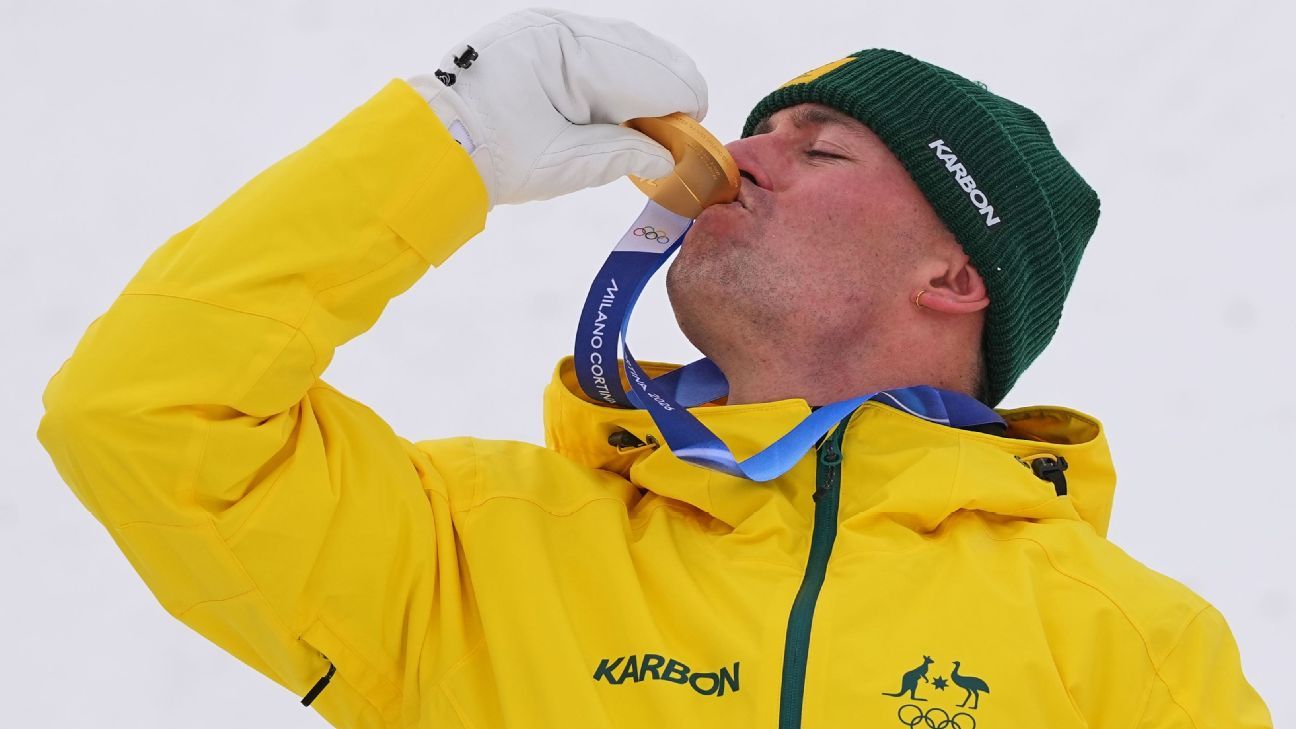
Australia’s Cooper Woods has secured the gold medal in the men’s freestyle skiing moguls at the Milan Cortina Winter Olympics. The event, held in Livigno, concluded with a rare administrative resolution after both Woods and Canadian athlete Mikaël Kingsbury finished with identical scores of 83.71 points.
This result represents a significant shift in the competitive landscape of freestyle skiing. Woods, previously considered a challenger to the established order, successfully managed the technical requirements of the Livigno course to match the performance of Kingsbury, a figure widely regarded as the sport’s all-time leader.
The Mechanics of the Olympic Tiebreak
The resolution of the gold medal status required the application of specific Federation Internationale de Ski (FIS) protocols. In freestyle moguls, total scores are aggregated from three distinct categories: turn technique, aerial maneuvers, and speed.
When two athletes achieve an identical total score, the technical system triggers a secondary evaluation of sub-category performances. Historically, the turn score, which accounts for sixty percent of the total evaluation, serves as the primary tie-breaking metric to ensure that technical execution remains the sport’s highest priority.
In this instance, the administrative verification process confirmed that Woods held the necessary advantage within the specified technical sub-categories. This narrowest of margins highlights the increasing precision of modern judging systems and the high stakes of minor technical variances at the Olympic level.
Technical Pressures in the Livigno Environment
The course in Livigno provided a rigorous test of endurance and consistency for both finalists. The configuration of the moguls and the quality of the snow required athletes to maintain a delicate balance between aggressive speed and controlled form.
For Woods, the gold medal is the culmination of a performance strategy designed to maximize points in the turn execution phase. By maintaining a clean line through the middle section of the course, he remained within striking distance of the score set by Kingsbury.
Kingsbury, who has long dominated the sport through a combination of speed and aerial complexity, found himself on the losing side of a tiebreak for the first time on such a high-profile stage. The result underscores the reality that even perfect execution can be challenged when the scoring system encounters absolute numerical parity.
Administrative and Procedural Integrity
The use of a tiebreak to determine an Olympic champion involves intense scrutiny from officials and technical delegates. The results underwent a rigorous audit to ensure that every point was recorded in accordance with the scoring software and the observations of the judging panel.
Judges are tasked with evaluating carving, absorption, and body position, while separate judges assess the quality and landing of jumps. The aggregation of these subjective evaluations into a definitive numerical value is what allows for the precision seen in the 83.71 score.
The finality of the decision rests on the pre-established rulebook that all competing nations agree upon prior to the start of the Games. This procedural transparency is vital for maintaining the credibility of judged sports when outcomes are decided by thousandths of a point or secondary criteria.
Impact on the Competitive Ecosystem
The success of an Australian athlete in a discipline traditionally dominated by North American and European powerhouses signals a broadening of the sport’s geographic reach. The investment in winter sports programs in Australia has consistently aimed at producing podium contenders capable of challenging established stars like Kingsbury.
For the Canadian camp, the loss via tiebreak is a reminder of the vulnerability inherent in sports where the margin for error is effectively zero. While Kingsbury’s status as a premier athlete remains unchallenged by his performance, the official record will reflect the rise of a new gold medalist in Woods.
The outcome in Livigno will likely prompt a review of technical preparation strategies among top-tier teams. When the gap between gold and silver is eliminated in the primary score, the emphasis on winning every sub-category becomes the central focus of high-performance coaching.
Future Implications for Moguls Judging
This tiebreak scenario provides a case study for the evolution of Olympic officiating. As athletes reach higher levels of technical mastery, the frequency of near-identical scores may increase, putting further pressure on the rules governing ties.
The clarity of the FIS rulebook in this situation prevented a prolonged dispute, allowing the medal ceremony to proceed as scheduled. This administrative efficiency is a core requirement for the successful operation of the Winter Games under global media scrutiny.
Woods and Kingsbury have set a benchmark for the quadrennial cycle, demonstrating that the pinnacle of the sport is now defined by total technical parity. The move toward more granular data in judging may be the next step in ensuring that such razor-thin margins are explained with maximum transparency to the public.