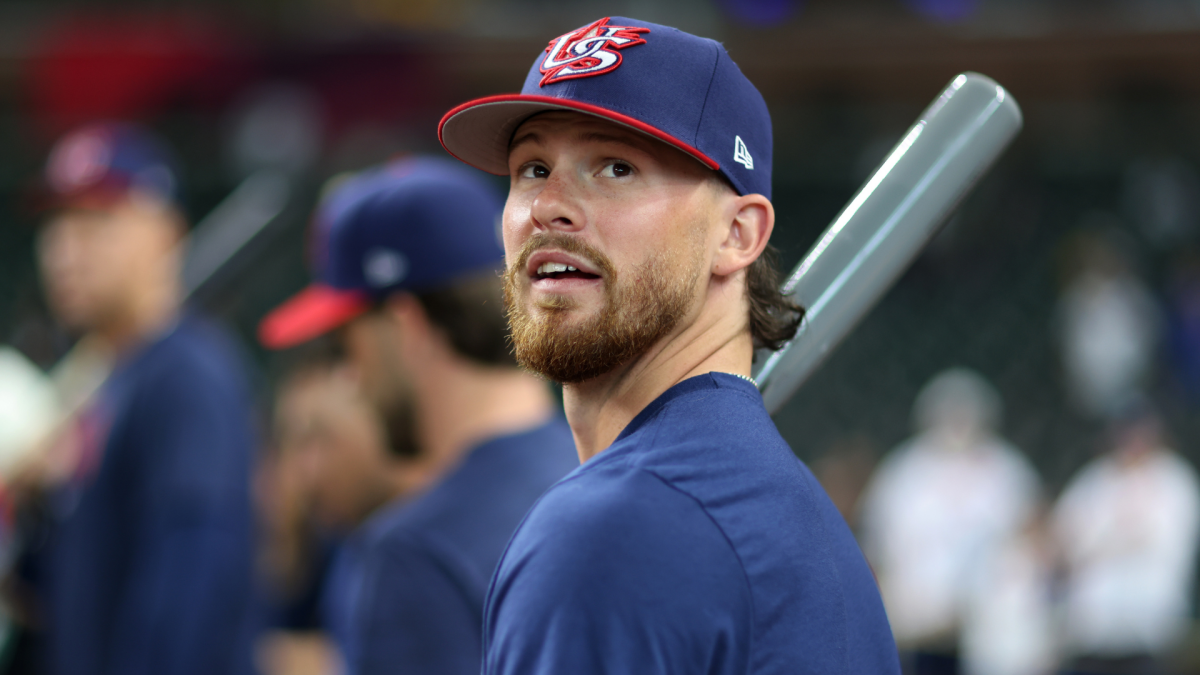
The metamorphosis of Bobby Witt Jr. from a peripheral 2023 roster inclusion to the foundational leadoff hitter for Team USA’s 2026 campaign denotes a paradigmatic shift in American international baseball strategy. In the 2023 World Baseball Classic, Witt Jr.—the squad’s youngest member—was limited to two plate appearances as a veteran-centric roster fell to Japan in the final. His projected elevation to the lineup’s apex for 2026 signifies an institutional pivot toward a high-floor, high-variance offensive model that prioritizes elite speed, defensive range, and contact efficiency over traditional power-heavy configurations.
Athletic Control as a Performance Multiplier
Witt Jr.’s operational utility is best defined by ‘athletic control’—a qualitative metric cited by teammates like Michael Massey to describe movement that transcends standard defensive analytics. This spatial awareness, exemplified by his ability to neutralize slicing fly balls with unnatural range, provides Team USA with a defensive floor that mitigates pitching volatility. By converting high-leverage defensive chances into routine outs, Witt Jr. allows the coaching staff greater latitude in roster construction and late-inning bullpen management.
Strategically, the leadoff role functions as a mechanism for tempo dictation. Witt Jr.’s evolution suggests a departure from a reliance on the three-run home run toward a philosophy centered on base-path disruption. By forcing opposing rotations to manage high-speed variables from the opening pitch, Witt Jr. creates immediate structural pressure, often destabilizing starters before they establish a rhythm. This ‘table-setting’ capability is essential for a lineup tasked with maximizing the run production of its subsequent middle-order power hitters.
Regional Identity and Brand Alignment
Witt Jr.’s persona serves as a case study in authentic market positioning. His synergy with the Texas-based Whataburger brand—highlighted by his themed ‘Wittaburger’ wedding—functions as a strategic asset for the Kansas City Royals. This alignment reinforces his status as a homegrown anchor within the Texas-Kansas corridor, fostering an emotional and financial bond with a mid-market fan base. Such localized branding is a critical buffer against the inherent limitations of small-market Regional Sports Network (RSN) viability, elevating Witt Jr. into a global ambassador whose commercial reach extends beyond traditional geographic boundaries.
Navigating Competitive Volatility: The Dominican and Japanese Threats
The 2026 WBC landscape is defined by the emergence of the Dominican Republic as a statistical outlier. With an offensive core drawing comparisons to the 1927 Yankees, the Dominican roster presents a concentration of talent that challenges the depth of the American pitching staff. The absence of top-tier starters like Tarik Skubal necessitates a tactical reliance on defensive efficiency and early-inning run creation. In this high-stakes environment, Witt Jr.’s ability to mitigate pressure through elite infield play and OBP becomes the team’s primary risk-management tool.
Furthermore, the anticipated rematch with Japan represents a clash of organizational philosophies. While Japan emphasizes fundamental discipline, the inclusion of Witt Jr. indicates a convergence of styles, where the U.S. incorporates Japanese-style tactical precision into its high-powered framework. For the Royals, Witt Jr.’s leadership in this international laboratory validates his development trajectory, transforming him from a prospect of potential into a documented elite shortstop capable of sustaining performance under global scrutiny.