
Belfast Civil Unrest: Unpacking Anti-Immigrant Tensions and Stability Risks
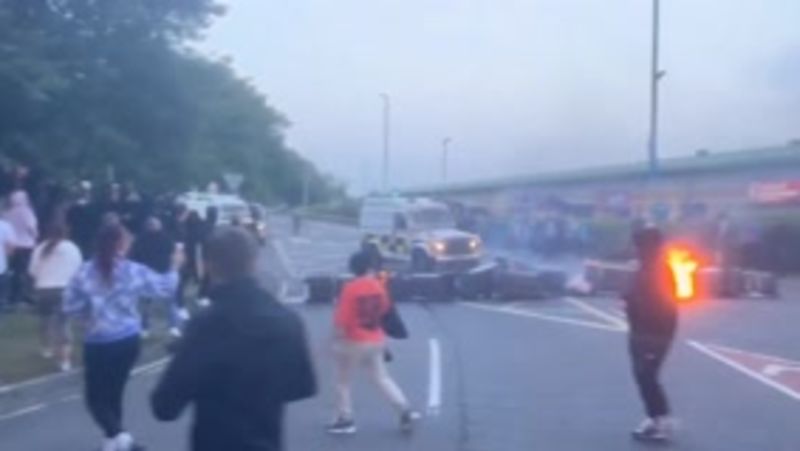
The recent surge of civil disorder in Northern Ireland, primarily concentrated around Belfast, signifies a critical escalation in communal tensions. The Police Service of Northern Ireland’s (PSNI) deployment of water cannons at the Sandyknowes roundabout directly illustrates the shift from conventional protest to more aggressive crowd management tactics, necessitated by the nature of the unrest.
These incidents, marked by property destruction and direct confrontation with law enforcement, were immediately catalyzed by a violent attack in north Belfast. The severe injury to a victim, leaving them blinded in one eye, acted as a potent trigger, fueling and mobilizing pre-existing anti-immigrant sentiment that subsequently manifested in nights of sustained violence.
Judicial and Political Implications
The legal system’s swift response, highlighted by the appearance of a 30-year-old Sudanese national in Belfast Magistrates’ Court on attempted murder charges, has become a pivotal element in the crisis. This judicial process not only provides a concrete focal point for public discourse but critically tests the Northern Irish justice system’s capacity to uphold the rule of law and impartially administer justice amidst intense communal pressures. Its outcome will profoundly influence public trust and future stability.
Politically, the unrest has elicited rare, unified condemnations from across the spectrum. First Minister Michelle O’Neill denounced the targeting of residential properties as cowardly, a sentiment echoed by Deputy First Minister Emma Little-Pengelly, who labeled the violence unacceptable. This bipartisan alignment among Stormont’s principal stakeholders underscores a collective imperative to restore public order, yet also highlights the deep-seated challenges in addressing the underlying causes that transcend traditional political divides.
Operational Challenges for Law Enforcement
The PSNI navigates a profoundly complex operational landscape, tasked with containing violence while mitigating the risk of further escalation. The sustained, albeit fluctuating, intensity of these incidents demands not only significant resource allocation but also strategic vigilance to prevent widespread disorder. This prolonged engagement strains both personnel and equipment, diverting critical resources from other policing priorities.
The immediate aftermath of the violence imposes significant economic and social costs on affected communities. Beyond the visible damage to properties and essential infrastructure, the necessity of continuous police presence in flashpoint areas places substantial and unbudgeted strain on regional security finances. This financial burden, coupled with community apprehension, complicates post-crisis recovery and reinforces a cycle of reactive policing rather than proactive community engagement.
Strategic Context and Social Stability
The geographically differentiated response to the unrest, with peaceful demonstrations in areas like Coleraine juxtaposed against violent confrontations near Belfast, reveals a fragmented social landscape. This divergence indicates that while the immediate trigger was singular, the motivations, grievances, and levels of participation in the disorder are diverse, reflecting deeper socio-economic and identity-based divisions within Northern Ireland. Understanding these nuances is crucial for developing effective de-escalation strategies.
Prime Minister Sir Keir Starmer’s unequivocal declaration that perpetrators will face the full force of the law serves as a vital strategic signal. This rhetoric aims to unequivocally assert state authority, deter further escalation, and counter any attempts to legitimize violence as a mechanism for expressing grievances. Such firm statements are essential in re-establishing the primacy of the rule of law and preventing the normalization of vigilantism or public disorder.
Institutional Resilience and Future Risks
Belfast’s current volatility mirrors broader European trends where migration-related tensions increasingly strain local institutional resilience. The Northern Irish government’s capacity to manage this crisis will be critically judged on its ability to prevent the radicalization of discontent into sustained protest movements, concurrently upholding the rule of law as the sole arbiter of justice, thereby safeguarding democratic processes against populist exploitation.
As the region remains in a heightened state of alert, the focus extends to the profound long-term implications of these events on community cohesion and trust in governance. The sensitive interplay between ongoing judicial proceedings and evolving public perception will be instrumental in determining the future trajectory of the unrest. This necessitates a sophisticated strategy that delicately balances rigorous security enforcement with inclusive political engagement to address root causes and rebuild community confidence.
Economic and Social Consequences
The economic fallout from sustained civil disorder extends far beyond immediate property repair costs. Businesses within affected zones confront elevated insurance premiums, potential supply chain disruptions, and a pervasive decline in consumer confidence. These factors collectively threaten regional economic development and deter investment, creating an environment of prolonged uncertainty.
Crucially, the predominant reliance on police intervention to manage these outbreaks exposes a significant deficit in proactive community engagement and preventative strategies. Effectively addressing the deep-seated root causes of the unrest necessitates a robust institutional framework capable of bridging disparate community interests, fostering dialogue, and implementing socio-economic interventions, rather than perpetually reverting to reactive security measures.
Analytical Synthesis of the Current Crisis
The unfolding events in Belfast are not isolated occurrences but rather acute symptoms of deeper, systemic socio-political and economic frictions requiring urgent, comprehensive monitoring. The current response perimeter, characterized by the convergence of criminal justice processes, unified political condemnation, and active policing, addresses immediate symptoms. However, the underlying drivers of the unrest—including socio-economic deprivation, identity politics, and unresolved historical grievances, now exacerbated by migration-related tensions—remain complex and multifaceted.
Moving forward, the paramount challenge for regional authorities will be to meticulously uphold the integrity of the judicial process, ensuring fairness and impartiality, while simultaneously implementing robust strategies to address the legitimate security concerns of the public. A failure to strike this delicate equilibrium risks perpetuating a cycle of recurring instability, further fraying the already intricate political and social fabric of Northern Ireland and undermining prospects for lasting peace.

Photo by creativesmilebelfast on Pixabay.