The June full moon—traditionally termed the Strawberry Moon—represents a notable structural extreme within the annual lunar cycle. Because the summer solstice positions the Sun at its highest northern declination, the opposite full moon must occupy the lowest southern declination along the ecliptic plane. This configuration constrains the lunar trajectory across the Northern Hemisphere, forcing a low, shallow transit near the southern horizon rather than the high overhead climbs observed during winter.
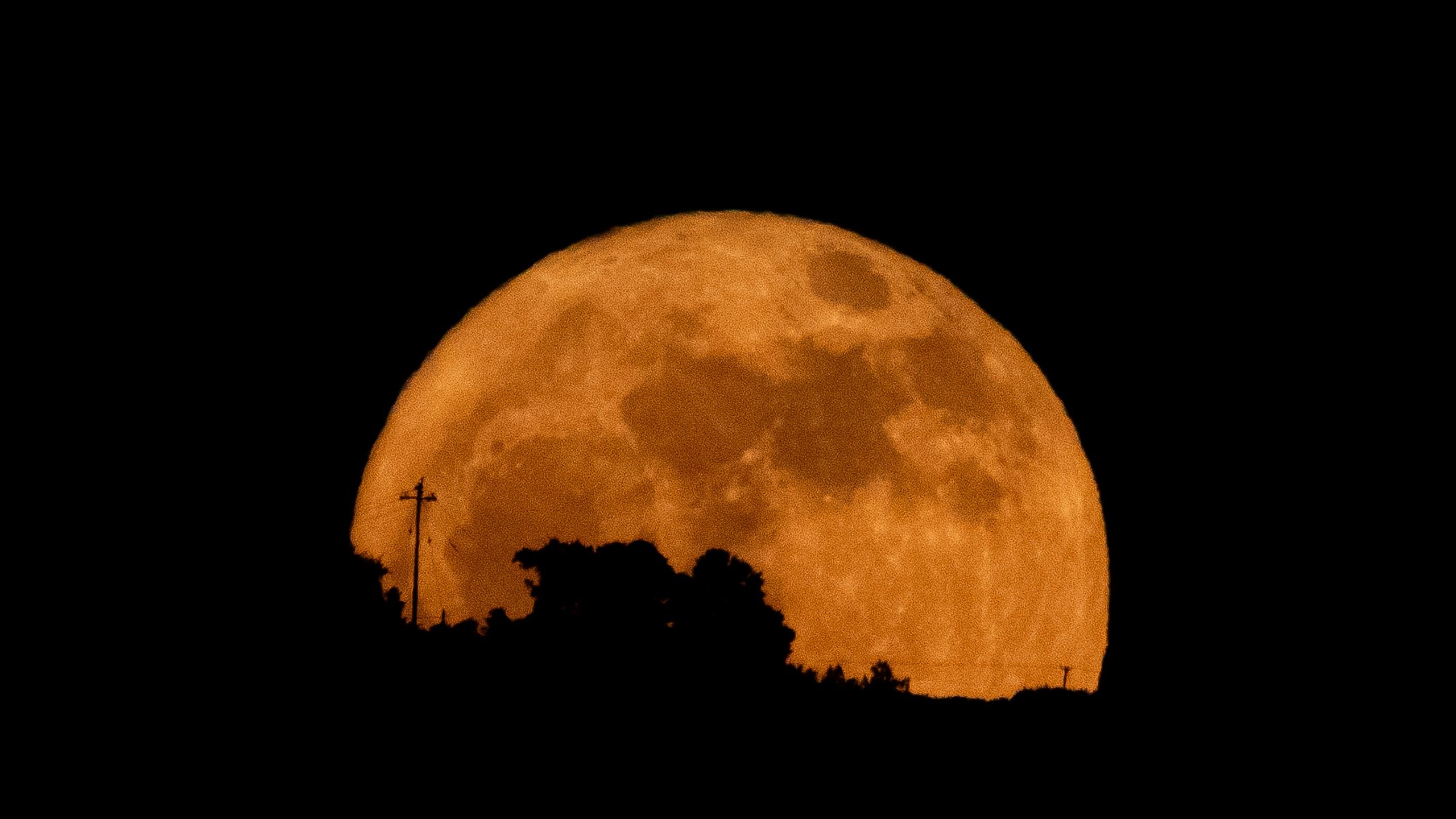
From an observational standpoint, this low-altitude path significantly increases the optical path length—or airmass—through which lunar light must travel to reach an observer. Passing through a thicker column of Earth’s atmosphere subjects the lunar disk to enhanced Rayleigh scattering and atmospheric extinction. Shorter blue wavelengths are dispersed, leaving longer red and orange wavelengths dominant. This filter effect, compounded by seasonal thermal inversion layers and summer aerosols, produces a distinct amber or golden hue and a highly turbulent visual boundary.
Deep-Sky Interference and Resource Allocation
For research observatories and astrophotographers, a full moon at low declination poses distinct operational hurdles. At peak illumination, the high lunar phase angle floods the night sky with scattered light, raising the background sky glow. This optical noise masks low-surface-brightness targets such as faint nebulae, galaxies, and diffuse interstellar dust clouds.
To optimize telescope efficiency, astronomical institutions pivot away from high-sensitivity deep-space imaging during this period. Research schedules are strategically reallocated to focus on high-cadence planetary monitoring, lunar topography, or routine hardware maintenance. Concurrently, this highly visible phenomenon acts as a public engagement vector, lowering the observational barrier of entry and shifting scientific attention toward accessible naked-eye stargazing.
Stellar Reference Coordinates: Arcturus and Vega
The late June sky is framed by two primary stellar benchmarks that serve as critical calibration points for celestial orientation: Arcturus (Alpha Boötis) and Vega (Alpha Lyrae). These luminaries represent distinct evolutionary stages and spectral classes, dominating the meridian shortly after nightfall.
- Arcturus: A yellow-orange K-type giant located 37 light-years away. Exhibiting an intrinsic luminosity roughly 150 times that of the Sun, its high proper motion makes it a critical subject for stellar kinematics.
- Vega: A white, class-A main-sequence star situated 25 light-years from Earth. Operating as the zero-point anchor for the UBV photometric system, Vega is approximately 50 times more luminous than the Sun.
Arcturus positions toward the southwest, while Vega anchors the eastern sky. Together, they establish a high-altitude baseline across the celestial sphere, allowing observers to map and measure the lower, more volatile trajectories of the moon and planets transiting the southern zodiacal constellations.
The Scorpius Conjunction and Lyra Framework
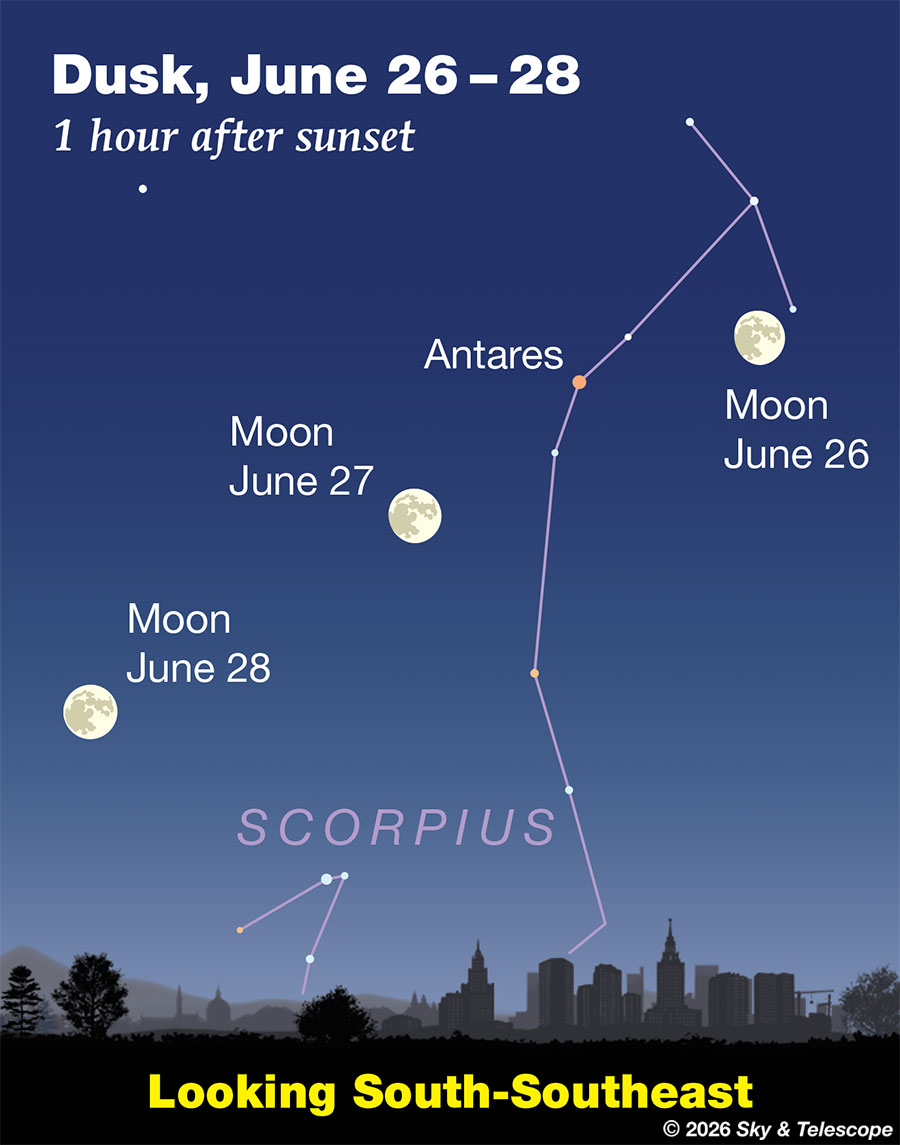
On the evening of June 26, the moon provides a visual reference for localized orbital tracking as it transits the northern boundary of the constellation Scorpius. The lunar disk sits directly beneath the three-star asterism marking the Scorpion’s head (Graffias, Dschubba, and Acrab), with the first-magnitude red supergiant Antares positioned approximately five to six degrees to the moon’s left.
By June 27, the waxing gibbous moon’s rapid orbital progression shifts its position to the left (east-southeast) of Antares, maintaining a comparable angular separation. This visible displacement over a 24-hour window offers a real-time demonstration of lunar orbital velocity against the static stellar background.
To the east, the constellation Lyra offers additional geometric structure. Extending from Vega, the stars Sheliak (Beta Lyrae) and Sulafat (Gamma Lyrae) form the base of a distinct, compact parallelogram. These stars serve as key targets for studying eclipsing binary systems and variable star physics, representing a secondary magnitude tier that remains observable despite lunar sky glow.
The Major Lunar Standstill Influence
The exceptionally low sweep of the Strawberry Moon is deeply connected to the 18.6-year nodal cycle, specifically the progression toward a major lunar standstill. During this orbital phase, the inclination of the moon’s orbit (approximately 5.15° to the ecliptic) aligns with the Earth’s axial tilt (23.44°), resulting in extreme declination ranges between +28.7° and -28.7°.
During a major standstill, the full moon closest to the summer solstice rises at its absolute southernmost azimuth and transits at its lowest possible altitude. Understanding these long-term orbital dynamics is essential for planetary geodesy, maritime navigational planning, and tidal modeling, proving that the moon’s low transit is an elegant manifestation of intersecting gravitational planes.