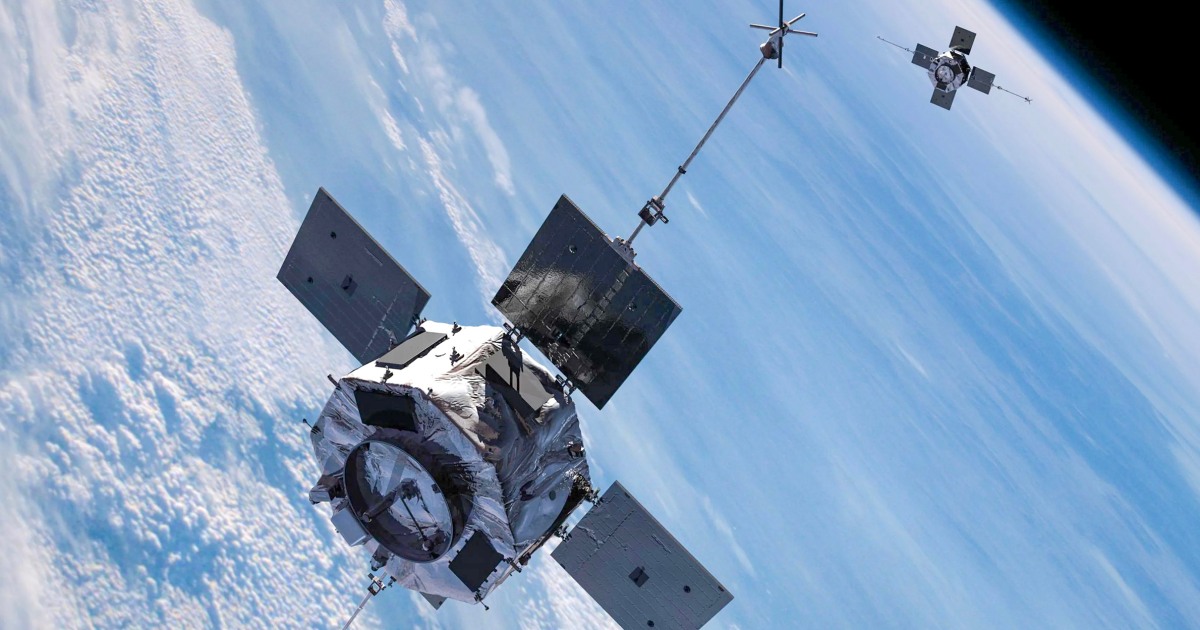
The recent uncontrolled atmospheric reentry of the defunct NASA Van Allen Probe A, weighing approximately 1,300 pounds (590 kg), starkly illustrates the persistent challenge of managing aging, long-lived space infrastructure.
Mission Extension vs. Disposal Mandates
Launched in 2012, the mission significantly surpassed its initial two-year objective, delivering nearly seven additional years of critical data on Earth’s radiation belts. This scientific success, however, directly extended the liability timeline, culminating in an uncontrolled deorbit due to critical fuel exhaustion, precluding necessary solar orientation and orbital maintenance maneuvers.
This scenario exposes a fundamental engineering trade-off: maximizing scientific Return on Investment (ROI) by utilizing all available propellant versus allocating necessary reserves upfront for guaranteed end-of-life propulsion to ensure a controlled descent.
Debris Risk Quantification and Context
NASA quantified the residual casualty risk to an individual on the ground as 1 in 4,200. This figure, while statistically low, necessitates comparison with regulatory norms and prior events. The successful ablation of the majority of the 1,323-pound structure highlights the expected performance of materials under extreme reentry heating.
Expert commentary, such as that from LeoLabs, places this figure within historical context, noting that reentries with higher probabilities (e.g., 1 in 1,000) have previously occurred without incident, confirming the current framework’s risk tolerance level for large assets.
Strategic Implications for Orbital Asset Stewardship
The reentry’s confirmation by the US Space Force underscores the reliance on defense and intelligence tracking assets for monitoring non-maneuverable objects. The final splashdown occurred approximately 12 hours outside the final prediction window, illustrating the inherent uncertainty in modeling atmospheric drag on large, tumbling bodies during the transition through lower atmospheric layers.
End-of-Life Architectural Requirements
The lack of post-mission maneuverability reinforces the strategic imperative for future mission architectures to incorporate robust, dedicated propulsion margins specifically for deorbiting or controlled graveyard orbits, particularly for high-mass satellites.
The joint monitoring process between NASA and the Space Force defines the necessary institutional coordination for public safety interface management regarding orbital decay, a procedure gaining critical importance due to increasing orbital congestion.
Regulatory and International Comparison
The high-profile nature of the Van Allen Probe A event contrasts with the routine reentries of smaller debris, as documented by ESA. This disparity indicates that regulatory scrutiny escalates sharply based on the potential for significant, identifiable debris reaching the surface.
The transparency regarding the 1-in-4,200 risk metric suggests an evolving international standard where open communication of casualty assessment is key to maintaining operational legitimacy in the global space domain, especially when compared to prior international incidents like the 2018 Chinese space station reentry.
Data Contribution to Orbital Strategy
This event provides valuable empirical data for refining orbital decay models and debris mitigation guidelines. For space agencies, managing such high-mass, uncontrolled returns serves as a live validation of evolving sustainability norms and accountability frameworks for assets launched decades prior. The successful, though unplanned, conclusion pressures policymakers to potentially mandate stricter propellant reserves for future end-of-life safety maneuvers.