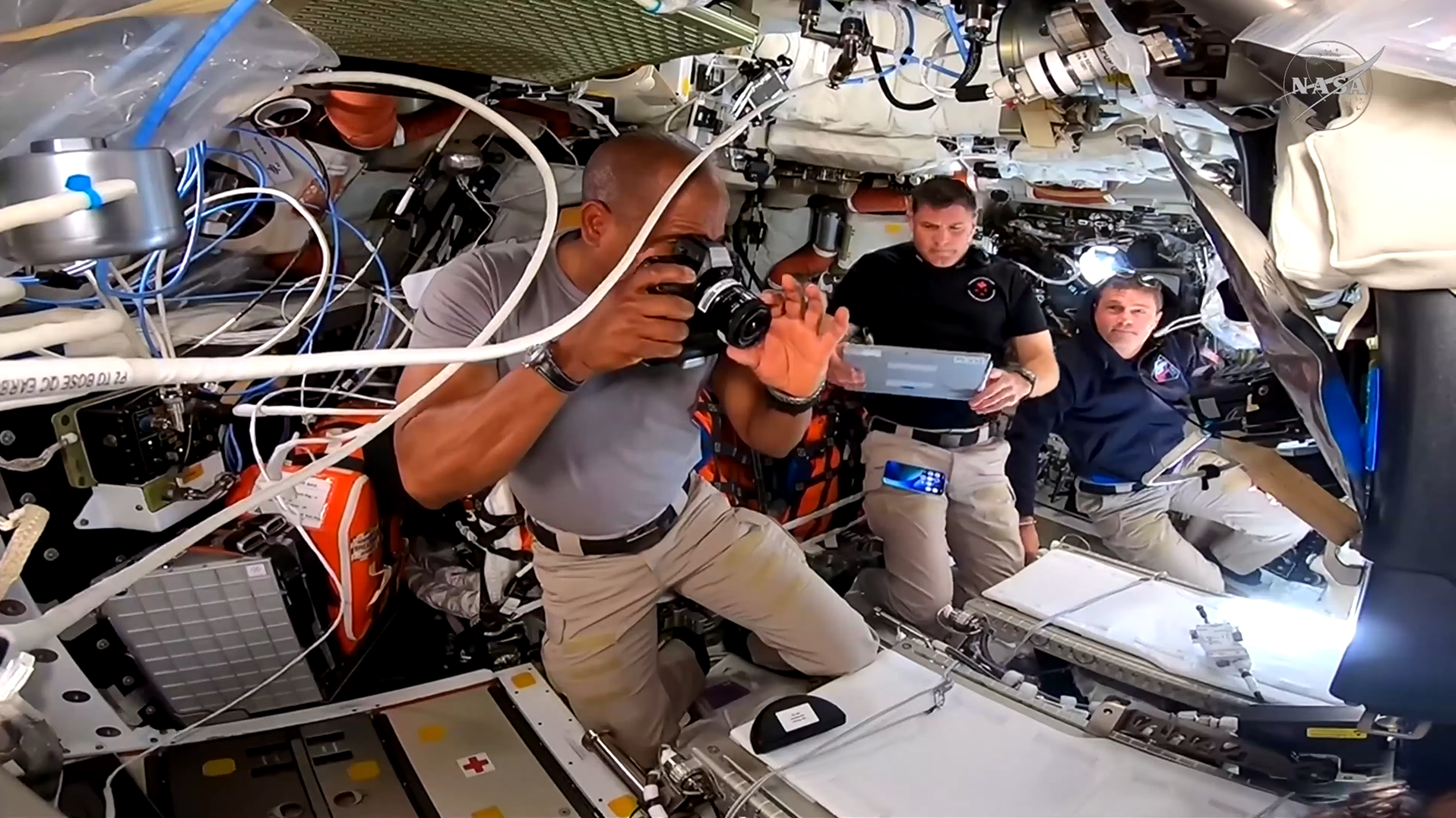
The Artemis II mission has entered a high-fidelity operational phase within the translunar corridor, with the Orion spacecraft positioned approximately 100,000 miles from Earth. This mission serves as the inaugural human-rated validation of Orion’s life support and navigation architectures in a deep-space environment. Current mission status is defined by optimal orbital mechanics and the successful verification of primary propulsion sequences.
Propulsion Efficiency and Trajectory Nominality
A critical technical milestone was achieved with the cancellation of the first outbound trajectory correction burn (OTC-1). Mission Control’s decision to bypass this maneuver indicates that the Trans-Lunar Injection (TLI) burn achieved a degree of precision that rendered immediate course adjustments redundant. This conservation of delta-v preserves vital propellant margins, augmenting the spacecraft’s contingency reserves for the high-G atmospheric reentry phase.
The Thursday night propulsion sequence successfully established a free-return trajectory. This strategic orbital configuration utilizes lunar gravity to facilitate a passive return to Earth, minimizing dependence on secondary engine firings. The maneuver confirms the operational integrity of Orion’s European Service Module (ESM) under the thermal extremes and vacuum conditions of the deep-space environment.
Avionics and Deep Space Network Integration
Operational focus on Flight Day 3 shifted toward the stress-testing of emergency communication subsystems. Establishing high-bandwidth telemetry at distances exceeding 100,000 miles is essential for the redundancy required by future long-duration lunar surface missions. These tests analyze signal-to-noise ratios and latency within the Deep Space Network (DSN) as it interfaces with Orion’s S-band and Ka-band transponders under high-radiation conditions.
Simultaneously, the crew executed medical contingency drills, a protocol signaling the shift from Low-Earth Orbit (LEO) rapid-evacuation models to autonomous deep-space medical management. Given the absence of immediate Earth-return options, crew proficiency in stabilization and onboard trauma protocols is a mission-critical requirement. These drills provide empirical data on medical ergonomics within the high-density configuration of the Orion cabin.
Physiological Mitigation and Cabin Reconfiguration
Preparation for the lunar observation window, beginning Monday, April 6, involves a systematic reconfiguration of the Orion interior. The crew is currently optimizing internal stowage to maximize the efficiency of high-resolution scientific imaging of the lunar far side. This process balances the requirements for optical clarity with the spacecraft’s shielding protocols and thermal control constraints.
Daily physical exercise remains a mandatory operational requirement to counteract microgravity-induced musculoskeletal degradation. Maintaining physiological readiness is imperative for both high-dexterity lunar flyby tasks and the physical demands of splashdown. These activities are synchronized with a rigid circadian schedule designed to optimize cognitive performance and mitigate mission-induced fatigue.
Geopolitical Integration and Strategic Transparency
The dissemination of Earth imagery downlinked by Commander Reid Wiseman serves as both a verification of optical sensor calibration and a tool for institutional transparency. These visual assets provide empirical confirmation of the spacecraft’s attitude control performance. Furthermore, the participation of the Canadian Space Agency (CSA) underscores the multilateral framework of the Artemis Accords, distributing technical risk and financial burden across a global industrial base.
Strategic Implications of the Free-Return Flyby
As Orion accelerates toward the lunar sphere of influence, the upcoming flyby represents a critical test of integrated ground-tracking and onboard flight computer synchronization. Success in this phase validates the mission architecture for Artemis III, which will build upon these orbital foundations for a crewed lunar landing. Each hour of transit yields unique telemetry regarding Orion’s radiation shielding efficacy, providing data that cannot be replicated in terrestrial simulations.
Transit Phase Conclusion
Artemis II is currently demonstrating the technical maturity of the Orion spacecraft as a deep-space exploration vehicle. The elimination of unnecessary trajectory burns and the robustness of the communication tests suggest a stable baseline for the remainder of the mission. As the crew approaches the 260,000-mile mark, the focus remains on the precision of the lunar gravity assist and the continued performance of the environmental control and life support systems (ECLSS).