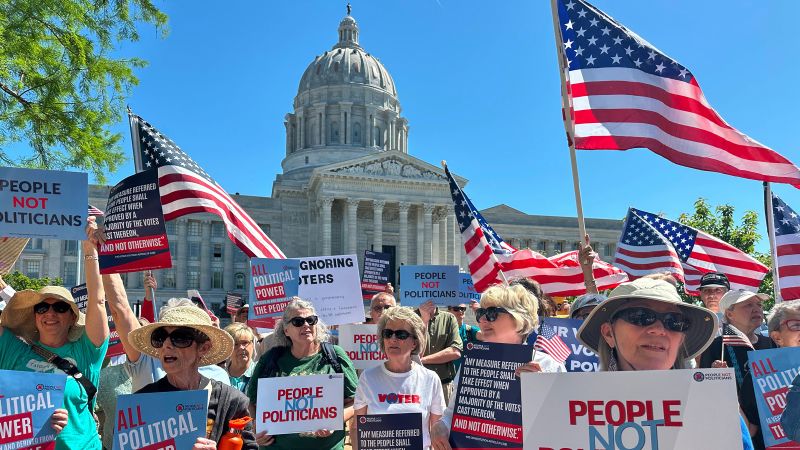
The United States 8th Circuit Court of Appeals has disrupted Missouri’s electoral framework by mandating the implementation of a Republican-backed congressional map for the 2024 general election. This decision prioritizes federal constitutional arguments over state-level determinations, effectively reviving a 7-1 partisan split that had previously been invalidated by the Missouri Supreme Court.
Jurisdictional Friction and Federal Overreach
The ruling highlights a growing tension between state and federal judiciaries regarding the authority to regulate electoral boundaries. While the Missouri Supreme Court previously blocked the 7-1 map—citing a state referendum challenge—the 8th Circuit panel asserted that reverting to a prior 6-2 configuration would violate the U.S. Constitution. This maneuver signals an increasing willingness by federal courts to scrutinize state-specific constitutional provisions when they impact federal elections.
Central to the court’s reasoning was the inclusion of data and projections provided by third-party advocacy groups. By integrating these estimates into its rationale, the appellate court has institutionalized the use of partisan statistical modeling as a metric for constitutional compliance, shifting the battlefield from legal theory to technical data analysis.
Administrative Volatility and the Purcell Principle
The court’s decision creates significant operational whiplash for election authorities. Local officials must now reconcile conflicting mandates under extreme time pressure, risking logistical errors in ballot printing and precinct configuration. The 8th Circuit justified its intervention by noting that the 7-1 map was utilized during the August primary, arguing that consistency across the primary and general cycles is necessary to preserve electoral integrity.
However, the abruptness of this reversal—occurring after the Missouri Supreme Court and the U.S. Supreme Court had seemingly settled the map for the 2022 and 2024 cycles—introduces the very instability federal courts typically seek to avoid under the Purcell principle. A one-week administrative stay currently pauses the ruling, providing a narrow window for the U.S. Supreme Court to issue a definitive mandate.
Strategic Leverage in the House Majority
The move from a 6-2 to a 7-1 map offers a substantial structural advantage for Republican leadership in a narrow national race for the U.S. House of Representatives. For Democratic stakeholders, the ruling represents an erosion of state-level litigation victories and a direct challenge to the popular sovereignty expressed through the Missouri referendum process.
The final resolution now rests with the U.S. Supreme Court. The high court must decide whether to defer to state court interpretations of Missouri’s constitution or uphold the 8th Circuit’s federalist intervention. This outcome will not only determine Missouri’s representation but also set a precedent for how federal courts may override state-led redistricting processes in future cycles.