
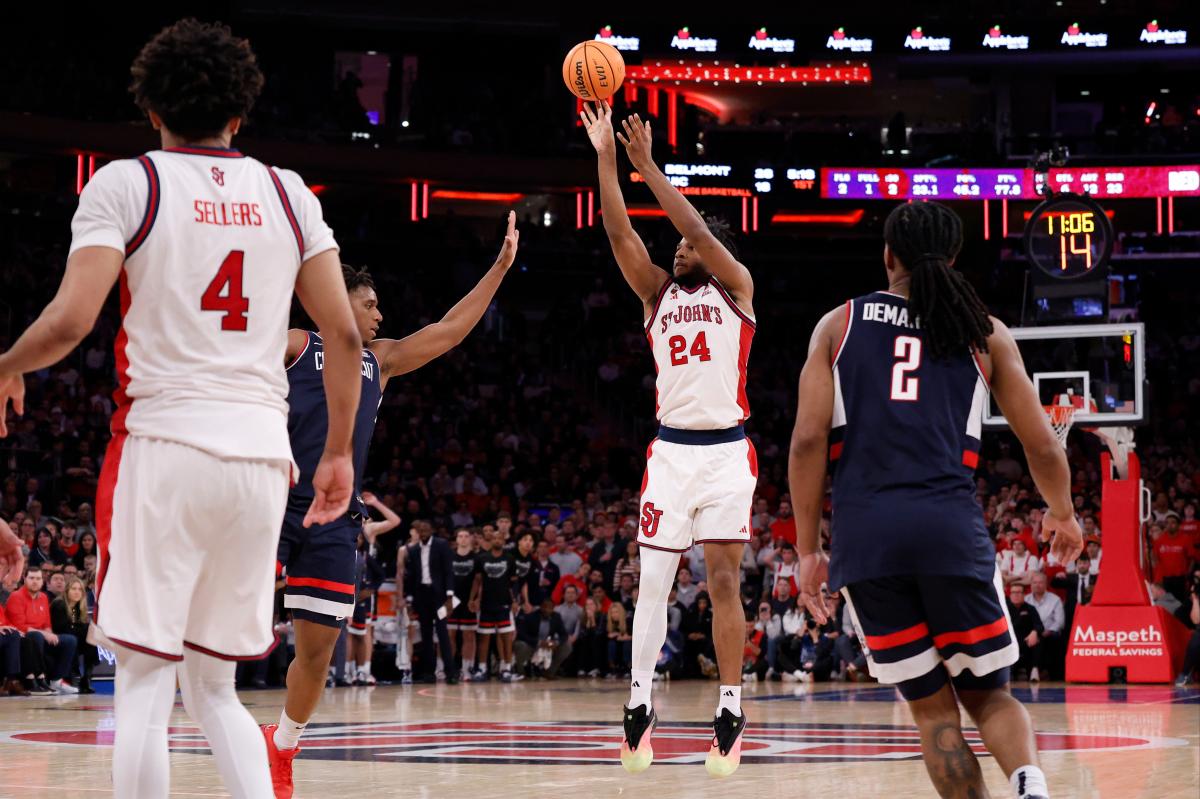
The Tactical Rubber Match: Assessing Conference Supremacy
The 2026 Big East Men’s Basketball Championship at Madison Square Garden represents a definitive assessment of conference hierarchy, featuring a high-stakes rubber match between top-seeded St. John’s (27-6) and second-seeded UConn (29-4). This final transcends seasonal completion; it serves as a performance audit of two programs that have maintained a statistical stranglehold on the Big East. The matchup is defined by the polarized outcomes of their regular-season series, providing divergent data points on operational efficiency and defensive resilience.
Defensive Paradigms: High-Pressure vs. Positional Attrition
The strategic landscape is framed by the contrasting coaching philosophies of Rick Pitino and Dan Hurley. In their February 6 meeting, St. John’s leveraged a disruptive perimeter scheme to force 15 turnovers, fueling an 81-72 victory. This success was anchored by Zuby Ejiofor’s interior dominance (21 points, 10 rebounds), validating Pitino’s high-pressure transition system. Conversely, the February 25 rematch in Hartford exposed a total collapse of the Red Storm’s offensive infrastructure. UConn’s 72-40 rout featured a historic statistical anomaly: St. John’s failed to record a field goal for the final 17.5 minutes of play, missing 24 consecutive shots.
This volatility underscores the primary tactical variable for the final: St. John’s ability to sustain half-court execution under the duress of UConn’s elite defensive rotations. Currently ranked sixth nationally, UConn’s defense has demonstrated the capacity to entirely neutralize opponent identities, as evidenced by their 67-51 semifinal suppression of Georgetown. For Hurley, the objective is to replicate this positional attrition to force St. John’s into the low-percentage perimeter looks that defined the Hartford collapse.
Institutional Stakes and Performance Metrics
The path to the championship has tested the depth of both rotations. St. John’s enters the final following efficient victories over Providence (85-72) and Seton Hall (78-68), suggesting their late-February scoring drought was an isolated outlier. However, the championship environment at Madison Square Garden—essentially a secondary home for the Red Storm—will provide the ultimate stress test for their offensive recovery. UConn’s trajectory has been characterized by defensive suffocation, highlighted by a 25-point quarterfinal victory over Xavier.
Beyond the immediate trophy, the result carries significant weight for NCAA Tournament seeding. A UConn victory would likely solidify a top-tier regional seed, reflecting a 30-win profile and a potential conference double. For St. John’s, a repeat title would validate the long-term viability of Pitino’s resurgence and elevate their national standing ahead of Selection Sunday. The commercial impact is equally substantial; the prime-time FOX broadcast at a sold-out MSG reinforces the Big East’s status as a premier basketball-centric media property.
Conclusion: A Strategic Heavyweight Collision
The 2026 final is the logical culmination of a season defined by the pursuit of these two programs to outpace one another. With no margin for error, the game will be decided by the marginal gains in turnover margins and rebounding discipline. Whether St. John’s achieves the repeat or UConn reclaims the tournament crown, this encounter serves as a high-water mark for strategic collegiate basketball in the modern era.

Photo by anvel on Pixabay.