Trump’s Economic Approval Plummets to Record Low: Midterm Implications
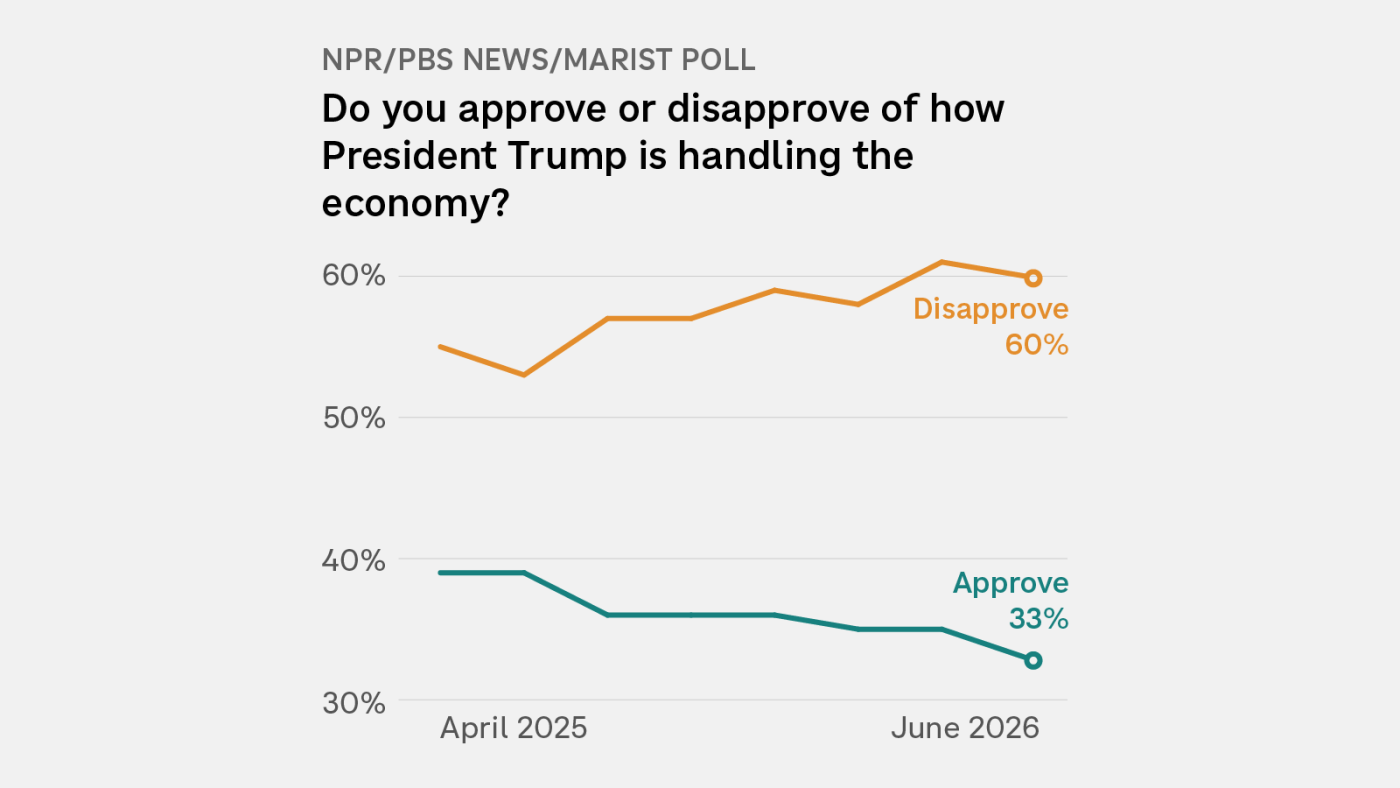
A new NPR/PBS News/Marist poll reveals President Trump’s economic approval rating has plummeted to a record low of 33%. This deep dissatisfaction, notably three points lower than former President Joe Biden’s lowest marks, signals a critical erosion of public confidence and introduces significant vulnerabilities for Republicans heading into the midterm elections.
The overall job performance rating for President Trump stands at 36% approval against 59% disapproval, marking the widest negative differential observed throughout either of his terms in office. Such a pronounced gap indicates a substantial weakening of his political capital, directly impacting the administration’s capacity to advance its agenda and rally its base.
Driving Factors: Gas Prices, Inflation, and Public Dissatisfaction
Soaring gas prices are identified as a primary catalyst for this widespread economic discontent, directly impacting household budgets and fueling a pervasive ‘summer blues’ sentiment across the nation. This tangible financial pressure extends beyond immediate costs, influencing broader consumer spending patterns and overall economic outlooks, which are crucial indicators of voter sentiment and trust in governmental institutions.
This pronounced public dissatisfaction with economic conditions, particularly concerning inflation and cost of living, correlates strongly with diminished trust in governmental leadership. The sustained pressure from rising essential costs challenges the administration’s narrative of economic prosperity and stability, shaping a negative perception among a broad swath of the electorate.
Cracks in the Base: Republican Dissent and Voter Apathy
Significantly, discontent extends within the Republican base: 22% of Republicans now disapprove of President Trump’s economic handling. Furthermore, strong approval among Republicans dropped eight points, from 61% in April to 53% in June. This erosion of core support not only challenges party unity but also complicates fundraising efforts and signals potential hurdles for voter mobilization in competitive electoral contests.
The tangible impact on voter engagement is exemplified by Regina Kulenga, a 36-year-old Trump voter in Georgia, who expressed uncertainty about participating in the upcoming midterm elections. Her hesitation underscores a broader risk of voter apathy among key segments of the electorate. Such individual decisions, when aggregated, threaten to significantly alter electoral outcomes, especially in closely contested districts, as the perceived disconnect between policy promises and lived economic realities undermines base loyalty and turnout.
Electoral Fallout: Strategic Shifts for Midterm Elections
This volatile economic landscape creates a distinct strategic advantage for Democrats, who are exhibiting heightened enthusiasm heading into the midterms. The pronounced gap in approval ratings empowers opposition candidates to frame the election as a direct referendum on the incumbent administration’s economic policies, simplifying the choice for financially strained voters and potentially galvanizing their base.
For Republicans, these sobering poll numbers necessitate an urgent and fundamental recalibration of campaign strategy, messaging, and resource allocation. The focus must shift from defending past performance to articulating a credible vision for future economic relief and stability, a challenging pivot given current public sentiment and persistent economic headwinds.
Diminished Presidential Leverage and Systemic Challenges
A president facing record-low economic approval experiences a significantly diminished capacity to exert legislative influence. This erosion of political capital not only impedes the passage of key bills, even those with bipartisan appeal, but also fragments intra-party loyalty, as evidenced by some Republican lawmakers openly dissenting on various issues. This internal fragmentation further complicates governance, making it harder to forge consensus and execute a cohesive legislative agenda.
Even non-economic policy areas, such as international diplomatic endeavors (e.g., a preliminary deal with Iran), become more challenging to navigate. A president with weakened public standing finds it harder to secure domestic support or international credibility for such initiatives, as political opponents are emboldened by the perceived lack of public backing.
The consistent decline in approval ratings on a core issue like the economy signals a broader systemic challenge to political stability and governance effectiveness. Media amplification of these findings, as highlighted by discussions from outlets like The Atlantic and MS NOW, further embeds the narrative of economic struggle and political vulnerability into public consciousness. Long-term, this dissatisfaction is likely to trigger a profound re-evaluation of economic priorities, shaping future party platforms and candidate selections across both major parties.
Conclusion: A Volatile Landscape Demanding Strategic Recalibration
The confluence of record-low economic approval, persistent inflation (especially gas prices), and significant intra-party dissent presents a formidable and multifaceted challenge for the incumbent administration. This landscape, coupled with heightened Democratic enthusiasm and observed voter apathy among some Republican segments, sets the stage for a highly competitive and potentially transformative midterm election.
Ultimately, the profound shift in public economic sentiment underscores its critical role in shaping political fortunes. The current environment demands a deep strategic recalibration from all stakeholders, as the implications extend far beyond immediate electoral contests to the very fabric of national governance and public trust, potentially reshaping the political discourse for years to come.