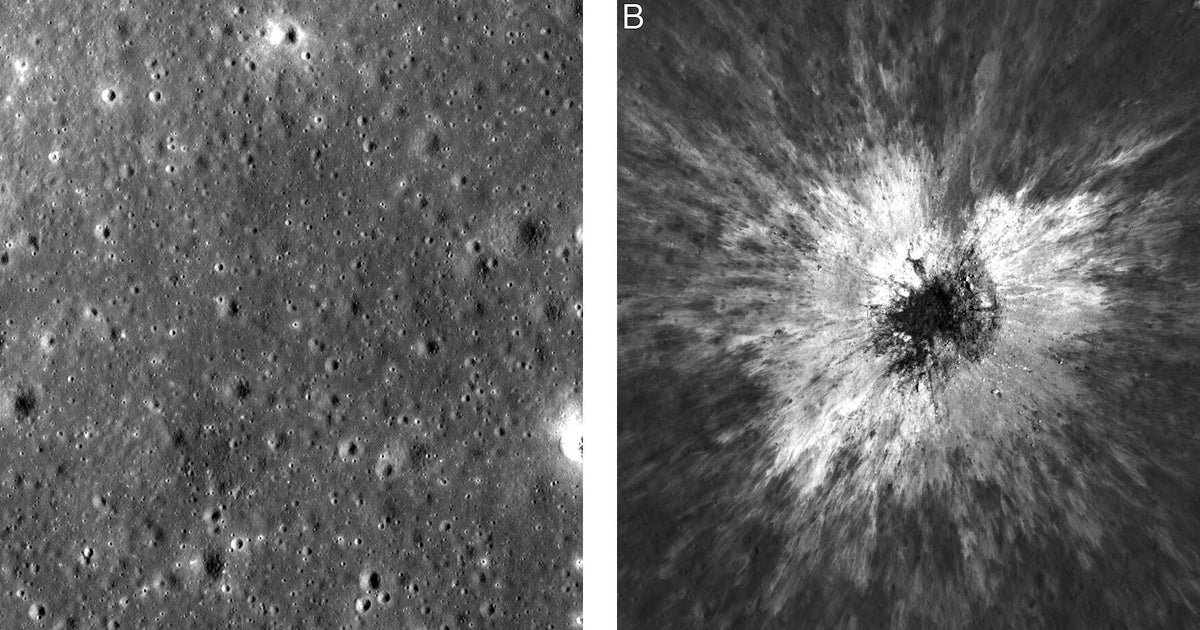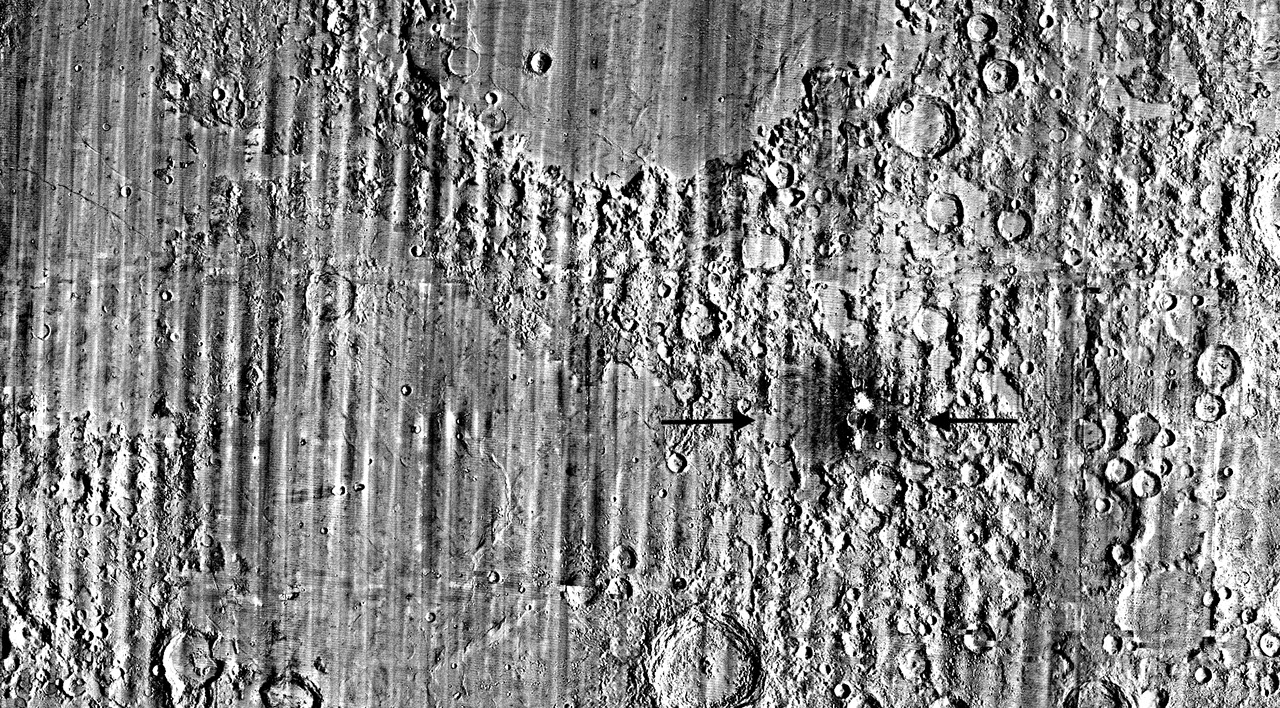
A recent quality assurance review of lunar orbital cartography has identified the largest newly formed impact crater documented in the solar system in modern observational history. The discovery, made using imagery from NASA’s Lunar Reconnaissance Orbiter Camera (LROC) system, records a significant surface disruption that occurred undetected in real-time.
The impact structure has been officially designated McGetchin Crater, honoring pioneering planetary scientist Tom McGetchin. Detailed scientific findings on its morphology and kinetic origin are formally documented in two research studies published in Science Advances.
McGetchin Crater measures approximately 222 meters (728 feet) in diameter, equivalent to the span of two standard American football fields. Structural measurements confirm the steep-sided crater reaches depths of up to 141 feet, an excavation comparable in vertical scale to three stacked school buses.
Orbital Detection Mechanics and Image Processing
The discovery originated from standard operational maintenance of the global lunar surface map. Robert Wagner, an image-processing specialist from commercial contractor Intuitive Machines supporting the LROC program, isolated the anomaly during an administrative workflow.
Orbital change-detection protocols rely on the computational alignment and temporal stacking of wide-angle photographic frames captured years apart. Subtractive analytical software is designed to neutralize persistent geological terrain into uniform grey values, isolating physical changes as contrasting light and dark anomalies.
Under standard parameters, automated comparison scripts generate numerous false-positive readings due to transient solar illumination angles and shifting topographical shadows. The signal identified on October 24, 2025, significantly diverged from statistical noise, exhibiting an expansive bright core enclosed by a distinctive dark circular halo.
The anomalous footprint spanned hundreds of individual pixels where a single pixel roughly corresponds to the physical dimension of an American football field. The immense spatial scale of the radiometric signature indicated that the underlying regolith had undergone sudden kinetic disturbance, not seasonal lighting variation.
Upon verifying the automated flag, Wagner executed comparative cross-referencing against archival baseline scans to evaluate the terrain before and after the disturbance. This verification protocol confirmed that a previously pristine expanse of the Moon’s eastern near side had suffered catastrophic mechanical deformation within an identifiable multi-week operational window.
Kinetic Parameters and Impactor Dimensions
Orbital mapping intervals established that the impact event transpired between April 11 and May 22, 2024. Despite releasing sufficient kinetic energy to carve an excavation larger than the Roman Colosseum, the celestial collision evaded immediate Earth-based and orbital astronomical surveillance networks.
Ballistic assessments published by mission scientists indicate the excavating projectile measured between three and six stories in vertical height. Planetary researchers classify the incoming object as either an asteroidal fragment or a comet core that intersected the Moon’s orbital path at hypervelocity.
The collision instantly displaced thousands of tons of compacted regolith, generating an interior cavity characterized by precipitous structural gradients and localized faulting. The bright interior reflectance marks newly excavated subsurface material, while the surrounding dark halo delineates the physical boundary of shock-displaced ejecta blankets.
The absolute volume of mobilized surface strata establishes McGetchin as the most significant kinetic cratering event recorded in contemporary lunar surveillance. The physical magnitude of the excavation provides empirical data on mechanical disruption thresholds previously constrained to theoretical computational simulations.
Operational Risks for Long-Term Lunar Infrastructure
The identification of a 728-foot excavation carries immediate operational implications for sustained lunar surface habitation. As NASA accelerates programmatic initiatives for permanent surface bases, empirical data on primary impact risks transition from theoretical physics into civil engineering requirements.
Actuarial cratering models referenced by the research team calculate that an impact event of this specific volumetric threshold occurs on the Moon roughly once every 132 years. Planetary scientists characterized the detection as a statistically rare, effectively once-in-a-lifetime observation capturing a primary geological event under contemporary orbital monitoring.
While a century-scale recurrence interval suggests low localized probability for short-duration sorties, the absolute surface area affected by ballistic ejecta broadens the structural risk envelope. Subsurface habitation modules, power infrastructure, and communication arrays must account for localized ground shock and high-velocity debris dispersals documented around the McGetchin perimeter.
The sheer depth of the 141-foot vertical cavity highlights severe limitations of surface-level regolith shielding against multi-story kinetic projectiles. Critical life-support architecture and resource-processing facilities face structural vulnerability if deployed within unmitigated surface topologies lacking natural topographical shielding.
The presence of an undetected impact on the eastern near side demonstrates spatial exposure across zones previously evaluated for programmatic base infrastructure. Strategic site selection frameworks must integrate kinetic displacement probabilities into ongoing trade studies determining surface asset distribution.
Data Synthesis and Public-Private Collaboration
The operational framework that yielded the identification underscores the integration between institutional space agencies and specialized private contractors. Robert Wagner’s affiliation with Intuitive Machines within the LROC operational pipeline highlights how commercial analytical labor sustains core planetary defense and mapping functions.
Commercial space contractors increasingly execute mission-critical telemetry interpretation, sensor calibration, and data reduction for long-duration orbital hardware. Intuitive Machines’ integration into LRO operations reflects an institutional transition toward private sector execution of public data pipelines.
The processing architecture of LROC relies on exhaustive manual oversight to cross-check machine-learning filtering protocols. Without domain-specific human verification intercepting automated false-positive queues, anomalies spanning hundreds of resolution units risk operational obsolescence within institutional data archives.
The delayed timeline between the physical impact in early 2024 and the formal peer-reviewed characterization in Science Advances demonstrates institutional verification cycles. The scientific imperative for rigorous radiometric modeling and morphological validation routinely extends the administrative interval separating detection from technical disclosure.
Geological Evolution and Surface Dynamics
The naming of Crater McGetchin honors Tom McGetchin, an influential figure whose pioneering work advanced the theoretical understanding of lunar geology and impact processes. The formal designation links classical planetary stratigraphy with automated orbital surveillance methodologies.
Before the introduction of long-duration orbiter data streams, planetary geologists conceptualized modern lunar surface weathering as an exceedingly gradual process dominated by micrometeoritic erosion. The documented emergence of McGetchin validates the role of punctuated, high-energy impact shocks in reshaping macro-scale lunar topography.
The contrasting albedo levels documented between the dark peripheral halo and the central bright floor provide a baseline for measuring solar wind exposure rates over time. Planetary scientists can now benchmark optical maturation models against an excavation feature possessing an absolute, constrained chronological origin point.
The spatial distribution of ejecta around the 222-meter rim provides direct physical evidence regarding the mechanical cohesion and shear strength of near-surface regolith. The resulting structural cross-sections offer empirical calibration points for geotechnical surveys supporting civil infrastructure design.
Strategic Imperatives for Space Situational Awareness
The failure of global sensor architectures to register the incoming projectile in real time highlights substantial coverage gaps in space situational awareness systems. An object the size of a three- to six-story building traveling through circumlunar space represents an unmonitored kinetic factor capable of neutralizing surface assets without tactical forewarning.
Current terrestrial and orbital tracking assets remain heavily optimized for orbital debris cataloging within low Earth orbit and deep-space planetary defense sweeps. The translunar corridor represents an observational blind spot where non-reflective asteroid fragments and cometary bodies can intersect target vectors without tripping early-warning thresholds.
The physical proof delivered by McGetchin demonstrates that orbital assets and surface outposts must operate under persistent impact assumptions. Institutional stakeholders must evaluate whether dedicated optical early-detection networks are required around the Moon to safeguard human surface missions.
As commercial logistics missions and international exploration partnerships proliferate across the lunar near side, physical security from natural kinetic hazards emerges as an operational priority. Standard risk assessments based on historical statistical models must incorporate the newly quantified mechanics of the McGetchin excavation event.
Reframing Long-Term Lunar Settlement Models
The analytical significance of Crater McGetchin extends beyond astronomical curiosity, directly impacting the financial underwriting and structural engineering of future lunar exploration. Institutional and commercial entities planning capital expenditures on the lunar surface must evaluate environmental stability through verifiable observational records.
The documented 132-year recurrence interval confirms that while massive impact events remain statistically infrequent, their destructive footprint imposes non-negotiable structural parameters. Space agencies and commercial developers must balance the capital expense of deep regolith burial against the catastrophic hazards documented by the McGetchin strike.
Long-term investments in lunar surface infrastructure will increasingly rely on data derived from ongoing LROC change-detection initiatives. The integration of commercial image processors, academic research boards, and government spaceflight programs will define how modern space exploration adapts to a dynamic, hazard-prone planetary environment.
The physical scar left on the Moon’s eastern near side serves as an enduring operational reminder of the mechanical forces operating across interplanetary space. With McGetchin formally documented within planetary catalogs, the transition toward sustained lunar industrialization must proceed with an empirical appreciation of the kinetic realities governing the lunar surface.