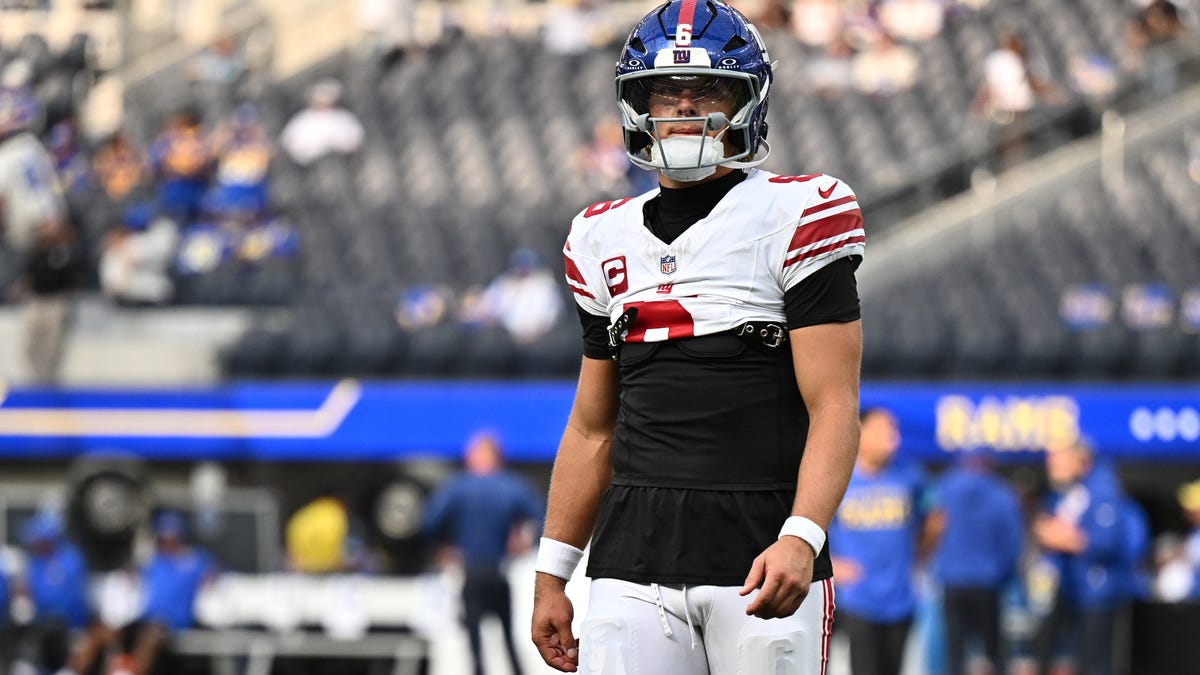
Giants QB Jaxson Dart Exits Week 2 Rams Matchup with Knee Injury
New York Giants starting quarterback Jaxson Dart departed the pivotal Week 2 prime-time contest against the Los Angeles Rams with a knee injury just seven plays into the game. The setback occurred during the Giants’ opening possession on a third-down attempt, as Dart, attempting a downfield pass to tight end Theo Johnson, sustained a significant hit. The play resulted in an incomplete pass and immediately forced veteran backup Jameis Winston into action, fundamentally altering New York’s offensive strategy from the outset.
The injury sequence involved a high-low tackle, a critical vulnerability point for quarterbacks. Dart received simultaneous contact from multiple Rams defenders, including reported knee-to-knee contact with outside linebacker Josaiah Stewart. This perpendicular force distribution, often resulting from collapsing pockets, places immense rotational and compressive stress on the lower extremities. While Dart was able to walk off the field under his own power, visible discomfort was apparent, signaling a potentially significant joint integrity issue beyond a minor impact bruise. The incident underscores the inherent risks of modern pass protection challenges against dynamic interior and edge pressure.
Medical Protocol and Diagnostic Nuances for Quarterback Injuries
Following his exit, Dart immediately underwent initial evaluations within the sideline medical tent, a standard protocol for in-game assessments. This preliminary examination, often involving manual stability tests and range-of-motion checks, allows medical staff to gauge immediate concerns away from public view. Subsequently, the 23-year-old quarterback proceeded to the locker room for more advanced secondary diagnostics, including potential imaging. The Giants officially categorized the injury as a “knee injury” and designated Dart as “questionable to return,” indicating an ongoing, comprehensive assessment for structural integrity.
This systematic diagnostic progression from the field to advanced imaging reflects the high-stakes nature of quarterback joint injuries. Premature clearance risks compounding existing damage, jeopardizing a franchise’s significant investment in its signal-caller. Dart’s injury history prior to this incident was limited; his primary professional absence was a two-game stint during his rookie year due to a concussion. This knee ailment marks his first significant lower-extremity vulnerability, prompting a meticulous medical review to determine the extent of connective tissue damage versus a less severe contusion or sprain, with long-term player health prioritized over immediate game demands.
Jameis Winston’s Immediate Role and Offensive Scheme Adaptation
With Dart sidelined, veteran Jameis Winston assumed command of the Giants’ offense, entering the game on the team’s second offensive series. Winston’s presence as the primary backup reflects a front-office strategy to mitigate significant downturns in offensive efficiency during unforeseen starting quarterback absences. His immediate insertion offers a steadying presence in high-leverage situations, capable of navigating complex defensive looks and executing intricate play designs.
However, this quarterback transition necessitates substantial operational adaptations across the entire offensive unit. While both Dart and Winston operate within the same playbook framework, their distinct mechanics—including delivery tempo, pocket presence, and decision-making speed—fundamentally alter the timing and rhythm of every play. The coaching staff faces the urgent challenge of adjusting route trees, protection schemes, and play-calls to align with Winston’s strengths and limitations, particularly in a hostile road environment against a potent Rams defense. This shift inevitably reduces the offensive ceiling and forces a more conservative, rhythm-based approach.
Furthermore, Dart’s early-season development is predicated on live game repetitions against elite NFL defenses. Every snap Winston takes represents a lost opportunity for Dart to accumulate crucial foundational experience, which is vital for a second-year quarterback’s progression. This situation forces the organization to weigh immediate competitive needs against the long-term developmental trajectory of its presumed franchise signal-caller.
Broader Institutional and Competitive Implications for the Giants
A starting quarterback injury in Week 2 creates compounding operational friction for an NFL organization’s entire seasonal trajectory. For the Giants, the potential for Dart to miss extended time significantly narrows their margin for error, placing immense pressure on Jameis Winston to maintain offensive consistency. This scenario tests the robustness of the entire depth chart, impacts special teams field position, and heightens reliance on defensive resilience to compensate for any reduction in offensive output.
The incident forces the Giants’ front office and coaching staff into an immediate strategic re-evaluation. They must balance the imperative of immediate competitive performance with the long-term organizational duty to protect and develop a foundational young talent like Dart. This includes assessing personnel protections, adjusting practice allocations, and refining game plans in an elevated state of tactical contingency until definitive diagnostic results are known.
Ultimately, this single snap serves as a stark reminder of the fragile nature of success in professional football. The trajectory of an entire season, a coaching staff’s tenure, and a player’s career can pivot instantaneously, demanding adaptability and strategic foresight from every level of the organization.