
Systemic Fragility in Trans-Cascadian Logistical Architecture
The simultaneous closure of Interstate 90 and critical secondary arteries across the Cascade Range exposes a profound vulnerability in the Pacific Northwest’s freight and transit infrastructure. When environmental forcing—manifesting as heavy snowfall and high-velocity collisions—paralyzes the Snoqualmie Pass corridor, the resulting economic friction transcends localized delays, triggering a systemic disruption in regional supply chain fluidity and institutional resource allocation.
The operational shutdown of I-90 between North Bend (Milepost 34) and Easton (Milepost 70) represents a total severance of Washington’s primary east-west commercial artery. This disruption forces a reliance on redundant corridors that, as evidenced by concurrent failures on US 2 and US 12, lack the capacity to absorb diverted tonnage, resulting in a state of regional logistical paralysis.
Strategic Node Management: MP 34 and MP 70
WSDOT’s decision to implement hard closures at Milepost 34 and Milepost 70 is a strategic maneuver designed to manage high-volume queuing. By arresting traffic at these specific lower-elevation nodes, authorities mitigate the risk of mass-vehicle stranding in high-altitude zones where emergency response is hampered by blizzard conditions. These closure points function as institutional pressure valves, shifting the burden of idling freight to municipal infrastructures in North Bend and Easton.
The Redundancy Deficit: Simultaneous Corridor Compromise
The failure of secondary transit corridors compounds the economic impact of the I-90 shutdown. US 2, the primary northern alternative, suffered total blockages at Tye River Road and Tumwater Canyon due to collisions, neutralizing the northern bypass. Concurrently, US 12’s closure for avalanche assessment near Packwood and Naches highlights a necessary regulatory prioritization of risk mitigation over throughput, ensuring safety at the cost of immediate commercial efficiency.
Peripheral Vulnerability and Vegetation Risk
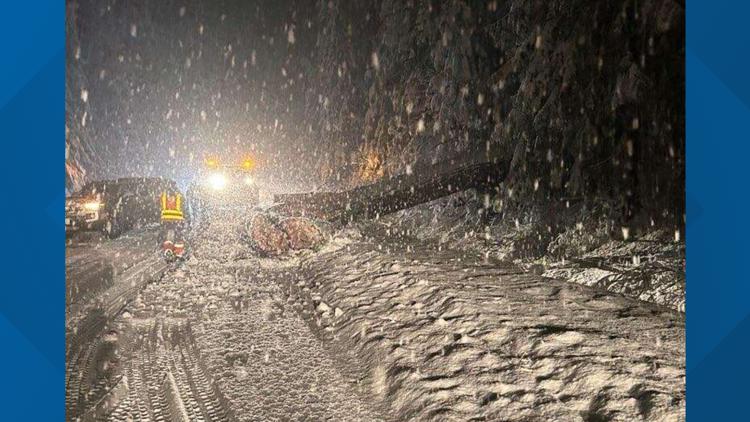
Closures on SR 900 and SR 410 due to fallen timber indicate a secondary layer of infrastructure fragility. Heavy, wet snow loading triggers localized failures that dilute maintenance resources, as specialized clearing crews are diverted from primary highways to resolve peripheral blockages. These incidents isolate smaller communities and complicate the regional bypass network, forcing vehicles back into the congested I-5 and I-405 urban core.
Regulatory Triggers and Economic Friction
The issuance of a Blizzard Warning serves as a high-level regulatory trigger, shifting agency posture from proactive maintenance to reactive emergency management. While the mandate for tire chains on I-90 is a critical enforcement mechanism, its efficacy is frequently undermined by non-compliance, leading to the multi-vehicle incidents that necessitated the Wednesday shutdown.
This paralysis introduces significant friction into just-in-time delivery models. Freight carriers operating between the Port of Seattle and inland hubs face compounding delays that disrupt labor schedules and fuel efficiency. While the 5 p.m. reopening suggests successful incident recovery, the residual backlog ensures that the economic ripple effects persist well into subsequent operational cycles.
Conclusion: Institutional Resilience and Future Policy
The synchronization of these closures serves as a case study in the limits of current infrastructure resilience. While rapid reopening demonstrates institutional competence in recovery, the lack of viable, all-weather redundancy remains a strategic liability. Future policy must address vegetation management and automated hazard detection to ensure the continuity of commerce across the Pacific Northwest when primary corridors fail.