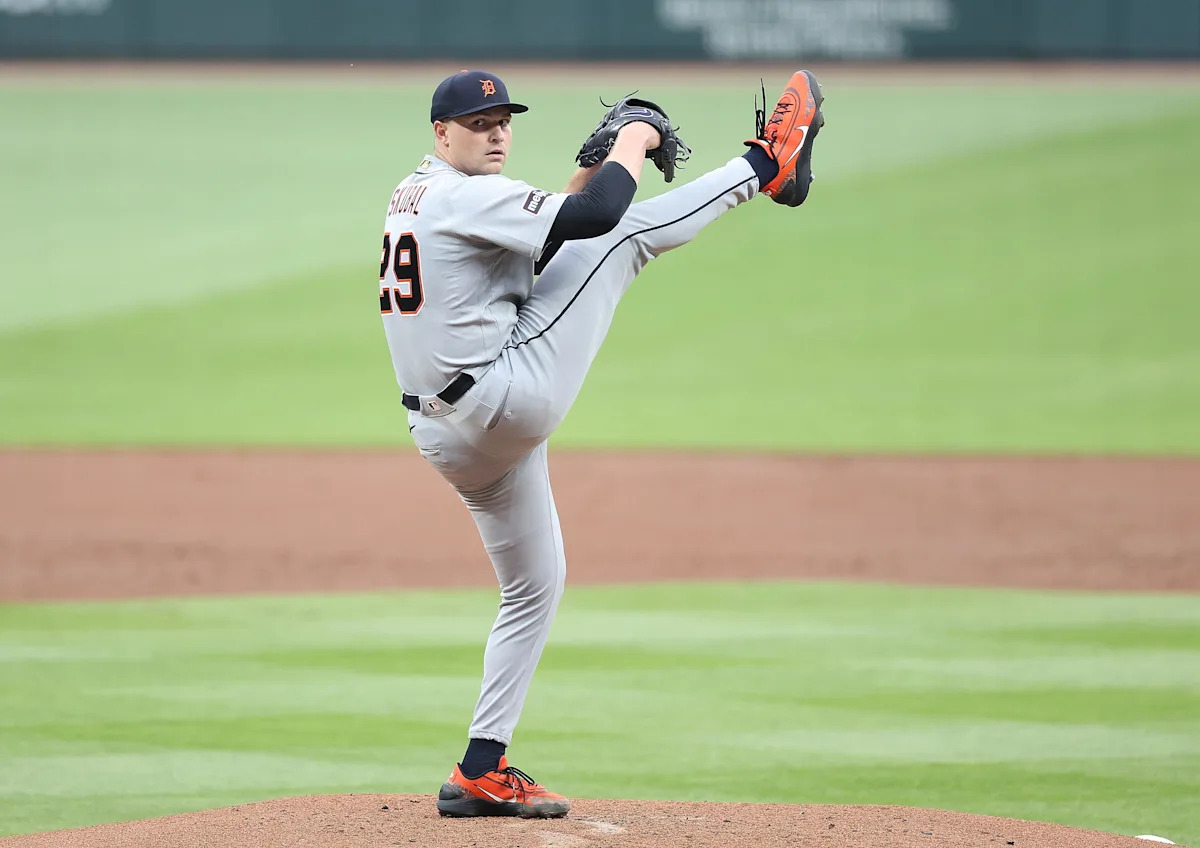
The Detroit Tigers’ 2026 competitive architecture suffered a structural fracture on Monday with the announcement that two-time American League Cy Young winner Tarik Skubal requires elbow surgery. This medical intervention necessitated an immediate scratch from his scheduled start against the Boston Red Sox, fundamentally devaluing the Tigers’ rotation and forcing an emergency tactical recalibration at Comerica Park.
The Operational Shift: From Workhorse to Bullpen Committee
The removal of a premier left-handed starter creates an immediate resource vacuum. Manager A.J. Hinch has pivoted to a high-leverage bullpen strategy, tapping Tyler Holton (5.27 ERA, 0-1) to initiate a collective relief effort. This transition replaces a ‘quality start’ model with a series of fragmented matchups, placing immense strain on a Detroit pitching staff that has recently limited opponents to two or fewer runs in 75% of their last four outings.
For Boston, Skubal’s absence removes a significant statistical barrier. Skubal’s historical dominance over the Red Sox—notably a ten-strikeout clinic at Fenway—served as a psychological deterrent. Without his high-velocity precision, a struggling Boston offense (averaging just 1.6 runs over six games) gains a vital window for regression toward the mean.
Market Volatility and WAR Valuation
The betting markets mirrored this personnel crisis with aggressive corrections. Originally heavy favorites, Detroit’s odds collapsed to -109, while Boston moved to -110. This flip quantifies Skubal’s individual Wins Above Replacement (WAR) value; predictive models, including 10,000 simulations from SportsLine, indicate that removing an ace of Skubal’s caliber effectively neutralizes Detroit’s home-field advantage.
The total line, set at 8, now serves as a metric for the perceived vulnerability of Holton’s 5.27 ERA versus the Red Sox’s offensive stagnation. Investors are currently weighing Detroit’s defensive momentum against the statistical risk of an overextended bullpen.
Boston’s Offensive Crisis and Strategic Leverage
The Red Sox (13-21) enter this series under heightened regional scrutiny following the conclusion of the Celtics and Bruins seasons. Their severe run-production drought has rendered competent pitching moot, resulting in five losses in their last six contests. The strategic mandate for Boston is to exploit Detroit’s emergency pitching configuration to reset their offensive rhythm.
Sophomore lefty Payton Tolle (3.38 ERA) represents Boston’s primary stabilization asset. While he holds an 0-1 record, his underlying metrics suggest a reliability that could disrupt Detroit’s recent 4-1 run if supported by league-average run support. This matchup is a diagnostic test of whether Boston can capitalize on a depleted opponent or if their roster construction is fundamentally flawed.
Long-Term Institutional Implications
Skubal’s surgery introduces a period of asset depreciation for Detroit. As a cornerstone of the franchise’s market valuation, his health dictates the Tigers’ competitive window. Conversely, the Tigers’ ability to maintain an 18-17 record without their ace depends on offensive contributions from Spencer Torkelson, whose sixth home run recently signaled a potential power surge.
Ultimately, the May 4th opener is a test of organizational depth. Detroit must prove their system can mitigate the loss of elite raw talent through analytical matchups, while Boston must prove its core can leverage a situational advantage to exit a season-defining slump.