Legislative Prioritization: Access Over Immediacy
The protracted tabulation timeline of the 2026 California primary is not an administrative failure but a structural byproduct of a legislative framework designed to maximize the franchise. By statutory mandate, California accepts ballots postmarked by Election Day that arrive within seven days, effectively transforming a singular event into a multi-week rolling window. This policy prioritizes demographic inclusivity over the speed of certification, creating an inherent lag that complicates the traditional ‘Election Night’ narrative.
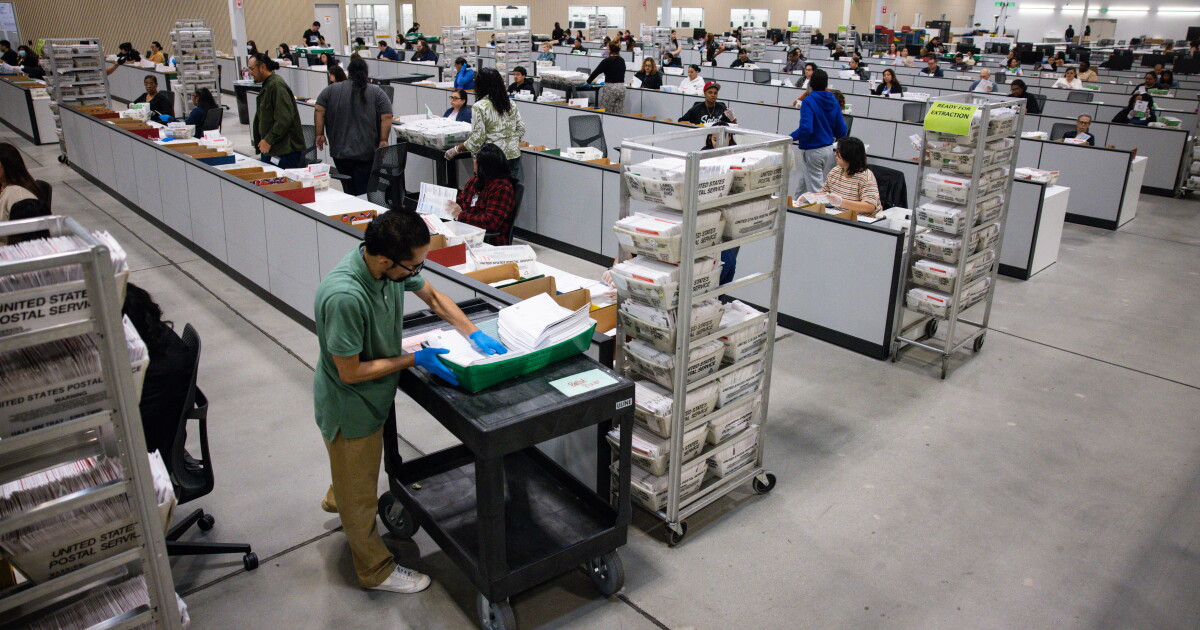
The operational burden of this system falls on county registrars who must execute rigorous, multi-stage verification protocols. From signature matching to curing defective ballots, the labor-intensive nature of paper-based processing ensures accuracy at the cost of temporal efficiency. In a digital-first information environment, this physical requirement creates a ‘transparency gap’ that partisan actors frequently exploit.
Strategic Deadlock and National Implications
California’s sluggish reporting has immediate consequences for national governance. Because the state houses a significant concentration of competitive U.S. House districts, the balance of power in Washington often remains in a state of suspended animation for weeks. This uncertainty prevents national parties from finalizing leadership structures and delays the transition of power, forcing campaigns to maintain high resource burn rates long after the polls have closed.
For the gubernatorial primary, the delay disrupts the typical ‘pivot’ to the general election. Nominees are unable to consolidate donor bases or formalize statewide strategy while results remain in flux. This vacuum of certainty often yields to speculative narratives that can preemptively delegitimize the eventual winner, especially when late-arriving ballots significantly shift the initial margins.
The ‘Blue Shift’ Phenomenon: The Raman-Pratt Case Study
A persistent trend in California’s electoral data is the ‘Blue Shift’—a progressive tilt in late-counted mail-in ballots. This was exemplified in the 2026 Los Angeles mayoral primary. Initial returns favored Spencer Pratt, whose early lead was bolstered by older, in-person voters. However, as 140,000 outstanding mail-in ballots were processed, City Councilmember Nithya Raman saw a steady increase in vote share.
This reversal is a predictable outcome of voting behavior: younger, urban, and more progressive cohorts tend to utilize the full extent of the mail-in window. Raman’s eventual qualification for the November runoff against Karen Bass underscores the volatility of early data points. In California’s model, the most decisive demographic data is frequently the last to be recorded, creating a perception of ‘flipped’ results that are, in reality, merely complete results.
Institutional Trust and Regional Bottlenecks
The intersection of slow counts and a national climate of election denialism presents a significant risk to institutional stability. High-level rhetoric questioning delayed results transforms technical administrative tasks into flashpoints for conspiracy. Democratic strategists face a paradox: the very laws designed to empower voters provide the fertile ground for skepticism regarding the count’s integrity.
Operational bottlenecks in high-population centers like Orange County—which managed over 92,000 uncounted ballots in 2026—exacerbate this issue. The fragmented reporting landscape, where rural counties finish days before urban hubs, creates a skewed perception of statewide trends. Addressing this requires either a massive investment in automated processing technology or a cultural shift in voter expectations, as the state’s commitment to paper-based security remains non-negotiable.