Creative Pedigree and Platform Retention Strategies
Netflix’s ‘Mating Season’ arrives as a calculated expansion of the platform’s mature animation portfolio. Developed by Mark Levin and Jennifer Flackett—the creative minds behind the critically acclaimed ‘Big Mouth’—the series represents a deliberate effort to retain an established viewer demographic. By leveraging known creative capital, Netflix mitigates the financial risks inherent in launching original IPs, capitalizing on existing audience familiarity with Levin and Flackett’s signature blend of transgressive humor and psychological candor.
Anthropomorphic Allegory and Psychosexual Dynamics
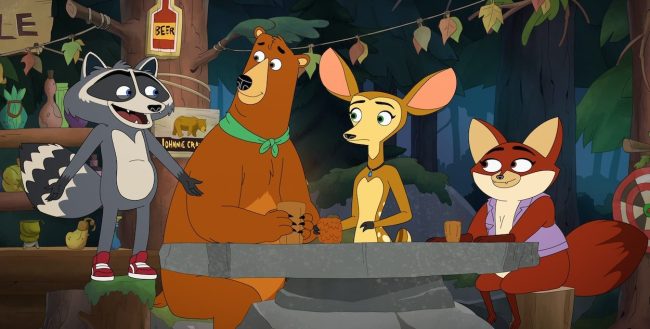
The core premise of ‘Mating Season’ utilizes a diverse ensemble of anthropomorphic animals to anatomize contemporary human relationships. This structural device serves as a psychological buffer, allowing the narrative to explore complex, taboo-adjacent themes without the immediate alienation often triggered by live-action equivalents. The character roster is highly stratified to reflect distinct relational pathologies:
- Josh the Bear: Represents romantic inertia and avoidance, with his narrative arc catalyzed by losing a partner due to his literal and metaphorical hibernation.
- Penelope the Fox: Explores the social anxieties of modern dating, specifically detailing the communicative hurdles of a lesbian fox navigating courtship.
- Fawn the Doe: Anchors the narrative in complicated generational trauma, balancing complex family dynamics with fraught sexual choices.
- Ray the Raccoon: Embodies compulsive philandering and intimacy avoidance, illustrating the destructive patterns of perpetual non-commitment.
By translating these domestic anxieties into animalistic behavior, the series achieves an allegorical distance that makes raw psychological struggles highly palatable and humorously acute.
Meta-Streaming and Intertextual Irony
A defining narrative mechanism of ‘Mating Season’ is its sophisticated self-referentiality, epitomized by the show-within-a-show parody, ‘Big Mouse,’ airing on the fictional platform ‘Mice-flix.’ This segment features a rodent Hormone Monster tempting a mouse character, directly referencing the structural mechanics of ‘Big Mouth.’ By staging a meta-commentary where characters react to ‘Big Mouse’ with visceral disgust, Levin and Flackett construct a satirical hall of mirrors. This double-loop learning invites the viewer to audit their own consumption habits, preempting external moral panic by integrating critical pushback directly into the text.
The Portfolio Challenge: Balancing Continuity and Redundancy
Early industry critiques highlighting that the series is simultaneously “too much and too little like ‘Big Mouth'” expose a classic portfolio-management dilemma. Streaming platforms must strike a delicate equilibrium between brand consistency (which secures core fanbases) and creative redundancy (which induces IP fatigue). If ‘Mating Season’ leans too heavily on its pedigree, it risks being dismissed as a cosmetic reskinning of ‘Big Mouth’; if it diverges too radically, it risks alienating the legacy audience. Striking this balance is crucial for long-term viability in an increasingly saturated streaming ecosystem.
Market Segmentation in the Streaming Era
From an industrial standpoint, ‘Mating Season’ represents an aggressive defense of Netflix’s market share in the adult animation vertical. As competitors expand their own mature animated offerings, Netflix relies on specialized, high-yield niches. The series’ deliberate identification as a “witty, sleazy, and extraordinarily dark comedy” positions it to capture high-engagement demographics. Ultimately, its success will be measured not merely by raw viewership metrics, but by its capacity to minimize churn and cultivate organic digital discourse around its polarizing themes.