Strategic Leverage and Asymmetric Playoff Pursuits
The San Jose Sharks and Ottawa Senators meet at a critical juncture where developmental milestones intersect with immediate postseason desperation. While operating on divergent rebuild timelines, both clubs face high-stakes mathematical pressures. San Jose occupies a precarious position, holding a one-point lead for the Western Conference’s second wildcard spot. Their 32-26-6 record indicates stability but masks a razor-thin margin for error against surging Seattle and Los Angeles units.
Conversely, the Ottawa Senators face a steep climb in the Eastern Conference. Despite a respectable .577 points percentage—which would place them comfortably in the Western postseason bracket—they trail Detroit and Boston by five points. This conference-wide disparity necessitates a maximum-point acquisition strategy during this home stand, particularly before high-leverage head-to-head matchups with Atlantic Division rivals.
Offensive Architecture: The Celebrini-Smith Synergy
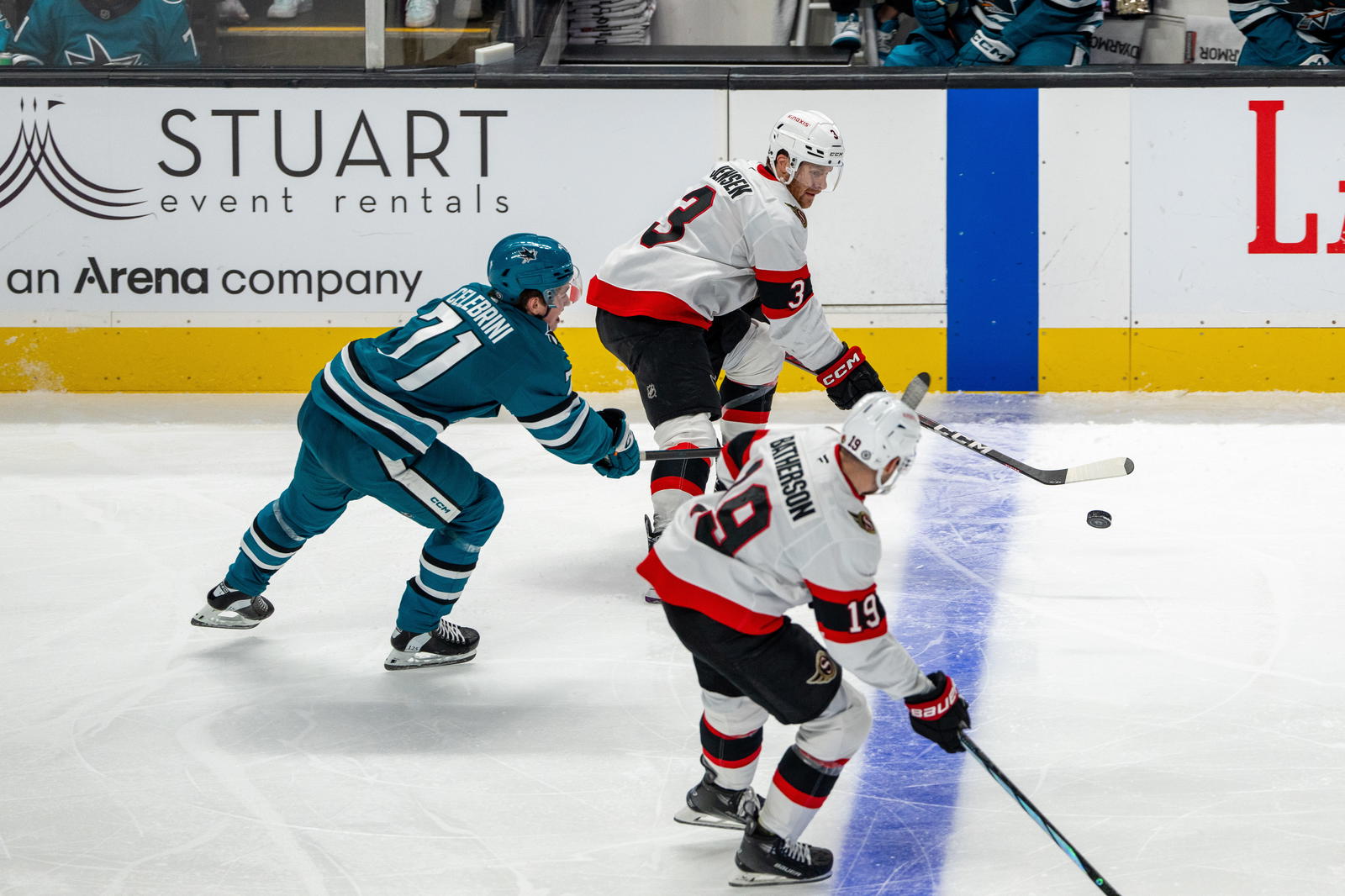
The spotlight centers on Macklin Celebrini’s performance in Ottawa, serving as a primary metric for San Jose’s long-term roster architecture. Deploying Celebrini on the top line alongside Collin Graf and Will Smith represents a calculated risk by the Sharks’ coaching staff, prioritizing chemistry and high-leverage exposure for their most valuable assets. This rookie-centric line challenges Ottawa’s defensive structure with elite playmaking and transitional speed.
Ottawa counters with the veteran-led efficiency of Tim Stutzle, Drake Batherson, and Claude Giroux. Statistical data suggests this combination is one of the league’s most potent transitional threats. Batherson, specifically, sees a significant spike in high-danger assist rates when paired with Stutzle’s zone-entry capabilities, creating a tactical mismatch for a Sharks defense that often struggles with gap control.
Defensive Metrics and Goaltending Variables
San Jose’s primary structural vulnerability remains their league-worst shot suppression, currently ranking 31st in shots allowed per game. This defensive porosity provides a tactical invitation for high-volume shooters like Stutzle, who averages 4.1 shots per game on home ice against bottom-tier suppression units. To mitigate this, Sharks defenders Dmitry Orlov and John Klingberg must prioritize zone exit efficiency to prevent sustained offensive cycles by Ottawa’s heavy bottom-six, featuring Brady Tkachuk and Dylan Cozens.
Goaltending rotations introduce a volatile operational variable. The recall of Laurent Brossoit from the AHL places immense pressure on a goaltender who hasn’t seen NHL action since April 2024. If Brossoit starts, his rebound management will be under intense scrutiny against an Ottawa team that excels at crashing the crease. In contrast, Linus Ullmark provides Ottawa with elite-level stability, fresh off a 23-save shutout, allowing the Senators to maintain an aggressive offensive pinch with reduced risk of catastrophic transition goals.
Institutional and Financial Stakes
Beyond tactical execution, this matchup serves as a commercial litmus test. The presence of Macklin Celebrini in a Canadian market drives broadcast engagement for partners like TSN5 and RDS, while Ottawa’s ability to remain in the playoff hunt is vital for home-gate revenue and season-ticket retention. For San Jose, these games validate a high-risk rebuilding strategy, proving the organization can integrate elite prospects while remaining competitive in the Northern California sports market.