The Boston Celtics’ developmental blueprint for Dillon Mitchell is a precise exercise in modern NBA optimization. By imposing an explicit mandate for perimeter volume, the organization is attempting to solve the geometric limitations that historically constrained the wing’s elite physical tools. This strategic pivot is designed to transform Mitchell from a situational transition threat into a foundational floor-spacer for the Celtics’ five-out offensive architecture.
Mitchell, a second-round selection in the 2026 draft, entered the professional ranks with a profile defined by defensive elasticity and high-motor rebounding, yet hindered by a negligible shooting volume. His collegiate tenure at St. John’s—marked by a single successful three-pointer in his senior season—suggested a non-viable floor-spacing threat. However, the Celtics’ coaching staff, led by player development specialist Craig Luschenat, has prioritized mechanical consistency and psychological assertiveness to override this historical hesitation.
The Calculus of Perimeter Gravity
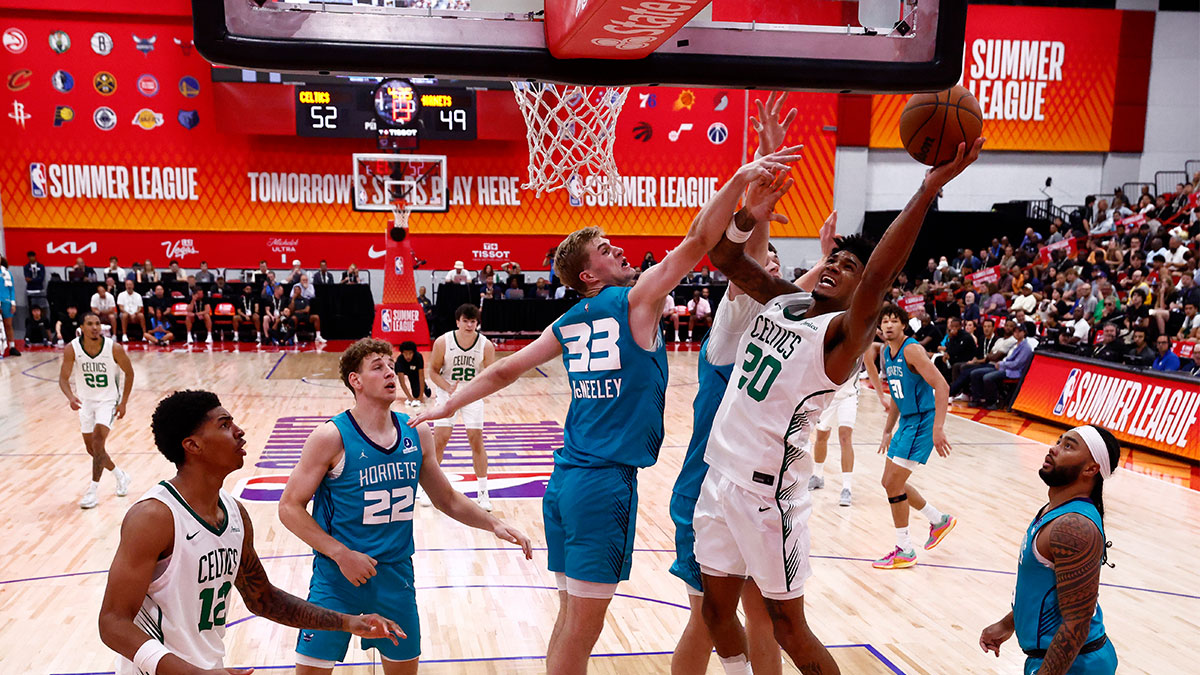
The instruction for Mitchell to “fire away” is a tactical necessity rather than a mere confidence exercise. In the Celtics’ system, a wing who cannot threaten the arc creates a defensive focal point that allows opponents to collapse the paint and neutralize primary creators. During the Celtics’ 87-75 victory over the Charlotte Hornets, this developmental theory was stress-tested against 7-foot-1 center Ryan Kalkbrenner.
Kalkbrenner’s initial defensive drop—a common strategy to dare non-shooters into low-efficiency attempts—was rendered ineffective as Mitchell converted two of five attempts from distance. This single-game output doubled his entire senior season production, providing a proof of concept for his offensive ceiling. By punishing sagging defenders, Mitchell forces defensive re-alignment, creating the requisite spacing for Boston’s drive-and-kick sequences.
Operational Efficiency and Psychological Load
The “green light” provided by the coaching staff serves to reduce the cognitive load on Mitchell, allowing him to bypass the internal deliberation that often plagues young non-shooters. This institutional permission was the catalyst for Mitchell’s 24-point, eight-rebound, six-steal performance against Charlotte. The shift from his hesitant Summer League debut against Toronto to this assertive display underscores the efficacy of clear developmental directives.
From a roster-building perspective, Mitchell’s evolution into a respectable shooter represents significant cap-efficient value. As the Celtics navigate a veteran-heavy salary cap, securing a versatile 3-and-D wing on a rookie-scale contract is a strategic imperative. Mitchell’s defensive versatility—demonstrated by his six steals and two blocks—already provides a high floor; the perimeter shot simply determines his ultimate ceiling within the rotation.
Defensive Multi-Functionality as a Safety Net
While the shooting narrative dominates the headlines, Mitchell’s established defensive instincts remain his primary value proposition. His ability to disrupt passing lanes and provide secondary rim protection aligns with Boston’s organizational preference for switchable, multi-positional defenders. Furthermore, his relentless pursuit of offensive rebounds (seven of his eight boards against Charlotte) ensures he remains a net-positive contributor even during cold shooting stretches.
The tactical battle in Las Vegas serves as a laboratory for Mitchell’s adaptation. The 13-point advantage Boston maintained during his 29 minutes on the floor suggests his presence enhances team efficiency. As the Celtics continue to prioritize long-term structural improvement over short-term results, Mitchell’s progress will be measured not just by shooting percentages, but by his ability to maintain defensive intensity while expanding his offensive gravity.
Institutional Risk and Projected Growth
The primary developmental hurdle remains Mitchell’s 49.4% collegiate free-throw average, often a leading indicator of mechanical volatility. However, the Celtics’ commitment to this high-volume experiment indicates a belief that these issues are correctable through professional-grade intervention. If Mitchell maintains this trajectory, he becomes a viable, low-cost replacement for more expensive rotation players in future seasons.
Ultimately, the Mitchell experiment reflects a broader trend in NBA asset management: identifying high-ceiling athletes and aggressively correcting a singular, defining flaw. For the Celtics, the early returns suggest their second-round investment may yield a substantial strategic dividend, reinforcing their status as a premier destination for player development.