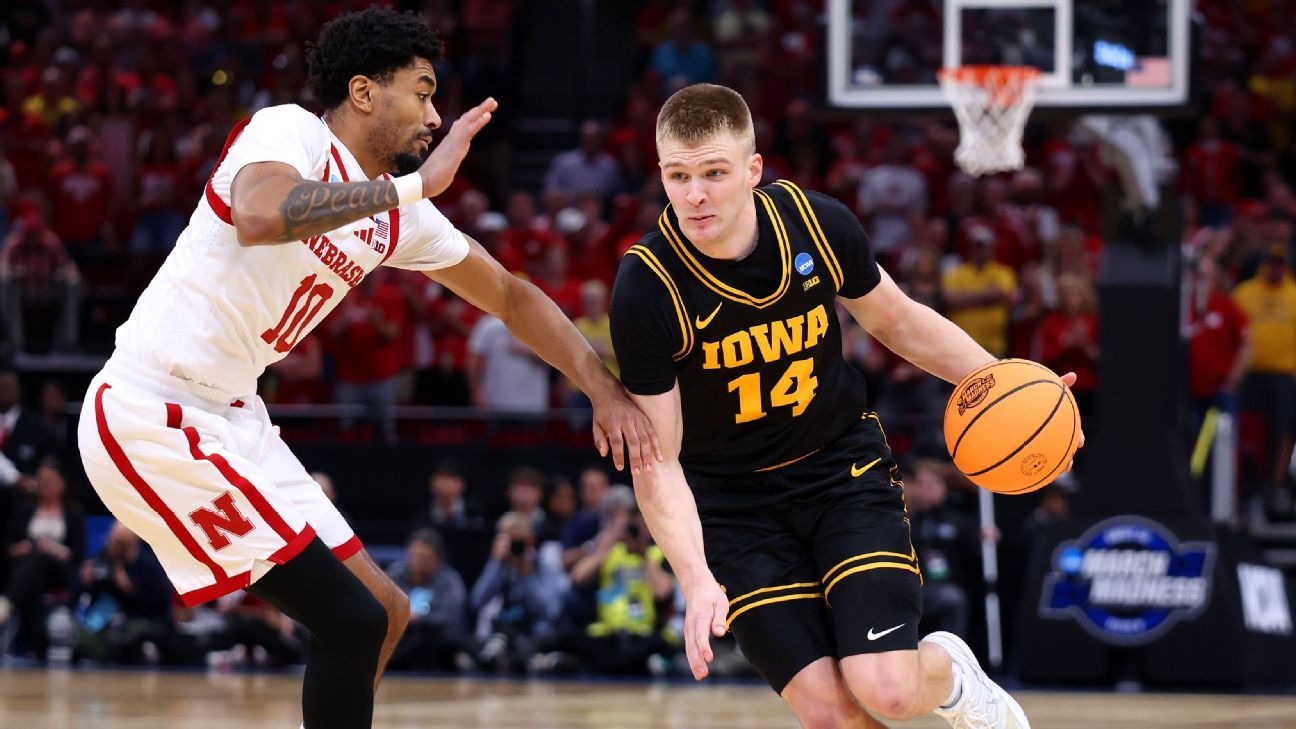
The Iowa Hawkeyes’ advancement to the Elite Eight, clinched by defeating No. 4 seed Nebraska 77-71 in the South Region semifinal, represents a profound inflection point, primarily due to their low ninth-seed positioning.
This result culminates Iowa’s first regional final appearance since 1987, fundamentally recalibrating performance benchmarks under first-year head coach Ben McCollum.
Quantitative Analysis: Performance Leverage Over Seeding Stratification
Iowa’s path—eliminating the No. 8 seed Clemson, No. 1 seed Florida, and No. 4 seed Nebraska—demonstrates exceptional competitive leverage against perceived seeding superiority. This indicates a strategic scheme highly effective at neutralizing higher-ranked opponents.
Key moments, such as Alvaro Folgueiras’s critical conversion against a four-defender alignment in the Nebraska game, underscore operational precision under duress, yielding disproportionate returns in high-leverage tournament scenarios.
The simultaneous peak performance of key contributors—Bennett Stirtz (20 points) and Folgueiras (16 points) against Nebraska—was a necessary condition for this level of deep tournament advancement from a lower seed.
McCollum’s established success securing four DII National Titles at Northwest Missouri State provides context for this rapid D1 translation, bypassing the typical multi-year integration curve seen in coaching transitions.
As the lowest-seeded Big Ten team to reach a regional final since 1979 seeding, this achievement transcends standard conference metrics, implying systemic tactical advantage over pure recruiting pedigree compared to Big Ten elite peers.
Intra-Conference Dynamics and Volatility Exposure
The immediate trajectory leads to a Final Four contest against Big Ten rival Illinois. This forces a direct system confrontation where prior seeding disparities are nullified by recent, intimate tactical familiarity.
Navigating both the Sweet 16 and Elite Eight against conference foes (a feat last seen by Kentucky in 1986) exposes the inherent volatility when conference play parity translates to single-elimination pressure.
Iowa’s success validates the competitive depth within the Big Ten structure, simultaneously exposing the vulnerability of higher-seeded conference members against motivated, lower-seeded intra-conference challengers.
Crucially, the team’s 7-1 record on neutral courts suggests superior strategic preparation mitigating environmental adjustments, a key indicator for sustained postseason viability.
Achieving 24 total wins ties for the fifth-most in program history, meaning this single tournament run has significantly elevated the season’s overall performance profile beyond typical historical expectations for the Hawkeyes.
Institutional Capital Revaluation and Narrative Control
McCollum’s deliberate rejection of the ‘Cinderella’ label signifies an institutional effort to shift the narrative from underdog status to validated competitive achievement, impacting stakeholder perception immediately.
This performance directly influences institutional capital allocation decisions, likely increasing budgetary flexibility for coaching retention, facility modernization, and recruiting infrastructure investment.
The victory over Florida, secured by Folgueiras’s late three-pointer, serves as potent recruiting evidence, showcasing the tangible ceiling achievable within the current operational structure to prospective athletes.
Nebraska’s inability to maintain their early 10-point lead exposed critical vulnerabilities in execution consistency against sustained pressure during high-stakes regional semifinals.
Operational Resilience in Closing Sequences
The sequence where Iowa erased deficits, tying the score four times before Stirtz’s go-ahead three-pointer at 68-65 (2:10 remaining), illustrates superior psychological and operational resilience.
This late-game command contrasts sharply with the initial deficit, suggesting a refined capacity for in-game adjustments and motivational maintenance throughout the contest’s critical final five minutes.
The subsequent 9-0 offensive surge, capped by Tate Sage’s shot, denotes an efficiency spike precisely when Nebraska’s defensive structure fractured under the pressure of the lead reversal.
This pattern of overcoming early deficits to dominate the close suggests a coaching emphasis on conditioning and late-game tactical deployment that proved superior to Nebraska’s closing capacity.
Historical Context and Statistical Anomalies
Iowa stands as only the sixth No. 9 seed in history to reach the Elite Eight, establishing a significant statistical anomaly requiring deeper examination of the underlying metrics that produced their seeding relative to their demonstrated output.
This anomaly suggests traditional ranking methodologies may have systematically undervalued the team’s knockout-stage potential, possibly due to regular-season variance or conservative strength-of-schedule weighting.
The pursuit of the Final Four, last achieved in 1980, underscores the magnitude of this breakthrough; a multi-decade gap between Elite Eight appearances signifies a prolonged period of performance stagnation relative to institutional capacity.
Bridging this gap immediately contrasts with standard multi-year rebuilding cycles common in major conference leadership transitions.
The financial acceleration—increased media revenue sharing, enhanced alumni engagement, and recruiting leverage—makes this run an immediate capital accelerator for the athletic enterprise.
The core challenge is translating this singular, high-leverage tournament output into sustained, year-over-year competitive relevance, necessitating administrative alignment with McCollum’s strategic vision.
The tactical adaptability demonstrated against three consecutive higher seeds must be institutionalized to counter future scouting reports designed to specifically counter the Hawkeyes’ current blueprint.
The narrative tension between embracing the ‘Cinderella’ status while asserting established stature defines the required strategic messaging for the offseason and the subsequent competitive cycle.
Securing three wins over higher seeds confirms that the margin in their regular-season metrics was likely narrower than the final seeding suggested, pointing toward prior systemic underperformance before bracket release.
The late-game operational efficiency, particularly the 9-0 closing run, implies superior command over clock management and foul strategy compared to defeated opponents.
This execution level under duress is difficult to replicate consistently and will be the focal point for opposing scouting departments.
While the 1980s Final Four benchmark is distant, the current landscape (transfer portal, NIL) renders direct comparison strategically irrelevant for modern planning.
The immediate focus remains the Illinois matchup: a critical test of whether Iowa’s advantage is temporary variance or the foundation of McCollum’s sustainable competitive model.
The 7-1 neutral court performance is a key metric confirming success is not contingent on home-court advantages, de-risking future high-stakes neutral-site matchups.