Top-10 SEC Stakes in Oxford: Lane Kiffin’s Return
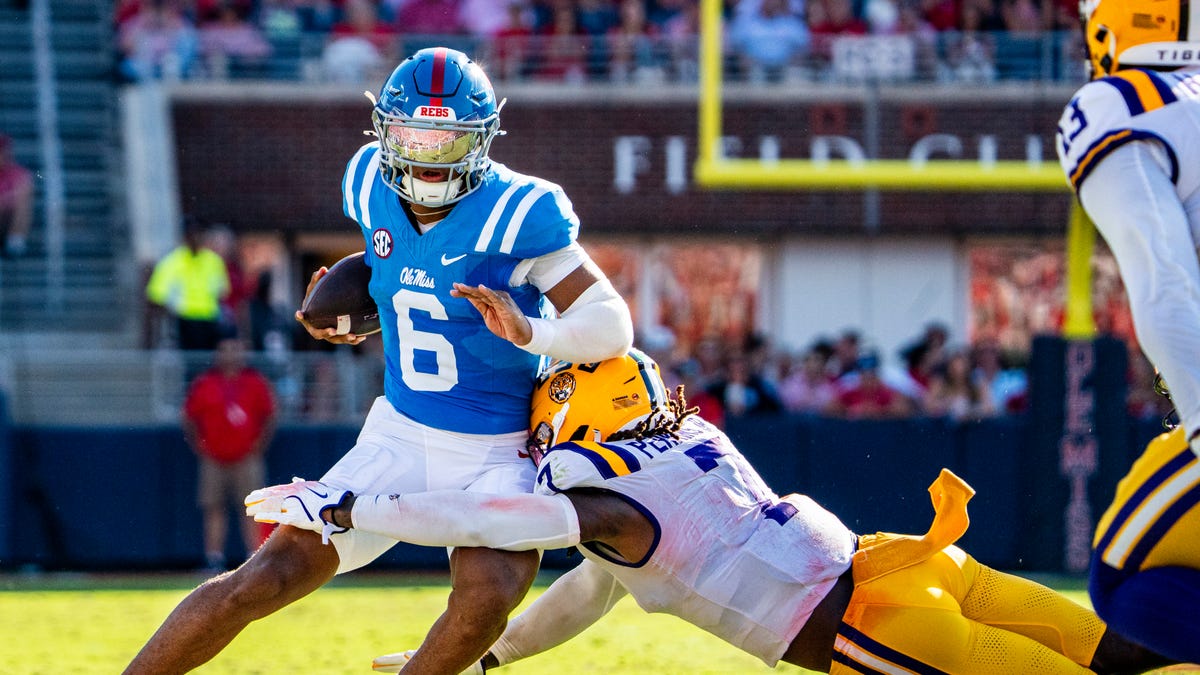
The first top-ten encounter of the 2026 college football season takes place at Vaught-Hemingway Stadium, where No. 7 LSU visits No. 8 Ole Miss as a three-point road favorite. Beyond immediate Southeastern Conference hierarchy and expanded College Football Playoff seeding leverage, the matchup features acute organizational subtext: head coach Lane Kiffin returns to Oxford following his November 2025 departure for Baton Rouge after six seasons leading the Rebels. The resultant schematic familiarity between Kiffin’s staff and Ole Miss’s core roster establishes high-level tactical friction from the opening snap.
Securing an early intra-conference victory provides critical insulation against late-autumn tiebreaker volatility. While the 12-team playoff structure ensures that a Week 3 setback does not eliminate either program from at-large contention, the victor secures immediate mathematical positioning inside the SEC race and avoids reliance on committee deliberations.
Tactical Matchup, Historical Trends, and Injury Clarity
Historical trends in this series heavily favor the home sideline. The hosting program has won each of the last six head-to-head meetings, creating an empirical headwind against LSU’s designation as road chalk. Winning in Oxford requires defensive communication discipline to manage hostile cadence environments alongside sustained red-zone touchdown conversion efficiency.
LSU’s operational ceiling received a significant boost with quarterback Sam Leavitt’s formal removal from the program’s injury report. Previously listed as doubtful, Leavitt’s full clearance stabilizes play-calling continuity and prevents reliance on unproven backfield depth in a hostile road venue. Oddsmakers responded by cementing LSU at -3, pricing in a one-possession expectation governed by drive finishing and fourth-quarter clock management.
Quantitative Modeling and Week 3 Market Context
Predictive simulation platforms highlight technical variance across the broader Week 3 slate. SportsLine’s proprietary engine—which models each FBS game across 10,000 algorithmic iterations and holds a 33-21 record on premier selections—identifies quantitative edges on underdogs such as Michigan State and South Carolina, reflecting structural divergences between automated efficiency ratings and public betting volume.
Secondary prediction markets and liquidity venues have concentrated substantial volume around Oxford. Platforms like Polymarket have deployed user incentives, including promotional trading credits, to capitalize on institutional and retail capital funneled into the schedule’s sole top-ten matchup. Concurrently, streaming platforms such as Fubo utilize trial access models to aggregate viewership around premier linear broadcast inventory, consolidating the game’s footprint as the weekend’s commercial anchor.
SEC Openers, Big Ten Road Tests, and Non-Conference Slate
Week 3 also initiates conference competition across several national contenders featuring pronounced talent differentials:
- SEC: No. 2 Georgia opens its conference slate hosting Arkansas as a 24.5-point favorite, focusing heavily on operational depth and early-season snap management.
- Big Ten: No. 12 USC travels across multiple time zones to face Rutgers as a 21.5-point road favorite, testing roster acclimatization under expanded conference travel demands.
- Interconference Clashes: No. 10 Alabama hosts Florida State (-19.5), while No. 25 Virginia travels to West Virginia as a 10.5-point underdog in high-friction border rivalries that generate critical non-conference comparative data for postseason algorithmic formulas.
Week 2 Precedents and Playoff Trajectories
The urgency in Oxford is sharpened by Week 2’s disruptive outcomes. Texas’s fourth-quarter comeback over Ohio State and Oklahoma State’s decisive upset against Oregon reshaped early-season national projections, proving that early rankings vulnerable to dynamic game-script shifts. Meanwhile, disciplined finishes like Iowa’s narrow victory over Iowa State set an operational baseline devoid of regulatory or late-game administrative disputes.
For LSU, an away victory validates the administrative investment behind Kiffin’s hire and clears a direct path toward the SEC Championship Game. For Ole Miss, defending home turf protects the foundation established under Kiffin while dealing an immediate blow to a division rival. The outcome at Vaught-Hemingway Stadium will serve as an anchor point for conference power ratings through the remainder of the 2026 season.