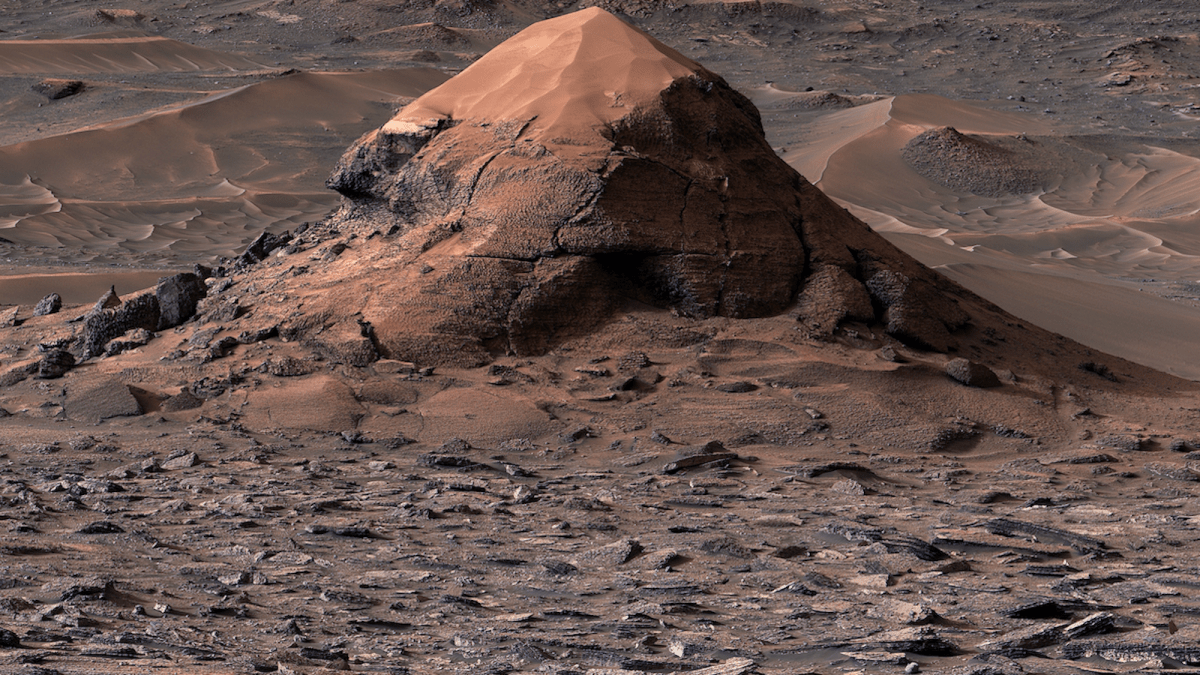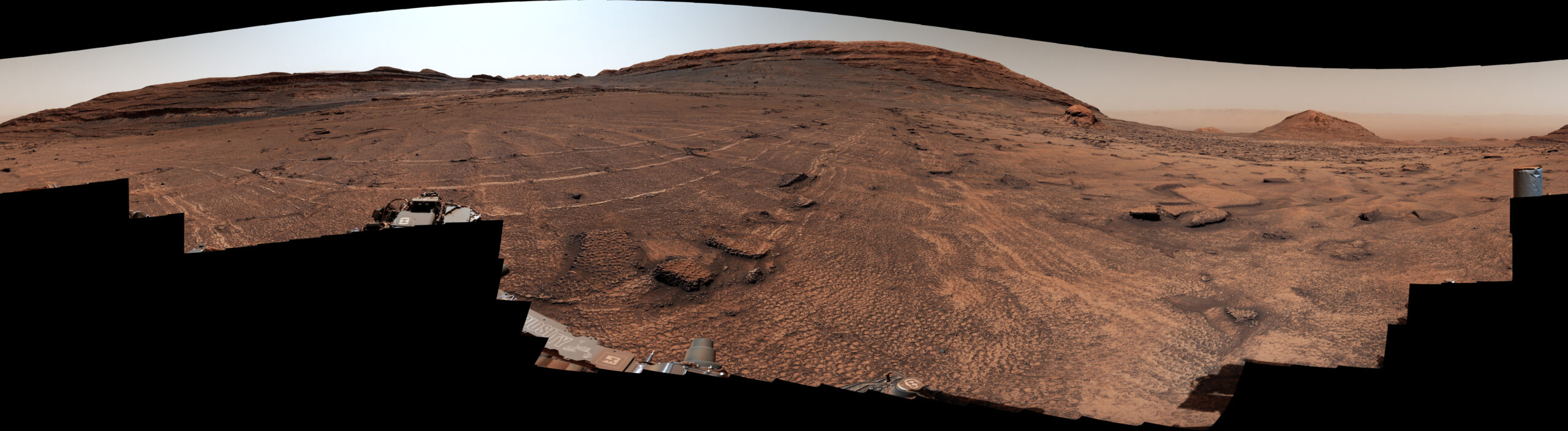
NASA’s Curiosity rover has documented an unprecedented expanse of honeycomb-like textures within Valle Grande, a Martian valley. Captured on Sols 4,930 and 4,931, a 360-degree panorama reveals geometric polygonal fractures measuring 1.5 to 3 inches across, spreading around a 20-foot sandstone-capped butte named Miraflores.
While mission scientists have previously identified isolated patches of similar geometric shapes, the scale of the Valle Grande discovery surpasses prior observations. Project scientist Ashwin Vasavada of the Jet Propulsion Laboratory noted that the magnitude and distribution surprised the team. Researchers are currently analyzing dimensional metrics and associated chemistry to pinpoint the exact geological drivers.
Hydrological Context on Mount Sharp
Curiosity has spent nearly fifteen years ascending the lower slopes of Mount Sharp within Gale Crater. Although the modern Martian environment is arid and frigid, geological data confirms these foothill regions hosted active waterways billions of years ago that emptied into a central lake system.
The dense polygonal fracturing within this depositional environment refines models of ancient hydrologic activity and climatic shifts. Planetary geologists are evaluating these fracture networks to reconstruct the precise chronological sequence of regional drying events.
Geological Mechanics and Formation Theories
Analyses indicate multiple potential formation mechanisms under ancient conditions. Similar structures typically form either as fine-grained sediments lose moisture to create desiccated mud cracks, or when internal compressions and thermal fluctuations induce volumetric stress within sediment layers.
The extensive scope of the Valle Grande field requires quantifying precise fracture boundaries to isolate the dominant physical forces at play. These metrics directly support broader institutional objectives regarding the historical presence and persistence of liquid water.
Operational Status and Hardware Longevity
Telemetry highlights the rigorous physical demands placed on the rover, with imagery showing mechanical wear on its mobility system and metal wheels. Navigating abrasive, high-friction terrain requires continuous adjustments by mission controllers to preserve mobility margins.
Managing this hardware degradation while maximizing scientific return remains a central challenge for Jet Propulsion Laboratory engineers. Consequently, the Valle Grande discovery serves simultaneously as a scientific milestone and a benchmark for aging space exploration infrastructure.