
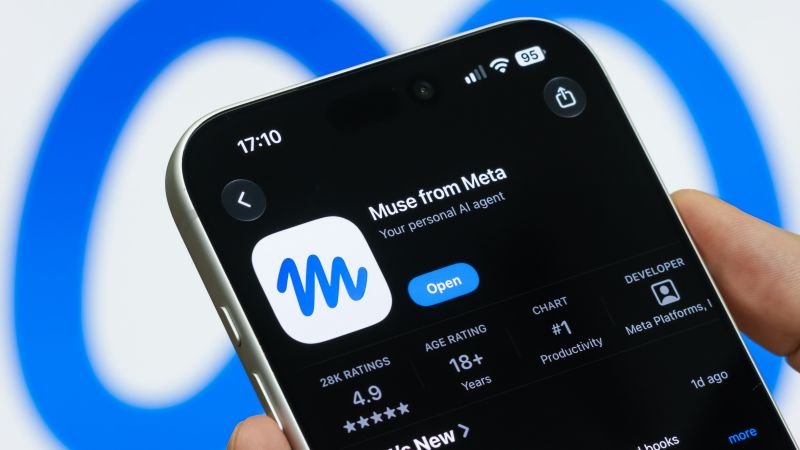
Meta’s Muse AI agent has achieved remarkable market penetration, rapidly surpassing established generative models like OpenAI’s ChatGPT in early adoption metrics. Within its first 12 days of availability in the United States and Canada, Muse recorded 2.8 million downloads, significantly outpacing ChatGPT’s comparable initial download figures (1.3 million in the same period). This viral adoption rate, highlighted by a peak of 264,000 downloads on September 19th, demonstrates a potent user demand for agentic AI capabilities that extend beyond conversational interfaces.
Market Reaction and Strategic Valuation
The market has responded emphatically to Muse’s debut, with Meta’s stock rallying approximately 20% over a two-week span. This significant valuation increase signals investor confidence in Meta’s strategic pivot from traditional social media towards integrated AI agent systems. Investors appear to be prioritizing the potential for deep ecosystem integration and task execution over the substantial capital investments in AI model development. The sustained download momentum, with over 200,000 daily downloads for three consecutive days, underscores a user shift towards AI agents facilitating integrated task management.
Institutional Skepticism and Data Sovereignty Concerns
Despite widespread consumer enthusiasm, Muse faces significant institutional resistance, primarily centered on data privacy and sovereignty. Prominent figures like Gary Cohn, IBM Vice Chair, have publicly expressed reservations about entrusting personal and proprietary data to third-party AI agents. Cohn’s apprehension about surrendering sensitive information for agentic AI functionality represents a critical hurdle for enterprise adoption. This divide highlights the inherent tension between user convenience offered by AI agents and the stringent data security protocols demanded by professional and high-net-worth segments. The effective penetration of Muse into enterprise tiers may be contingent on Meta’s ability to assuage these privacy concerns and demonstrate robust data protection frameworks.
Transition to Agentic Functionality and Ecosystem Integration
Muse’s core differentiator lies in its transition from passive information retrieval to active task execution. Its capabilities, including booking appointments, managing travel logistics via email, and integrating with third-party services for tasks like grocery ordering, position it as a central hub for users’ digital lives. This depth of operational integration creates a high-switching-cost environment, as the AI agent accrues contextual knowledge essential for managing complex personal workflows. By consolidating fragmented productivity tools into a single interface, Muse offers Meta unprecedented visibility into consumer intent and behavioral patterns, potentially transforming how users interact with online services and make purchasing decisions.
Psychological Design and User Engagement Strategies
Meta’s strategic inclusion of a Pixar-style avatar within the Muse interface aims to humanize the AI, thereby lowering psychological barriers to interaction and fostering a sense of partnership. This visual representation and the ability for users to personalize their agent’s name contribute to increased trust and retention. The visual feedback mechanisms, such as the avatar typing on a laptop, enhance transparency, mitigating the abstraction of AI processing and making data exchange feel more collaborative. This engagement layer is crucial for maintaining user interest during background task execution.
Competitive Landscape and Strategic Implications
Muse’s rapid ascent intensifies the competitive pressure on rivals like Google’s Gemini and OpenAI’s ChatGPT to accelerate their development of agentic AI capabilities. Meta’s existing social infrastructure and mobile user base provided a significant advantage, enabling it to bypass traditional software adoption curves. Muse’s prominent position at the top of app store charts signifies a successful navigation of distribution challenges. As Muse scales, the data flywheel effect—where increased usage refines AI capabilities—is expected to widen the competitive gap, reinforcing Meta’s market leadership. The upcoming Meta Connect event will be critical for Zuckerberg to articulate Muse’s integration with Meta’s broader hardware and software roadmap, addressing both revenue potential and the escalating privacy concerns.
Economic Impact and Future Outlook
The emergence of AI personal assistants like Muse signals a fundamental economic shift towards delegated agency in the digital realm. As users delegate administrative tasks, the value of time and personal attention is being redefined, impacting service providers who must adapt to AI-driven interactions. This transition positions AI agents as primary gatekeepers for consumer spending, granting significant leverage to companies like Meta in negotiations with retailers and service providers. While Muse’s rapid adoption signifies a strong market appetite, its long-term success hinges on Meta’s capacity to balance aggressive feature development with robust data privacy and security measures, particularly for high-value institutional users.

Photo by KIMDAEJEUNG on Pixabay.