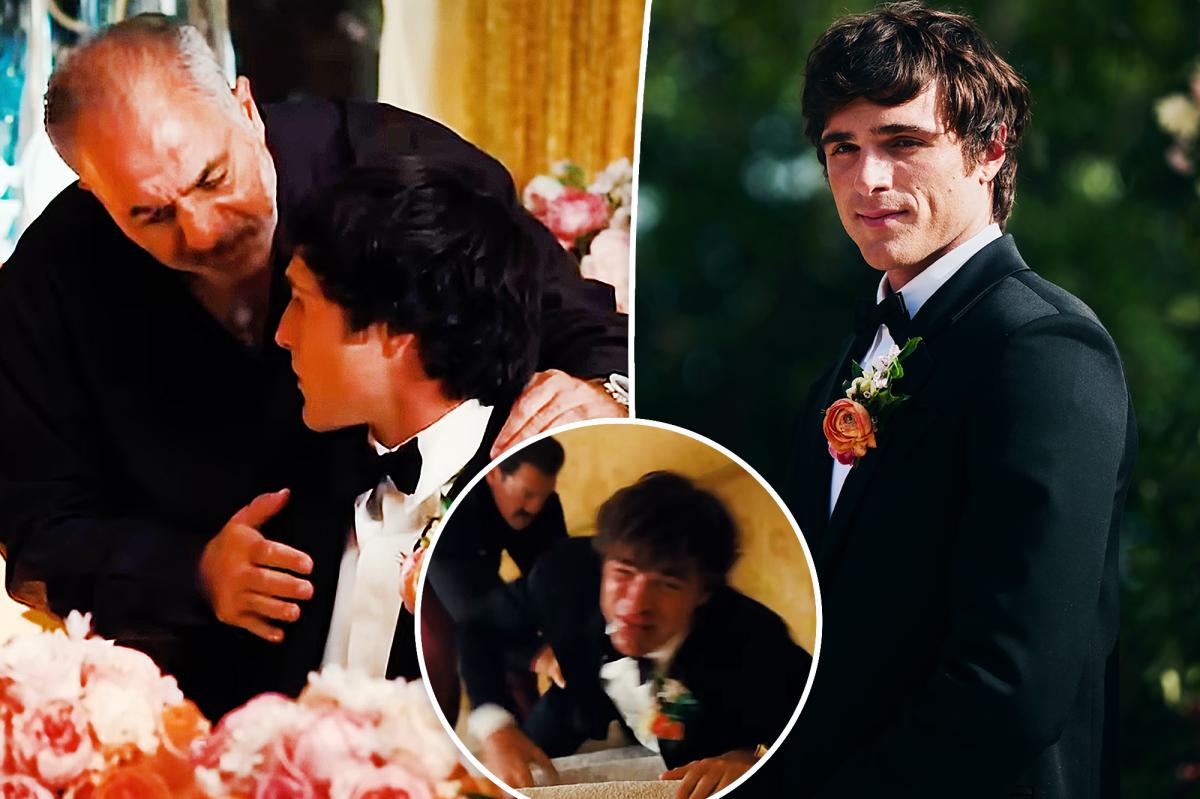
Episode 3 of Euphoria’s third season, “The Ballad of Paladin,” executes a decisive pivot in narrative architecture, transitioning from the insular preoccupations of adolescence to the cold calculus of financial liability and physical consequence. The wedding of Nate Jacobs and Cassie Howard functions as a structural catalyst where long-standing interpersonal frictions converge with external economic pressures, signaling a shift toward a neo-noir framework.
The introduction of Naz, a figure representing a predatory tier of financial enforcement, fundamentally deconstructs Nate Jacobs’ (Jacob Elordi) established persona. The revelation of a debt exceeding $500,000 strips the protagonist of his previous antagonistic agency, repositioning him as a vulnerable asset within an asymmetric power hierarchy. This insolvency introduces an operational risk that transcends the emotional volatility of earlier seasons, suggesting that the private-public divide in the Jacobs family has finally collapsed under the weight of systemic debt.
Semiotics of Fashion and Brand Subversion
Costume design in this episode transcends mere aesthetics to function as psychological warfare. Jules’ choice of a pale blue Acne Studios gown—a composition of sheer mesh and satin bows—serves as a deliberate semiotic disruption of bourgeois wedding decorum. By utilizing a brand synonymous with avant-garde deconstruction, the production reinforces Jules’ refusal to assimilate into traditional social scripts, sparking a meta-discourse on the boundary between ‘iconic’ curation and intentional ‘tacky’ subversion.
Maddy’s ‘revenge dress’ operates as a strategic instrument of social capital, maintaining her dominance even as she moves to the narrative periphery. In contrast, Rue’s refusal to engage in performative attire highlights her role as the detached observer of the escalating social decay. The fashion choices throughout the ceremony reflect a broader cultural critique: the characters are attempting to perform adult milestones while lacking the requisite emotional and economic stability, creating a jarring aesthetic dissonance.
Operational Realism and Genre Transition
The episode’s climax, featuring the visceral maiming of Nate Jacobs, marks the series’ definitive entry into body horror and noir territory. The amputation of Nate’s toe by Naz is not a gratuitous shock tactic but a structural necessity designed to reset the season’s power dynamics. Actor Jack Topalian, portraying Naz, highlighted the technical precision required for the scene, involving custom prosthetics and high-risk cutlery, reflecting the production’s commitment to physical realism in depicting the consequences of delinquency.
This violence materializes the abstract threat of debt, providing a tangible manifestation of Nate’s loss of control. The ‘mindful’ execution of such graphic content underscores the professional discipline required to navigate prestige television’s move toward extreme realism. The scene serves to establish Naz as a credible institutional threat, one that cannot be manipulated through the emotional leverage Nate previously utilized.
Institutional Fragility and Reputational Contagion
The union of Nate and Cassie, far from providing narrative closure, exposes the fragility of their constructed facades. Suze Howard’s psychological intervention during the processional seeds an institutional doubt that permeates the event. Furthermore, the role of secondary characters like Heather (Jessica Blair Herman) suggests that Nate’s financial collapse has triggered a ‘reputational contagion,’ rendering the couple’s social isolation inevitable.
The public nature of the debt reveal ensures that the fallout is not merely fiscal but existential. As the information circulates through their social circles, the couple’s attempt to project a image of domestic stability is rendered absurd. The episode’s conclusion—a tableau of blood and broken promises—confirms that the stakes have evolved: the characters now face life-altering ruin that extends far beyond the social embarrassments of their youth.