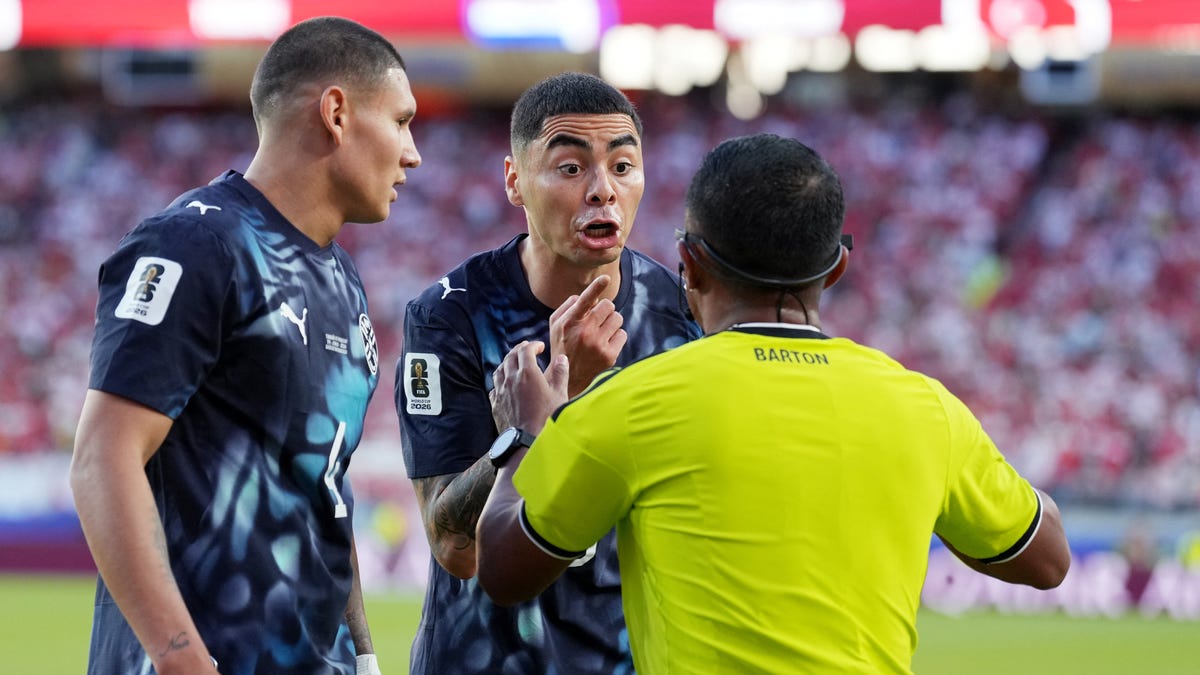
The dismissal of Miguel Almirón during the World Cup Group D fixture between Paraguay and Turkey at Levi’s Stadium represents a watershed moment in the regulatory governance of international football. By applying the recently enacted “Prestianni rule” on a global stage, match referee Ivan Barton established a strict precedent for how verbal conduct will be policed in the modern game. This decision not only altered the immediate competitive dynamics of the match but also signaled a systemic shift in the balance between player privacy and disciplinary accountability.
The incident occurred during the third minute of first-half stoppage time, immediately disrupting a match that Paraguay had controlled since Matias Galarza’s opening goal in the first minute. The sudden reduction to ten men forced the Paraguayan coaching staff to completely recalibrate their tactical approach for the entirety of the second half. This operational disruption highlights the high strategic risk that players now face when failing to comply with FIFA’s updated behavioral directives.
The confrontation itself was sparked by a physical clash involving Paraguayan striker Isidro Pitta, who remained down on the pitch with a knock. Turkish players, believing the forward was simulating an injury to waste time, reacted with visible frustration and demanded he rise. The resulting shouting match drew in multiple players from both squads, creating a high-tension environment where emotional control rapidly deteriorated.
The Tactical Disruption for Paraguay
Prior to the dismissal, Paraguay held a critical 1-0 lead and maintained significant structural control over the match. The loss of Almirón, a key creative midfielder, forced an immediate defensive retreat and compromised the team’s transition play. This sudden tactical imbalance illustrates how quickly regulatory infractions can dismantle months of strategic preparation for major tournaments.
For Paraguay, the consequences of playing with ten men for an entire half extended beyond the immediate match dynamics to affect tournament progression. In a highly competitive group stage, goal differential and squad fatigue are critical variables that dictate survival. The physical toll of covering extra ground in the second half left the remaining players highly exposed to late-game fatigue and tactical exploitation.
Furthermore, the loss of Almirón for subsequent matches due to the automatic suspension associated with a red card imposes a severe long-term penalty on the squad. Coaching staffs must now factor these strict behavioral rules into their squad rotation and risk-management strategies. The incident serves as a stark warning that technical ability can be completely neutralized by a failure to adhere to administrative conduct rules.
The Genesis of the Prestianni Rule
The regulatory framework that led to Almirón’s dismissal was established in response to a high-profile incident during a Champions League match in February. During that fixture, Benfica’s Gianluca Prestianni was accused of directing discriminatory abuse at Real Madrid’s Vinicius Junior while deliberately covering his mouth with his jersey. This physical barrier prevented match officials and lip-readers from verifying the exact nature of the exchange, exposing a significant loophole in disciplinary enforcement.
In response to the incident, FIFA moved rapidly to close this accountability gap by granting referees the authority to issue immediate red cards to any player who covers their mouth during a confrontation. The governing body recognized that the practice of obscuring communication was increasingly being used to shield offensive, unsporting, or discriminatory language from broadcast cameras and official scrutiny. By criminalizing the act of covering the mouth itself, FIFA shifted the burden of proof, establishing a standard of absolute transparency during on-field disputes.
This regulatory evolution reflects a broader institutional effort to combat discrimination and maintain the integrity of the sport’s global brand. Sponsors, broadcasters, and governing bodies have faced intense pressure to eliminate offensive behavior from the pitch. The “Prestianni rule” represents a direct administrative intervention designed to leverage technological surveillance to enforce behavioral standards.
The Structural Loophole in On-Field Communication
For decades, professional players have routinely covered their mouths during matches to discuss tactics, share private thoughts, or shield their words from opposing players and media lip-readers. However, the weaponization of this practice during hostile confrontations forced a reassessment of where player privacy ends and disciplinary oversight begins. Under the new directive, the physical act of covering the mouth during an active dispute is treated as a strict liability offense, regardless of the actual words spoken.
This distinction is critical because it eliminates the need for referees to prove that discriminatory or abusive language was used. The mere attempt to conceal communication during a confrontation is deemed an infraction worthy of dismissal. This structural shift simplifies the referee’s decision-making process but significantly increases the disciplinary risk for players accustomed to instinctive physical habits.
The rule also addresses the limitations of modern broadcast technology, which can capture high-definition footage of player interactions but remains vulnerable to physical obstruction. By ensuring that players’ faces remain visible, FIFA preserves the utility of post-match video reviews and lip-reading analysis. This integration of technology and regulation ensures that players remain accountable to both on-field officials and governing disciplinary committees.
VAR Integration and the Mechanics of Enforcement
The role of the Video Assistant Referee (VAR) was instrumental in Almirón’s dismissal, highlighting how technological surveillance has expanded beyond physical fouls to encompass behavioral compliance. When Mert Müldür alerted referee Ivan Barton to the infraction, the official did not rely solely on his real-time perception. Instead, he initiated a formal VAR review, utilizing slow-motion replays and multiple camera angles to confirm that Almirón had indeed covered his mouth while speaking.
This application of VAR demonstrates a significant expansion of the technology’s operational scope. Originally designed to correct clear and obvious errors in major match-deciding events, VAR is now being used to police the mechanics of player communication. This shift requires VAR officials to monitor not just the physical contact between players, but also their hand gestures, facial movements, and body language during stoppages in play.
The precision with which Barton executed the review suggests that match officials have received rigorous training on the enforcement of this specific rule. The brief nature of the review indicates that the visual evidence of a covered mouth is highly objective, leaving little room for referee discretion or interpretation. This objectivity makes the rule exceptionally powerful, as players cannot easily appeal or argue against clear video evidence of their hand placement.
The Role of Opposing Players as Regulatory Catalysts
A notable aspect of the incident was the immediate reaction of Turkish defender Mert Müldür, who actively signaled the infraction to the referee. This behavior indicates that teams have thoroughly analyzed FIFA’s new regulatory landscape and are prepared to use these rules to gain a competitive advantage. Opposing players are no longer just passive participants in confrontations; they are active monitors of compliance, ready to exploit any behavioral lapse by their adversaries.
This dynamic introduces a new layer of psychological warfare to high-stakes matches. Players may deliberately provoke opponents in the hope of eliciting a reaction that violates the communication rules. If an opponent instinctively covers their mouth during a heated exchange, they face immediate dismissal, turning a minor verbal dispute into a catastrophic tactical disadvantage.
Consequently, squad preparation must now include comprehensive briefings on how to handle provocations without triggering regulatory penalties. Players must be trained to maintain physical distance and keep their hands away from their faces during disputes. The ability to remain disciplined under provocation has become as critical a defensive skill as tackling or positioning.
Strategic and Tactical Risk Management
The enforcement of the Prestianni rule at the World Cup level will force club and national team managers to completely reevaluate their tactical risk-management strategies. In high-pressure tournaments, where the margin between success and failure is razor-thin, an unnecessary red card can derail an entire campaign. Managers can no longer tolerate players who engage in unnecessary confrontations, particularly when those interactions carry the risk of an automatic dismissal.
This reality will likely lead to stricter internal disciplinary codes within national associations and professional clubs. Players who jeopardize their team’s competitive standing through preventable behavioral infractions may face severe internal penalties, including fines and loss of playing time. The financial and sporting stakes are simply too high for organizations to overlook such lapses in discipline.
Additionally, this regulatory environment may alter how teams approach on-field leadership. Captains and designated leaders must take a more active role in defusing confrontations before they escalate to the point where players risk violating the communication rules. The traditional role of the captain as the sole mediator between the squad and the referee is reinforced, as other players must remain silent and distant to avoid scrutiny.
The Institutional Shift Toward Absolute Transparency
FIFA’s aggressive enforcement of the Prestianni rule reflects a broader institutional commitment to presenting a clean, respectful image of the sport to a global audience. The governing body is acutely aware of the negative impact that on-field hostility and allegations of discrimination can have on the sport’s commercial appeal. By implementing rules that mandate absolute transparency, FIFA seeks to reassure sponsors, broadcasters, and fans that the pitch is a controlled and respectful environment.
This institutional priority overrides traditional arguments regarding player privacy or the natural intensity of competitive sports. The message from Zurich is clear: the emotional intensity of a World Cup match does not excuse behavior that compromises the sport’s integrity or makes disciplinary oversight impossible. Players are expected to perform under a level of public and technological scrutiny that leaves no room for hidden communication during disputes.
As this standard becomes deeply embedded in the global game, it will likely influence domestic leagues and continental competitions. National federations often align their disciplinary codes with FIFA’s tournament regulations to ensure consistency across all levels of play. The Almirón incident is therefore not an isolated event, but the beginning of a global standardization of player conduct rules.
Legal and Disciplinary Implications for Global Football
From a legal perspective, the Prestianni rule introduces a fascinating precedent regarding the regulation of non-verbal conduct on the field of play. Traditionally, sports disciplinary bodies have focused on physical actions or documented verbal statements to issue sanctions. By penalizing the physical act of concealing speech, FIFA has created a preventative regulatory mechanism that operates on the presumption of risk rather than proven guilt.
This approach is designed to circumvent the evidentiary challenges that often plague cases of alleged verbal abuse, where conflicting testimonies and lack of clear audio recording make definitive rulings difficult. By making the concealment of speech an immediate red-card offense, the rule effectively deters the behavior that makes verbal abuse untraceable. This proactive stance represents a significant evolution in sports law, prioritizing the prevention of disciplinary blind spots over traditional evidentiary requirements.
However, this regulatory approach also raises questions about the potential for accidental infractions. In the heat of competition, players may naturally touch their faces, wipe sweat, or adjust their gear in close proximity to an opponent, actions that could be misinterpreted as covering the mouth. Disciplinary committees and referee associations will need to establish clear guidelines to distinguish between natural physical movements and deliberate attempts to conceal speech, ensuring that the rule is applied fairly and consistently across all matches.