
Professional sports franchises continually evaluate player acquisition models to identify undervalued assets. The journey of cornerback C.J. Henderson illustrates the complex evaluation matrix teams utilize when assessing former high-draft selections. Selected ninth overall in the 2020 NFL Draft by the Jacksonville Jaguars, Henderson entered the league with immense expectations. Over six professional seasons, his career intersected with four organizations, reflecting early-career turbulence typical of high-profile prospects facing initial friction.
Strategic roster construction requires front offices to balance draft capital investment with ongoing performance assessments. Transitioning through multiple franchises exposed Henderson to diverse defensive schemes, coaching philosophies, and organizational cultures. This extensive exposure positioned him to recalibrate his approach under the guidance of the Atlanta Falcons coaching staff, weighing the sunk cost of initial acquisition against potential tactical utility.
The Mechanics of Player Reinvention
Following comments from Atlanta Falcons defensive coordinator Jeff Ulbrich regarding Henderson’s background, the organization signaled a deliberate approach to player integration. Ulbrich emphasized the cornerback’s personal character and professional progression, framing his tenure in Atlanta as an opportunity for structural reinvention. This public endorsement establishes clear performance expectations within the defensive secondary.
Operational stability within a coaching staff provides the framework for athletes attempting to reverse unfavorable career trajectories. By establishing clear role definitions and leveraging specific physical traits—standing at six feet, one inch and weighing 205 pounds—defensive coordinators maximize efficiency for perimeter coverage assignments. The alignment between Henderson’s athletic profile and the Falcons’ defensive scheme created a functional pathway for his on-field utilization.
Tactical Adjustments and Roster Exposure
Roster depth is constantly tested during the NFL calendar, forcing organizations to rely on contingency plans. The placement of AJ Terrell Jr. on the injured reserve list created an immediate operational void, elevating Henderson into primary cornerback responsibilities. This sudden shift placed intense performance pressure on a player who previously operated in situational or rotational capacities.
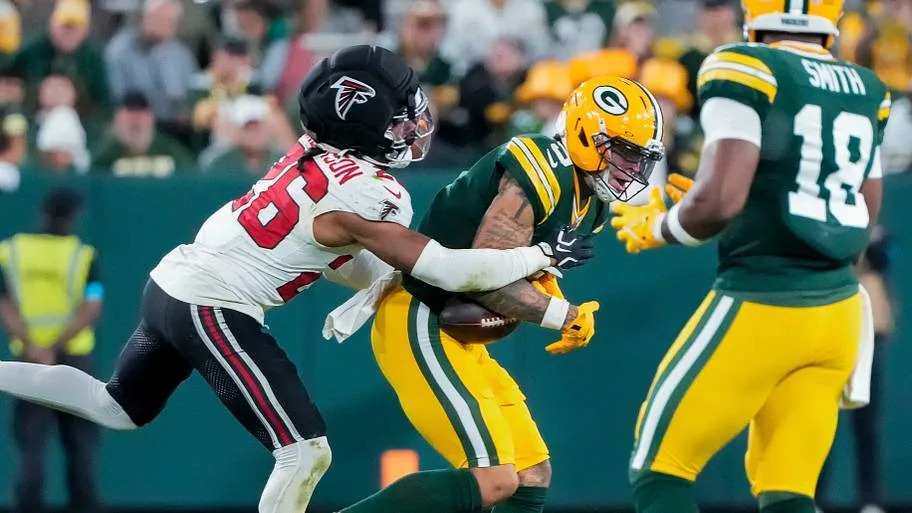
The Thursday Night Football fixture against the Green Bay Packers provided a rigorous operational test. Henderson managed demanding coverage assignments against wide receivers Romeo Doubs and Christian Watson, alongside tight end Tucker Kraft. Enduring twelve targets while allowing only five receptions demonstrated measurable defensive efficiency during a 35-14 team victory.
Institutional Incentives and Strategic Implications
Evaluating the long-term utility of players acquired via secondary channels involves careful risk assessment. For the Atlanta Falcons, extending Henderson’s playing time addresses immediate roster deficits caused by injuries while generating empirical performance data on a player approaching a critical career juncture. Success in these high-pressure scenarios alters market valuation and influences future contract allocation strategies.
Transforming a player labeled as a draft bust into a viable contributor yields significant structural advantages. Franchises that successfully rehabilitate veteran talent optimize salary cap allocation while mitigating the volatility associated with unproven rookies. Sustained performance in lead coverage roles will dictate whether this strategic gamble translates into a permanent fixture within the organization’s long-term competitive calculus.

Photo by MarkThomas on Pixabay.