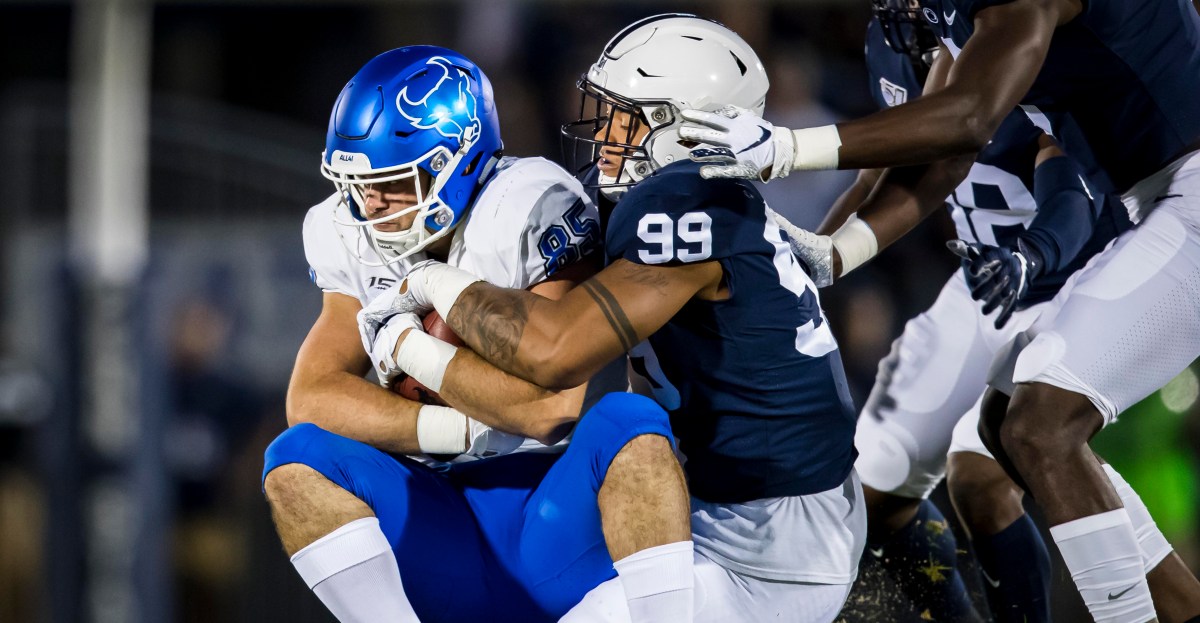
The Week 3 intersection of No. 14 Penn State and Buffalo at Beaver Stadium functions as a diagnostic benchmark for the Nittany Lions’ operational evolution. Beyond the mismatch in roster valuation, the contest provides a high-fidelity data set regarding the integration of Head Coach Matt Campbell’s schematic architecture and its long-term viability in the expanded Big Ten landscape.
Systemic Continuity: The Campbell-Becht Efficiency Profile
The core of Penn State’s 2-0 trajectory is the tactical shorthand between Matt Campbell and quarterback Rocco Becht. By porting their established Iowa State chemistry to Happy Valley, the program has effectively bypassed the traditional ‘lag phase’ of offensive installation. Becht’s 77.7% completion rate against Temple—defined by high-leverage decision-making and minimal turnover-worthy plays—demonstrates an advanced mastery of timing-based concepts.
This continuity serves as a force multiplier. While peer programs struggle with the cognitive load of new playbooks, Penn State is already deploying tertiary schematic variations. This depth forces opponents into a reactive defensive posture, increasing their mental fatigue and physical degradation over four quarters.
Buffalo’s Structural Fragility and Front-Seven Mismatches
Buffalo enters this matchup with significant offensive volatility. Following a narrow margin against Albany and a double-digit loss to FIU, the Bulls’ rushing metrics reveal a critical failure in gap integrity and offensive line leverage. Without a sustainable ground game to modulate the tempo, Buffalo’s offense becomes inherently predictable, playing directly into Penn State’s aggressive defensive pressure packages.
Compounding this is a unique scouting disadvantage. Having recently faced JJ Kohl’s similar offensive profile at FIU, Buffalo’s defensive staff possesses relevant film but lacks the personnel depth to counteract Penn State’s superior athletic profile. The discrepancy in specialized coaching resources suggests that Buffalo’s defensive front will likely experience a total system failure by the mid-third quarter.
Media Rights and Revenue Distribution Models
The 12:00 PM ET kickoff on the Big Ten Network (BTN) is a strategic move in media asset management. By placing a top-15 brand in the early window, the Big Ten optimizes its broadcast inventory, capturing high viewership during a low-competition slot. This maximizes the conference’s ‘Per-Subscriber-Per-Month’ value, a critical metric for future rights negotiations.
For Penn State, this exposure facilitates regional brand saturation and serves as a digital showcase for recruiting. The revenue generated by Beaver Stadium’s 100,000-plus capacity—combined with national streaming distribution via Fubo—provides the capital necessary to maintain the program’s elite infrastructure, creating a feedback loop of financial and competitive success.
Institutional Trajectory and CFP Implications
Operating as the No. 14 team, Penn State is navigating a narrow path toward the College Football Playoff (CFP). Poll inertia is a tangible asset; therefore, a high-margin victory over Buffalo is a requirement to maintain statistical standing against analytical models. The 45-0 shutout of Marshall established a defensive floor that now serves as the program’s baseline identity.
Ultimately, the presence of Becht via the transfer portal highlights the modern era of coach-player portability. This shift from institutional loyalty to schematic alignment allows Penn State to sustain its competitive ceiling regardless of personnel turnover, solidifying their status as a perennial Big Ten title contender.