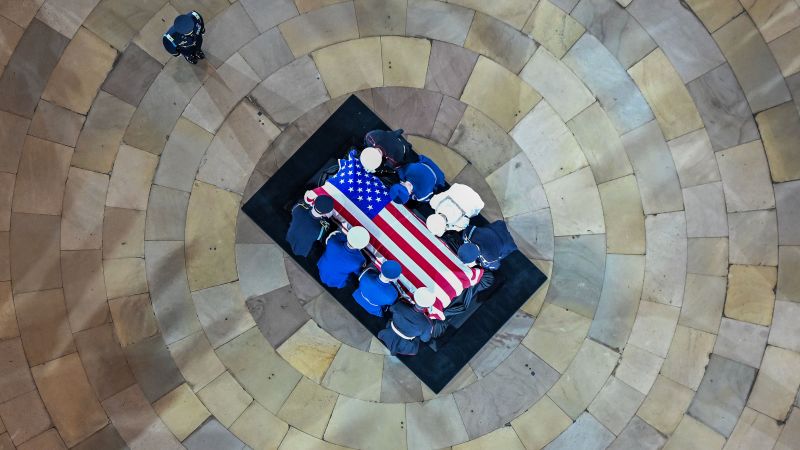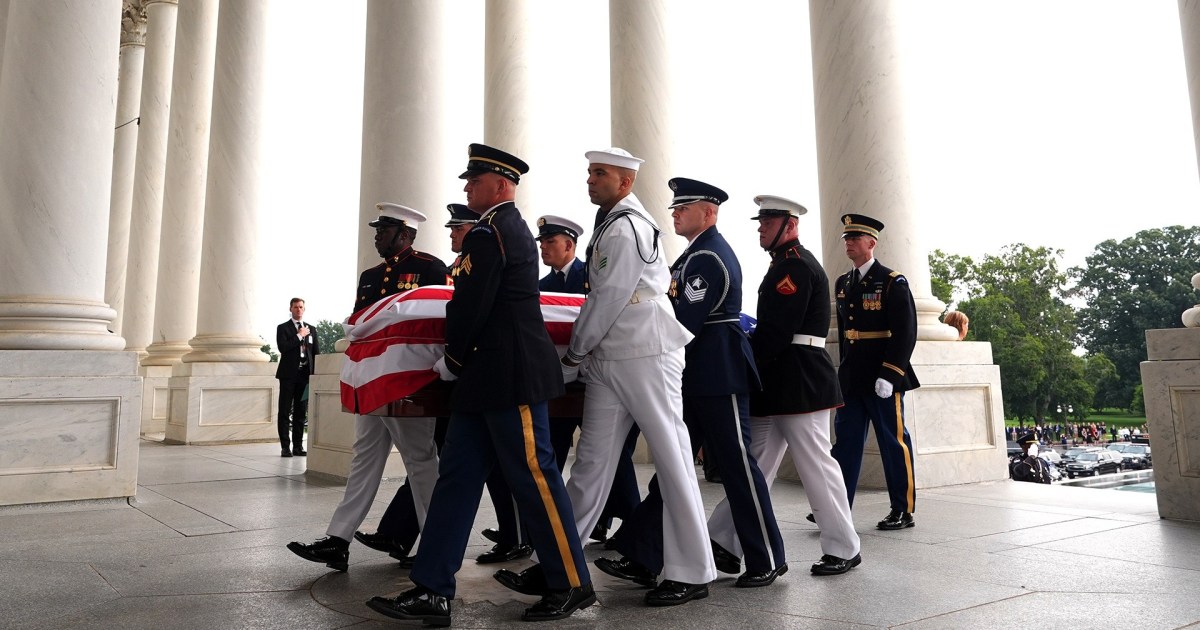
The funeral of Senator Lindsey Graham at the Washington National Cathedral transcended traditional mourning, manifesting as a high-stakes diplomatic theater. With Israeli Prime Minister Benjamin Netanyahu and Ukrainian President Volodymyr Zelenskyy in attendance, the event underscored Graham’s role as the final legislative conduit between legacy neoconservatism and the ascending populist constraints of the ‘America First’ era. His passing marks the dissolution of an informal but vital diplomatic infrastructure that historically streamlined military aid and strategic synchronization between Washington and its pivotal allies.
Graham’s absence creates an immediate vacuum in the Senate’s institutional memory and its Appropriations and Foreign Relations committees. He functioned as a uniquely agile convener, maintaining bipartisan cohesion while navigating the Republican Party’s internal shift toward the populist center of gravity established by Donald Trump. Without this mediating influence, the pathway for foreign leaders to secure U.S. commitments has shifted from a stabilized legislative process to a more volatile, direct negotiation with a party increasingly skeptical of long-term entanglements.
Donald Trump’s eulogy provided a stark rhetorical demarcation. By characterizing Graham as a man who ‘never saw a war he didn’t like,’ Trump effectively distanced the current GOP leadership from the interventionist legacy of the Graham-McCain era. This framing was a strategic acknowledgement of Graham’s utility in preserving donor bases, even as the party leadership pivots away from his globalist doctrine. The metamorphic ability Graham possessed—to advise Trump while advocating for intervention—previously buffered the defense establishment from the executive’s isolationist impulses.
Simultaneous to this political mourning, operational realities in the Middle East demonstrated a deepening, albeit transactional, security architecture. Joint U.S.-Saudi Arabian strikes against Iraqi militias, occurring alongside Jordanian interceptions of Iranian missiles, reveal a regional defense framework that persists through institutional momentum rather than personal diplomacy. However, the legislative speed required to fund such kinetic operations is now at risk; Graham’s seniority provided a level of budgetary certainty that the current fractured Senate may struggle to replicate.
The broader geopolitical landscape remains fraught with non-kinetic challenges, such as the ongoing search for survivors in Japan’s earthquake zones, which test the resource allocation of global alliances. Domestically, the release of Dr. Anthony Fauci’s journals and the Idaho murder proceedings highlight a climate of intense institutional scrutiny. Even the auction of Colonel Sanders’ personal effects serves as a cultural parallel to the proceedings in Washington: the commodification of an American icon’s legacy at a moment of transition.
Ultimately, the Graham funeral was a clarifying moment for the future of American power. The transition from a principle-based interventionism to a transactional, populist-driven foreign policy is no longer a theoretical shift but an operational reality. As various factions vie to occupy the void left by Graham, the durability of the post-Cold War international order faces its most significant test in decades.