
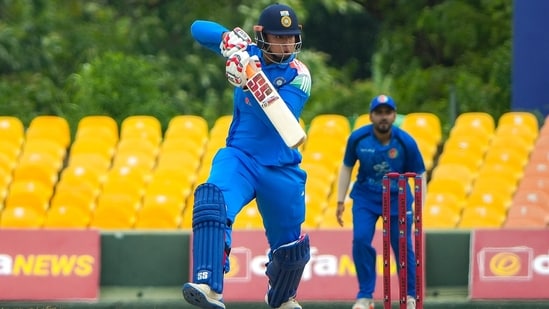
Sooryavanshi’s Strategic Integration into ODI Development
Vaibhav Sooryavanshi’s performances in Sri Lanka serve as a critical assessment for his long-term batting potential in the 50-over format, marking a strategic shift from his recent Indian Premier League (IPL) dominance. This focus on ODI development, concurrent with T20I call-ups, signals selectors’ intent to cultivate a multi-format player by leveraging his current form and momentum.
His inclusion in India A’s tri-series in Sri Lanka is a calculated move to accelerate his adaptation to one-day international cricket demands. This pathway aims to bridge domestic success with international readiness, providing competitive exposure against varied opposition under conditions simulating senior international pressures.
Sooryavanshi’s recent 44 off 22 balls against Afghanistan A showcased composure and precise strokeplay on a challenging pitch, demonstrating adaptability. His game, reliant on ground shots and nine boundaries, indicates a mature approach beyond raw power, suitable for longer formats.
Selection Pressures and Emerging Talent Pathways
Sanjay Manjrekar’s endorsement of Sooryavanshi as a potential “50-over phenomenon” underscores his recognized all-format capabilities, influencing selection strategies. The dual rewards—a maiden T20I call-up and India A ODI development—reflect a dual-pronged talent management approach by the Indian cricket board.
This rapid progression for a 15-year-old signifies a paradigm shift in identifying and nurturing emerging talent, prioritizing early multi-format exposure and competitive environments. The strategy mitigates talent stagnation risks by providing immediate opportunities aligned with demonstrated performance, optimizing development timelines.
Fast-tracking Sooryavanshi’s ODI development via the India A program indicates an institutional imperative to secure future 50-over talent. This aligns with cricket’s evolving landscape, demanding cross-format excellence and necessitating integrated development frameworks.
Competitive Landscape and Performance Leverage
Sooryavanshi’s ability to dominate IPL attacks and subsequently excel in the India A setup demonstrates significant performance leverage. His current form provides a strong foundation for national integration, potentially addressing long-term batting requirements for the ODI team.
The contrast between his IPL exploits and his measured approach on Sri Lankan pitches suggests a nuanced understanding of game situations and opposition. This adaptability is crucial for sustained international success, offering a competitive edge against diverse conditions and bowling attacks.
Selectors’ confidence in Sooryavanshi’s batting “depth,” as noted by Manjrekar, implies belief in his capacity to handle pressure and adapt—critical factors for ODI success. This assessment prioritizes technique and temperament for sustained career performance.
Downstream Implications for Squad Dynamics and Future Strategy
Sooryavanshi’s ascent introduces new dynamics to India’s selection calculus, potentially impacting established players’ career trajectories. His multi-format potential necessitates strategic planning for squad composition and player rotation across various international competitions.
The emphasis on developing young ODI talent through structured A-team tours signals a long-term vision for sustained national team dominance. This proactive approach ensures a consistent pipeline of skilled players ready for senior roles, maintaining competitive depth.
The successful integration of players like Sooryavanshi reinforces the efficacy of the India A program as a clear pathway for emerging cricketers, encouraging excellence in both domestic and representative cricket.
Media Context and Public Perception
Commentary from figures like Sanjay Manjrekar shapes public and media perception of emerging players. Endorsements amplify a player’s profile and set expectations, influencing the narrative around their development.
Media focus on IPL success and subsequent call-ups highlights the symbiotic relationship between performance, coverage, and career advancement in modern cricket, acting as both a catalyst and a source of pressure.
The framing of Sooryavanshi’s journey as a “50-over phenomenon” suggests strategic narrative management, common in sports to build anticipation and establish benchmarks for emerging stars.
Operationalizing Talent Development: The India A Role
The India A tour functions as a critical operational arm for national selectors, offering a controlled environment for evaluating players under pressure. The Sri Lanka tri-series provides a practical testing ground against diverse cricketing styles.
This developmental tour assesses players’ temperament, adaptability, and team integration capabilities, providing invaluable insights for senior selection decisions.
The program’s success hinges on meticulous planning, including scheduling and opposition selection, all geared towards maximizing player growth. Sooryavanshi’s performance validates this structured development model.
Capitalizing on Performance Leverage: Strategic Selection
Rewarding Sooryavanshi’s IPL success with immediate international exposure exemplifies a strategy of capitalizing on peak performance to maintain player momentum. Integrating him into the ODI setup via India A strategically positions him for future roles.
This proactive selection policy ensures a pool of players ready to fill specific needs, especially in the demanding 50-over format. Sooryavanshi’s current form makes him a compelling option, offering versatility across T20 and ODI formats.
Stakeholder Implications: Players, Selectors, and Fans
For players like Sooryavanshi, rapid ascent offers career advancement opportunities under immense performance pressure. The dual-format focus demands continuous adaptation.
Selectors face scrutiny to justify accelerated development, with success measured by sustained player contribution to team victories.
Fans are captivated by emerging prodigies, fueling excitement. The narrative of a young player conquering formats resonates strongly with the cricketing public.
Cascading Effects on Squad Composition and Future Planning
Sooryavanshi’s potential impacts squad composition and long-term planning, potentially leading to re-evaluated player roles and team balance across formats.
This integration intensifies competition, potentially pushing other aspiring cricketers to elevate their performance.
Selectors’ forward-thinking approach ensures a sustainable talent pipeline, maintaining India’s global competitiveness and adaptability.
The Role of Expert Commentary in Shaping Narratives
Expert analysis from former cricketers like Sanjay Manjrekar shapes perceptions of emerging players. Manjrekar’s assessment of Sooryavanshi’s “depth” and “50-over phenomenon” potential lends weight to his reputation.
Such opinions validate selectors’ decisions and build confidence around a player, managing expectations and providing psychological support.
Media amplification of these views contributes to the discourse on talent identification, highlighting the influence of seasoned voices in guiding public understanding and team management strategy.
Balancing T20 Aggression with ODI Temperament
Sooryavanshi must translate his T20 aggression into the measured approach required for ODIs. His recent performance suggests an early grasp of this distinction.
Selectors’ decision to expose him to ODIs via India A acknowledges that raw talent needs tempering with the specific skills and temperament for longer matches. This phase is critical for honing innings-building and situation-adaptation abilities.
Transition success hinges on his capacity to learn and adapt, balancing ODI nuances with his attacking flair—a hallmark of multi-format success.
The India A Program as a Strategic Incubator
The India A program serves as a vital incubator, offering a platform for players to prove themselves against international “A” sides. Sooryavanshi’s participation underscores its role in identifying and grooming talent for senior representation.
Structured exposure allows selectors to observe players under near-international conditions, yielding crucial data for selection decisions. The program’s effectiveness lies in bridging domestic performance with international rigors.
Strategic deployment of players like Sooryavanshi ensures a continuous talent flow, essential for maintaining competitive edge and adapting to global cricket’s evolving demands.
Performance Leverage in a Competitive Selection Environment
India’s intensely competitive selection landscape makes consistent performance under pressure a significant leverage point. Sooryavanshi’s rapid ascent, marked by IPL success and India A performances, demonstrates this capability.
High-level performance provides selectors confidence to fast-track development, addressing specific squad needs. His current form acts as a powerful endorsement, making him a versatile option across formats.
The strategic advantage of Sooryavanshi’s emergence is his versatility, potentially filling roles in both T20 and ODI teams, invaluable for optimizing squad composition.
The Evolving Definition of “Phenomenon” in Modern Cricket
The “50-over phenomenon” label for a 15-year-old reflects evolving expectations and accelerated timelines in modern cricket, driven by franchise leagues and global talent demand.
This designation signifies readiness to influence the game at the highest level in a specific format, suggesting skills and temperament aligned with elite ODI cricket, even at a nascent stage.
The strategic implication for selectors is to identify and nurture such “phenoms” early, providing appropriate pathways to fulfill their potential, crucial for maintaining India’s cricketing powerhouse status.