
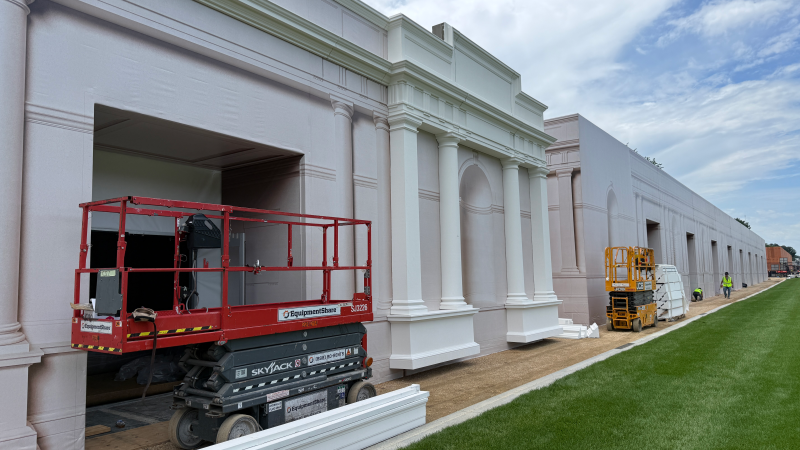
The Great American State Fair, conceived as a high-visibility exercise in national branding by the Trump administration, is facing a crisis of institutional participation. The formal withdrawal of Oregon, Washington, and North Carolina underscores a deepening divergence between federal executive initiatives and state-level autonomy. This refusal to participate represents more than a logistical hurdle; it is a manifestation of the friction inherent in modern American federalism, where national commemorations become sites of ideological and fiscal contestation.
Fiscal Sovereignty and Budgetary Gatekeeping
The primary deterrent for dissenting states is the significant financial commitment required for a two-week presence on the National Mall. For executive branches in Oregon, Washington, and North Carolina, the high capital expenditure for pavilion construction, staffing, and logistical support represents a high-risk allocation of discretionary funds. State officials are increasingly prioritizing domestic economic development over federal symbolic projects, especially when the return on investment (ROI) for tourism and trade remains speculative.
This fiscal gatekeeping reveals a structural flaw in the event’s design: a lack of federal subsidies to offset state-level costs. By placing the financial burden on participants, organizers have inadvertently created an asymmetric representation model. States with robust independent trade identities or those facing internal budgetary scrutiny view the fair not as a promotional opportunity, but as an unnecessary diversion of resources that fails to meet rigorous internal audit standards.
The Partisanship Threshold and Reputational Risk
Beyond economics, the fair faces a legitimacy deficit. Oregon Governor Tina Kotek’s characterization of the event as a “partisan affair” highlights the reputational risks associated with federally-curated patriotic programming. In a polarized political landscape, participation by Democratic-led states is often perceived as an implicit endorsement of the sponsoring administration’s ideological framework. This transformation of a civic celebration into a contested political platform creates an institutional barrier that prevents a unified 50-state presentation.
The resulting vacuum challenges the event’s status as a neutral national exhibition. For state leaders, the potential for domestic backlash from constituencies outweighs the benefits of national visibility. This strategic insulation of state branding from federal polarization suggests that the venue of the National Mall—traditionally a symbol of unity—is increasingly viewed as a theater for partisan signaling, compelling state governments to protect their regional identities from federal overreach.
Operational Paradoxes of the ‘Freedom 250’ Mandate
Despite official state withdrawals, the organizing body, Freedom 250, intends to provide representation for all 50 states and territories. This move shifts the fair from a collaborative model to a curated, top-down narrative. By representing states without their direct involvement, Freedom 250 risks creating “simulated” identities that may bypass official state trademarks and promotional priorities. This approach raises significant questions regarding the authenticity of the cultural artifacts and historical data presented.
The logistical pressure of finalizing these pavilions by the June 25 opening date, without the support of state agencies, indicates a strained planning phase. The reliance on a non-governmental organizer to fill gaps left by sovereign state governments creates a unique legal and operational precedent. The fair’s narrative may ultimately be defined by these omissions, as the absence of official state sanctioning undermines the event’s claim to be a comprehensive national World’s Fair.
Geographic Resistance and the Pennsylvania Pivot
The geographic distribution of the opting-out states—concentrated in the Pacific Northwest and a key Southeastern swing state—reveals a deliberate pattern of resistance. While Oregon and Washington cite partisan misalignment, North Carolina’s focus on cost provides a neutral shield for a politically sensitive decision. Meanwhile, Pennsylvania’s “undecided” status serves as a bellwether for the event’s broader viability. As a pivotal battleground, Pennsylvania’s eventual choice will determine if the fair can achieve any semblance of bipartisan legitimacy or if it will remain an ideologically isolated project.
Conclusion: A Real-Time Test of Federal Cohesion
The Great American State Fair is a physical manifestation of the current state of the American union. The friction between the administration’s vision and state-level resistance highlights the limits of centralized patriotic branding. As construction proceeds on the National Mall, the fair will serve as a high-stakes test of whether a national narrative can be sustained when the constituent parts of that nation refuse to participate. The event’s legacy will likely be a cautionary study in the challenges of executing large-scale public diplomacy in an era of fiscal pragmatism and extreme political fragmentation.

Photo by u_dg9pheol on Pixabay.