
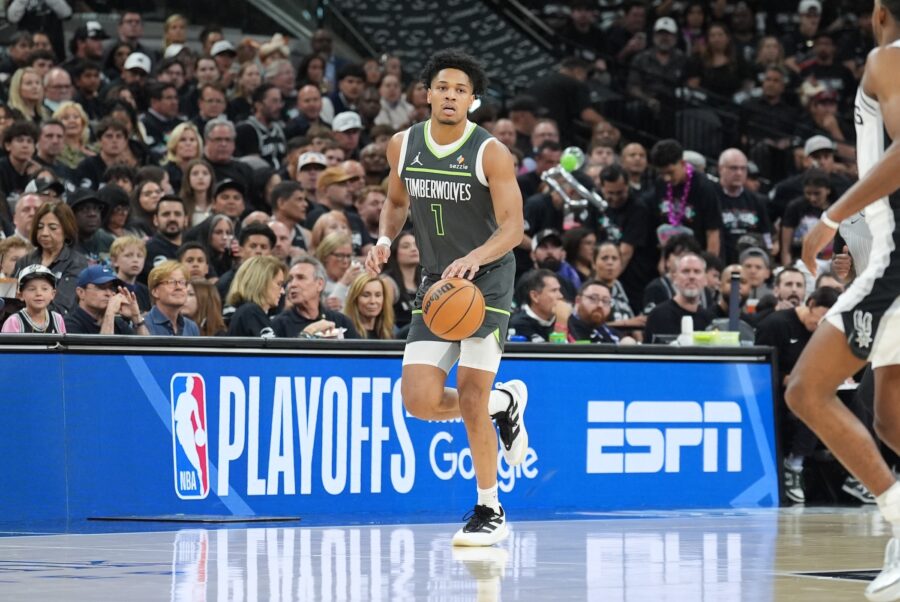
The Minnesota Timberwolves have officially upgraded guard Terrence Shannon Jr. to available for Friday’s pivotal Game 6 against the San Antonio Spurs. This administrative pivot follows a period of tactical uncertainty after Shannon was a late-addition to the injury report with a head contusion.
Injury Protocol Dynamics and Operational Uncertainty
The timing of Shannon’s inclusion on the injury report at 12:54 pm created a significant window of operational ambiguity. Late-day additions often signal a high probability of absence, forcing coaching staffs to preemptively adjust scouting reports and rotation hierarchies. His subsequent clearance at 7:10 pm suggests he successfully navigated the league’s stringent medical benchmarks, mitigating a potential depth crisis for a roster facing the structural pressure of a do-or-die elimination scenario.
Tactical Importance in the Western Conference Semifinals
Shannon’s availability is critical given his expanded utility within Chris Finch’s postseason rotation. While he averaged 12.5 minutes during the regular season, his workload has surged to 25.0 minutes per contest in this series. This 100% increase in minute allocation highlights a strategic reliance on his defensive versatility and transition play, even as his offensive efficiency remains under scrutiny. The decision to play him despite physical trauma underscores the lack of viable second-unit alternatives in high-leverage playoff moments.
Performance Divergence and Efficiency Metrics
Statistical analysis reveals a complex utility profile. Shannon is currently shooting just 29.2% from the floor and 17.6% from beyond the arc, reflecting the suffocating pressure of San Antonio’s third-ranked defensive unit. Despite these shooting struggles, his presence remains a tactical necessity for Minnesota’s spacing and defensive rotations. The coaching staff appears to prioritize his 8.6 points and 2.0 assists per game over the volatility of deploying less experienced bench assets in a series-deciding environment.
Institutional Stakes of the Elimination Context
Minnesota enters Game 6 on the verge of elimination, a situation that amplifies the consequence of every roster decision. Shannon’s transition from receiving multiple DNP-CDs early in the playoffs to becoming a 25-minute-per-game fixture represents a rapid evolution in institutional trust. His ability to manage performance swings while compromised by injury will be a primary factor in Minnesota’s ability to force a Game 7.
Strategic Implications for San Antonio’s Defense
For the Spurs, Shannon’s availability ensures a continuation of their perimeter containment strategies. San Antonio has successfully limited Shannon to 14-of-48 shooting by leveraging elite defensive positioning. The confirmation of his status prevents the Spurs from needing to pivot their focus toward other bench contributors, allowing them to maintain established defensive schemes without mid-game tactical recalibration.
Operational Risks of Head Contusions
While cleared, the nature of a head contusion introduces inherent risks regarding in-game performance and secondary symptoms. Any recurrence would force an immediate restructuring of the Timberwolves’ backcourt. In an elimination game, the margin for error regarding such medical contingencies is virtually non-existent, placing immense pressure on both the player and the training staff to deliver immediate, stable production.

Photo by ManniB on Pixabay.