
Strategic Realignment at the 2026 PGA Championship
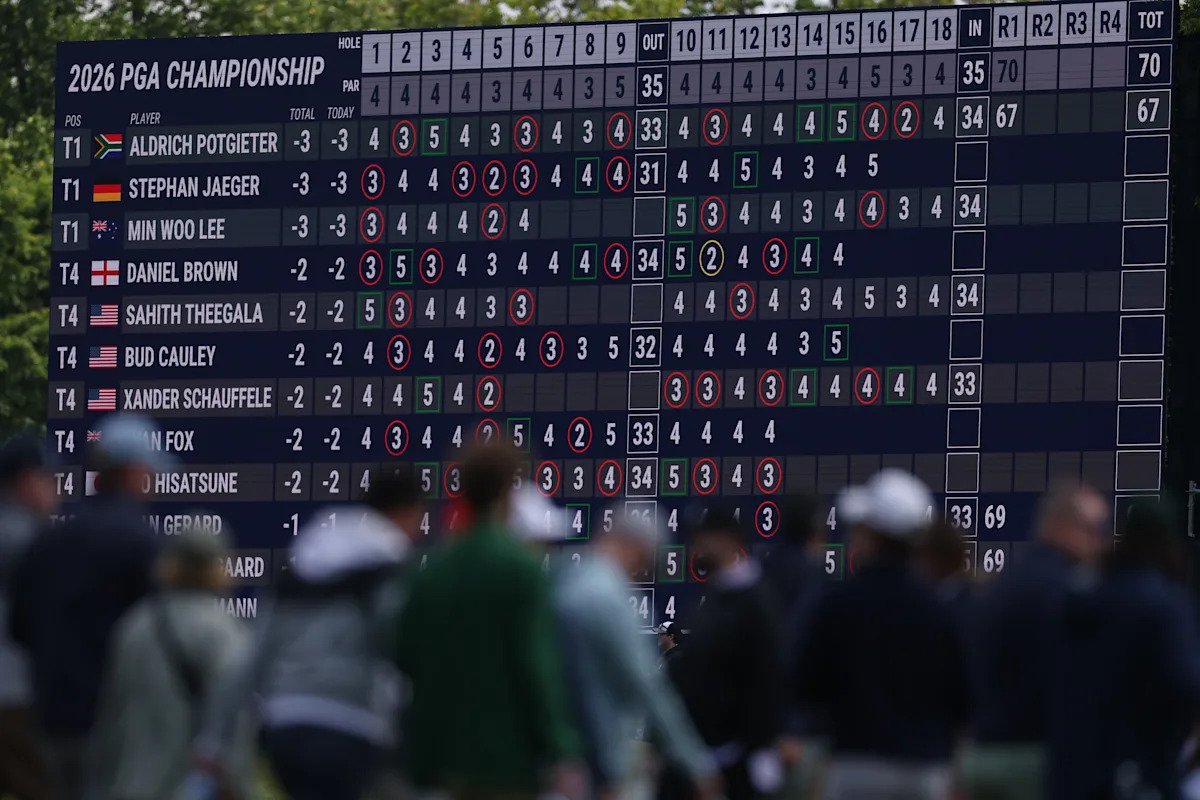
The opening round of the 2026 PGA Championship at Aronimink Golf Club has fundamentally altered the competitive landscape. Scottie Scheffler, the world No. 1, secured a 3-under-par 67, marking a pivotal departure from his historical performance patterns. By establishing an early lead—a deviation from his typical conservative start—Scheffler has transferred the psychological and strategic burden to his rivals, forcing an early abandonment of defensive play across the field.
This shift from chaser to front-runner introduces a new variable for performance analytics and betting markets. Scheffler’s tactical execution at Aronimink suggests a refined approach to course management under high-pressure conditions, prioritizing immediate dominance over late-tournament surges. This operational change compels the field to recalibrate their risk-reward thresholds far earlier than is standard for a major championship.
The Performance Gap and Commercial Risk
While Scheffler solidifies his position, the tournament faces a significant narrative challenge due to the underperformance of Rory McIlroy and Bryson DeChambeau. Finishing at 4-over and 6-over respectively, both players are now on the precarious side of the projected cutline. This performance delta highlights Aronimink’s structural resistance to raw distance, instead rewarding disciplined iron play and precision.
The potential early exit of these archetypal players—McIlroy as the traditional powerhouse and DeChambeau as the data-driven disruptor—represents a quantifiable risk to weekend viewership and engagement metrics. The nine-stroke disparity between Scheffler and DeChambeau underscores the unforgiving nature of the Newtown Square layout, where aggressive strategies are severely penalized when they fail to meet high-margin error thresholds.
Operational Dynamics of Round 2 Tee Times
Friday’s scheduling is engineered to manage physical course degradation while maximizing broadcast gravity. Scheffler’s 8:40 a.m. tee time alongside Matt Fitzpatrick and Justin Rose provides a strategic advantage regarding green consistency and wind stability. Early starters benefit from smoother putting surfaces before cumulative foot traffic impacts line and speed.
Conversely, the afternoon wave—featuring the high-leverage trio of Rory McIlroy, Jordan Spieth, and Jon Rahm at 2:05 p.m.—will face a course baked out by midday sun. These atmospheric conditions increase the difficulty of holding firm fairways and greens, likely widening the gap between those who capitalized on morning conditions and those forced into more volatile afternoon scenarios.
Aronimink as a Competitive Separator
Aronimink has validated its reputation as a premier test of institutional golf. With only seven players reaching 3-under, the course setup successfully prevents the field from overpowering the layout. Strategic decisions off the tee are dictated by severe penalties in the rough, ensuring the leaderboard is populated by players with high scrambling percentages rather than those relying solely on driving metrics.
The institutional significance of this setup reinforces the PGA Championship’s identity as a tournament prioritizing complete shot-making. For McIlroy and DeChambeau, the struggle to adapt highlights a misalignment between their current technical form and the architectural requirements of the venue. The outcome of the Friday session will determine if the tournament remains a multi-polar rivalry or becomes a runaway showcase for Scheffler’s dominance.

Photo by Felix-Mittermeier on Pixabay.