
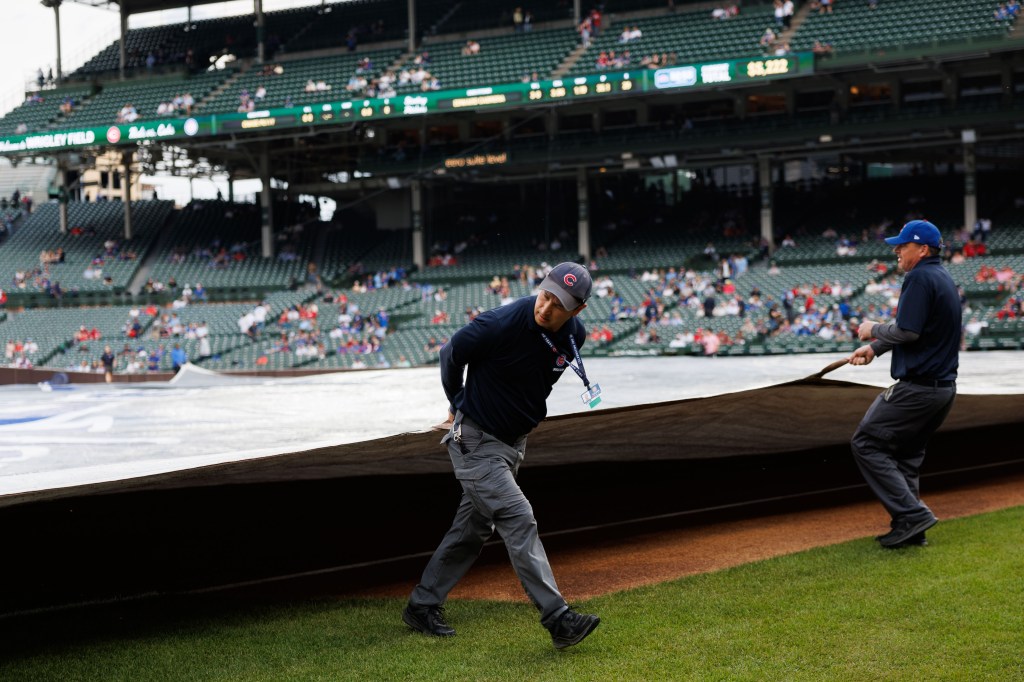
The recent clash between the Chicago Cubs and Cincinnati Reds at Wrigley Field served as a case study in how professional franchises navigate the intersection of environmental unpredictability and high-stakes athletic performance. The Cubs’ decision to preemptively move the start time—advancing from 6:40 p.m. to 6:10 p.m.—reflects an institutional commitment to data-driven risk mitigation. By attempting to exploit a narrow window of playability, the organization sought to minimize the fiscal and physiological fallout of a suspended game.
However, the ensuing thunderstorms demonstrated the persistent limits of predictive modeling in outdoor athletics. For starters Edward Cabrera and Chase Petty, the delay created a significant metabolic and psychological hurdle. The primary challenge in such scenarios is the recalibration of the kinetic chain; pitchers must balance active mobility with energy conservation to prevent muscle cooling, which significantly elevates the risk of soft-tissue injury upon resumption.
Divisional Leverage and the 22-12 Pivot Point
Currently, the NL Central landscape is a study in marginal gains. The Cubs (22-12) maintain a slim two-game advantage over the Reds and Cardinals (both 20-14). In this context, head-to-head encounters are no longer mere calendar entries but critical points of leverage. These games directly influence tie-breaker protocols that dictate post-season seeding and fiscal windfalls associated with home-field advantages.
For Cincinnati, the urgency is palpable. Labeled internally as a ‘brutal stretch,’ the series finale evolved into a salvage operation. Losing a divisional series via a sweep creates a statistical deficit that often requires weeks of high-output performance to neutralize. For the Cubs, their early-season insulation allows for more experimentation with high-upside prospects, though the proximity of their rivals demands constant tactical vigilance.
Tactical Reconfiguration: The De La Cruz DH Pivot
The Reds’ strategic move to utilize Elly De La Cruz as the Designated Hitter illustrates modern ‘load management’ protocols. By decoupling his high-velocity offensive output from the defensive taxation of the shortstop position, the coaching staff aims to maximize his WAR (Wins Above Replacement) while mitigating cumulative fatigue. This shift necessitated a secondary infield realignment, moving Matt McLain to shortstop and integrating Sal Stewart at second base—a testament to the importance of defensive versatility in contemporary roster construction.
Chicago’s lineup reflects a similar emphasis on tactical depth. The inclusion of Moises Ballesteros as DH and veteran Alex Bregman at third base creates a balanced threat profile. This architecture is specifically engineered to exploit the tendencies of right-handed pitchers like Rhett Lowder, prioritizing disciplined at-bats that inflate pitch counts and stress the opposing bullpen.
Pitching Macro-Management: Imanaga vs. Lowder
The series finale presents a fascinating stylistic divergence. Shota Imanaga, the Cubs’ left-handed anchor, utilizes a deceptive arsenal that is particularly effective in the volatile wind conditions of a Wrigley matinee. His role is to provide rotational stability, neutralizing the Reds’ power-hitting lefties and preserving the relief corps for high-leverage situations later in the week.
Conversely, Rhett Lowder’s objective is damage control. Tasked with halting a losing streak in a hostile environment, Lowder’s success depends on navigating a Cubs order characterized by elite run prevention and defensive range. Players like Nico Hoerner and Pete Crow-Armstrong represent a structural philosophy where defensive efficiency directly correlates to lower ERA totals, providing a safety net for the pitching staff.
Conclusion: Operational Resilience as a Competitive Advantage
Beyond the box score, the series highlights the necessity of institutional resilience. From the front office’s scheduling pivots to the strength coaches’ management of weather-induced downtime, the ability to adapt to external disruptions is a hallmark of the Cubs’ 22-12 start. As the Reds attempt to maintain parity, their ability to integrate young assets like JJ Bleday and Blake Dunn under pressure will determine if they can close the gap in the NL Central power vacuum.

Photo by Mohamed_hassan on Pixabay.