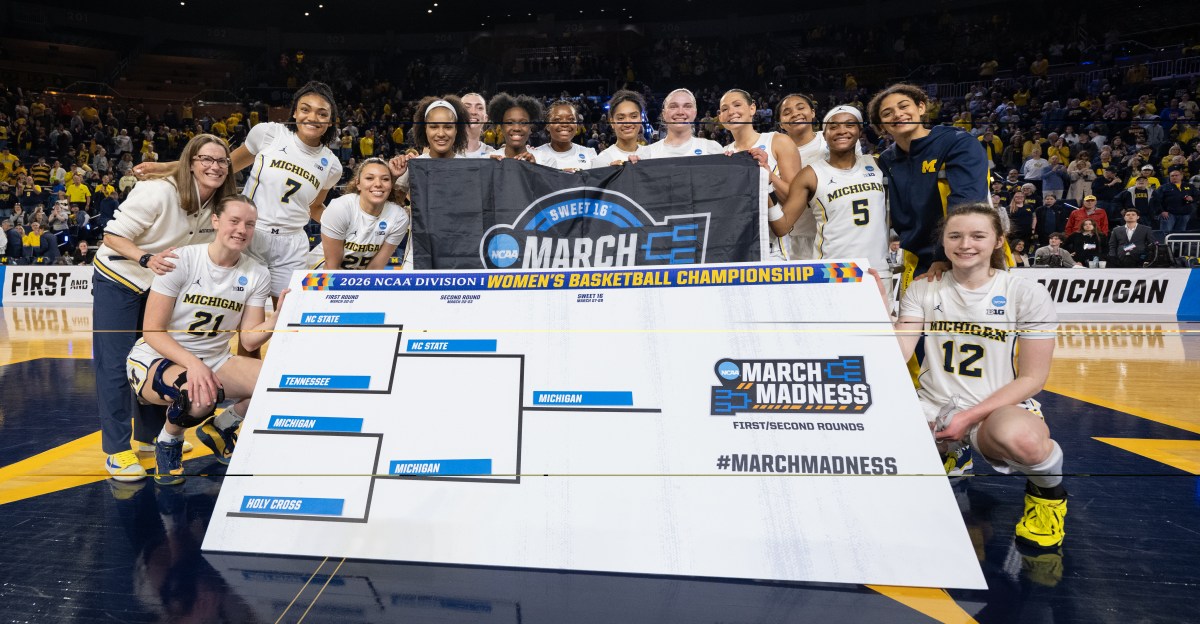
The NCAA Sweet 16 contest between the No. 6 seed University of Michigan Wolverines (27-6) and the No. 3 seed Louisville Cardinals (29-7) in Fort Worth represents a decisive strategic inflection point in the Fort Worth Regional 3 bracket. The matchup immediately contrasts Michigan’s high-octane offense against Louisville’s disciplined, pressure-oriented defensive framework.
Strategic Context: Historical Leverage Versus Current Execution
Michigan enters the Sweet 16 achieving their third consecutive second-weekend appearance, signaling sustained institutional competence in player development. However, this recurring stage demands conversion into deeper runs. Louisville arrives with a superior overall record (29-7), validating consistency through the regular season and early tournament rounds.
Historically, Michigan holds a 2-0 edge in NCAA Tournament meetings (2019, 2022), suggesting a favorable stylistic matchup. This historical advantage, however, was acutely challenged by Louisville’s opening-quarter execution, which established a commanding 15-9 lead after stifling the Wolverines.
Immediate Operational Strain: Defensive Neutralization
Louisville’s opening success was predicated on dismantling Michigan’s offensive rhythm. Holding Michigan scoreless for the first 5:15 and limiting them to just 29% shooting (1-for-17 outside of the paint) indicates a perfectly scouted defensive plan targeting Michigan’s primary initiators. This pressure directly contradicted Michigan’s season-long standing as a top-10 scoring offense (averaging 84 PPG), forcing immediate strategic recalibration.
Core Vulnerability: Sophomore Concentration Risk
Michigan’s offensive production this tournament is highly centralized. Success hinges disproportionately on the output of sophomores Olivia Olson (an AP All-American third-teamer), Syla Swords, and Mila Holloway. This trio collectively drives the majority of the offensive load.
This concentration creates a measurable ceiling. If Louisville can successfully dedicate high-level defensive resources to neutralizing these three playmakers, the supporting depth—though statistically present—has yet to demonstrate the necessary efficiency or volume to carry the offensive burden against elite tournament defenses. Olson’s ability to manufacture points via isolation (e.g., the successful ‘and one’ drive) highlights individual brilliance as an emergency counter, but systemic offensive efficiency is required for sustained success.
Path to Elite Eight: Navigating the Regional Apex
Advancing requires defeating Louisville, a process that involves overcoming the immediate defensive drag they impose. The subsequent challenge involves facing the winner of the No. 1 seed Texas (33-3) or No. 5 seed Kentucky (25-10) in the Regional Final. For Michigan, the Louisville game is the necessary filter to even approach the regional ceiling established by Texas.
Institutional Trajectories and Stakeholder Valuation
For Michigan, translating sustained Sweet 16 presence into a Final Four berth is the metric defining the current coaching era’s success, directly impacting resource allocation and recruitment leverage. Failure to break through introduces scrutiny regarding late-game strategic closing ability against top-tier variance.
Conversely, Louisville uses this matchup to reaffirm its status as a consistent national contender. Defeating a rising peer like Michigan strengthens their institutional brand equity and validates their competitive investment strategy, particularly given the high-visibility ABC broadcast slot.
The ACC Contextual Test
Michigan’s 3-0 record against the ACC this season suggests proficiency within that conference style. However, tournament pressure magnifies stylistic differences. This game is a stress test confirming whether Michigan’s Big Ten framework can execute efficiently against the specific physicality and defensive constructs employed by Louisville, a prerequisite for contention against the bracket’s top seeds.