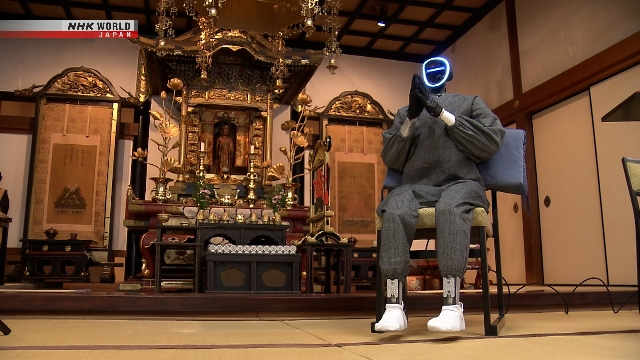
Kyoto University’s Institute for the Future of Human Society has unveiled ‘Buddharoid,’ a humanoid robot representing a strategic techno-spiritual intervention. Designed to navigate Japan’s socio-demographic challenges—marked by a shrinking clergy and the depopulation of rural temple communities—the project seeks to preserve religious continuity through advanced automation.
Under the leadership of Professor Seiji Kumagai, a researcher and ordained Buddhist priest, the initiative ensures theological integrity within a digital framework. This dual-domain expertise allows for a transition from static religious simulations to a dynamic, AI-driven pastoral agent capable of sophisticated scriptural interpretation.
Technical Architecture: BuddhaBot-Plus
The intelligence layer of Buddharoid is powered by BuddhaBot-Plus, a proprietary architecture built upon OpenAI’s large language models. Unlike previous iterations limited to pre-scripted responses, this system has been trained on an extensive corpus of specialized Buddhist scriptures. This enables the robot to synthesize canonical teachings into nuanced, context-aware advice for contemporary users, moving beyond rote recitation toward philosophical reasoning.
The hardware comprises a 1.3-meter humanoid chassis manufactured by a Chinese robotics firm, demonstrating a globalized supply chain. The physical design prioritizes solemnity, mimicking human-like gaits and prayer postures to maintain the gravitas necessary for sacred environments.
Socio-Demographic Resilience and Institutional Impact
Japan’s aging population and the resulting decline in active temples have created an institutional vacuum. Buddharoid serves as a scalable solution to maintain spiritual engagement where human resources are absent. Professor Kumagai posits that automating ritualistic and advisory tasks allows the remaining human priesthood to focus on complex pastoral care and high-level institutional management.
During its debut at Kyoto’s Shoren-in temple, the robot demonstrated its capacity for mental health support, advising on mindfulness and the Buddhist concept of non-attachment. The humanoid form is central to this strategy; researchers found that physical presence fosters greater engagement and trust compared to screen-based interfaces, vital for sustaining the atmosphere of traditional worship.
Strategic Implications and Ethical Frameworks
The integration of generative AI into spirituality raises critical ethical questions regarding machine-led guidance. Kyoto University is currently developing a framework to govern the limits of AI authority in sacred spaces. Strategically, the project positions the university at the forefront of the global AI discourse, showcasing how digital tools can safeguard cultural heritage during demographic transitions.
Furthermore, the project highlights market shifts in the religious sector. As temples face economic pressure, AI-powered agents may provide cost-effective spiritual services. However, long-term success depends on the public’s perception of the robot as a legitimate extension of the priesthood rather than a disruptive replacement. Ensuring the consistency of ‘digital wisdom’ with ancient canon remains the project’s primary technical and theological challenge.