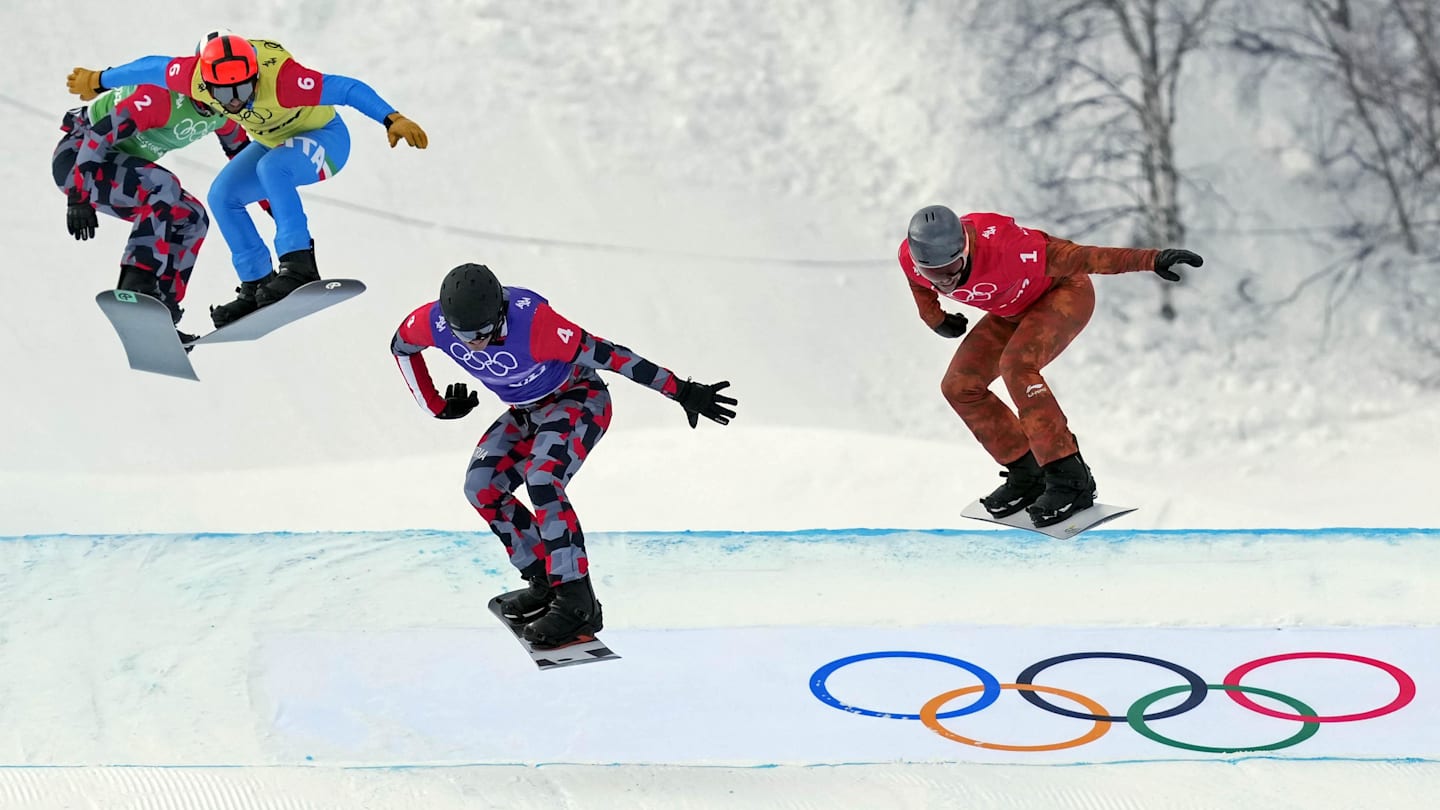
Elite Competition at the Livigno Course
In a repeat of the high-stakes finish seen in previous global competitions, Alessandro Haemmerle of Austria successfully defended his Olympic title in the men’s snowboard cross event. The race, held in Livigno, Italy, culminated in a razor-thin margin of victory that mirrored the close results of international snowboarding’s most prestigious stages.
Canada’s Eliot Grondin, who entered the final as a primary contender, secured the silver medal after a late-stage surge that nearly overturned the reigning champion’s lead. The two athletes have developed a consistent pattern of narrow finishes, with the separation between gold and silver shrinking from two hundredths of a second in the previous cycle to just three hundredths this year.
The Mechanics of the Finish Line Thrust
The final meters of the Livigno course required precise execution of a specialized maneuver known as the board thrust. As the riders descended the final rolling section, Grondin appeared to have the momentum necessary to overtake the lead, yet Haemmerle managed to extend his board across the line first.
This specific technique is essential in snowboard cross, where the physical reach of the equipment determines the official timing trigger at the finish. The reliance on this micro-maneuver highlights the level of technical mastery required when four athletes are traveling at high speeds in close proximity through a series of banks and rollers.
The Progression of the Tournament Bracket
The Olympic snowboard cross system uses a bracket-style elimination process that prioritizes immediate performance over seasonal rankings. In each round, four riders compete simultaneously on a course designed with rolling bumps and steep embankments, with only the top two finishers advancing to the subsequent stage.
This format creates an environment where a single error or a loss of speed on a jump can negate years of preparation. The unpredictability of this setup was evident in the semifinals, which saw the elimination of experienced competitors, including American veteran Nick Baumgartner.
The Profile of the Podium Finishers
Jakob Dusek, also representing Austria, completed the podium by securing the bronze medal. Dusek’s performance ensured that the Austrian national program maintained a significant presence at the top of the standings, effectively blocking France’s Aidan Chollet from reaching the medal positions.
The presence of two Austrians on the podium reflects a broader trend of success for the country’s snowboarding program. This achievement follows recent victories in other disciplines, such as Benjamin Karl’s successful defense of his gold medal in the men’s parallel giant slalom earlier in the week.
Overcoming Physical Adversity
Haemmerle’s victory was achieved despite significant health challenges leading up to the race. The athlete reported falling ill just days before the event, which raised concerns regarding his ability to maintain the physical output required for multiple rounds of high-intensity racing.
The recovery process and the subsequent management of energy levels suggest a highly efficient support system within the team. Navigating the physical demands of the course while recovering from illness adds a layer of complexity to the tactical decisions made during the heat of competition.
Historical Context and Career Longevity
With this second consecutive gold medal, Haemmerle joins an exclusive group of athletes who have defended an Olympic title in this discipline. Since the introduction of snowboard cross to the Olympic program in 2006, only two other riders, Seth Wescott of the United States and Pierre Vaultier of France, have achieved back-to-back victories.
Despite this historic achievement, Haemmerle has indicated that a third consecutive title is unlikely. The physical toll of the sport and the increasing level of competition from younger riders often influence the long-term career planning of elite snowboarders.
The Resilience of Veteran Competitors
The event also showcased the remarkable longevity of certain athletes within the sport. At 44 years old, American rider Nick Baumgartner reached the semifinals, demonstrating that tactical experience can often compensate for the raw speed of younger competitors.
Baumgartner, a previous champion in mixed team events, remains a significant figure in the sport’s development. His ability to compete at the highest level against athletes half his age provides a case study in the evolution of training methods and injury prevention in high-impact winter sports.
Market Context and Betting Outcomes
Entering the final, the betting market favored Eliot Grondin, who held a dominant position throughout the 2024-25 season. Grondin arrived in Livigno as the reigning world champion and the winner of the Crystal Globe, reflecting a season of consistent excellence across various international venues.
The discrepancy between Grondin’s status as the betting favorite and the final race outcome underscores the volatile nature of the Olympic format. While season rankings track performance over months, the Olympic final is a singular event where external variables, such as track conditions and immediate physical health, play a decisive role.
The Logic of the Odds
Initial betting odds placed Grondin at +220, suggesting a roughly 32 percent probability of victory in a field described by analysts as wide-open. Haemmerle, despite his status as the defending champion, was positioned at +500, reflecting the market’s assessment of his recent form compared to Grondin’s season-long dominance.
The fact that the race was decided by such a small fraction of a second confirms the accuracy of the assessment that the competition was among the most balanced in recent memory. The distribution of talent across the French, Austrian, and Canadian teams created a scenario where any of the four finalists had a legitimate path to the gold medal.
The Influence of Course Design in Livigno
The layout of the Livigno course played a vital role in the tactical execution of the race. Snowboard cross courses are designed to test both the technical jumping ability and the gliding speed of the riders, with specific sections designed to allow for drafting and overtaking.
The final rolling section proved to be the most critical part of the track, providing the opportunity for the photo finish between the two leaders. The design of these courses must balance the need for speed with the safety of the riders, particularly given the propensity for mid-air contact in the banked turns.
Technical Requirements for Success
Success in this environment requires an athlete to manage complex aerodynamic forces while navigating the changing textures of the snow. The ability to maintain speed through the rollers without losing contact with the surface is a differentiator between the gold medal and the rest of the field.
The interaction between the board’s base and the snow, often managed by a dedicated team of technicians, is as important as the rider’s physical maneuvers. In a race decided by 0.03 seconds, the choice of wax and the preparation of the equipment can be the deciding factor in the outcome.
The Future of the Sport
As the international snowboarding community looks toward the next cycle, the rivalry between Haemmerle and Grondin remains a central narrative. While Haemmerle has expressed hesitation regarding a three-peat, his current standing as the benchmark for Olympic performance remains unchallenged.
The emergence of younger talents like Jakob Dusek and the French contingent suggests that the field will continue to grow in depth. This increasing competition ensures that the technical standards of the sport will continue to evolve, requiring even greater levels of precision in future global events.
Implications for National Programs
The success of the Austrian team in Livigno provides a model for how focused investment in a specific discipline can yield high-level results. By securing multiple medals across different snowboarding events, the program has established a dominant position in the winter sports landscape.
Other nations are likely to analyze the Austrian approach to training and race-day management as they prepare for the next series of world championships. The consistency shown by Haemmerle and his teammates suggests a systematic approach to excellence that extends beyond individual talent.