The 2026 Women’s Basketball Invitational Tournament (WBIT) bracket is set, culminating with the final stages hosted at Charles Koch Arena in Wichita, Kansas, following the commencement of play on March 19th.
WBIT Structure and Logistical Concentration
The WBIT operational framework establishes a distinct secondary postseason path, concluding on April 1st. The strategic decision to centralize the semifinals and championship in Wichita contrasts with previous years, concentrating media rights value and institutional travel onto a single, fixed location for the final week.
Broadcast distribution is tiered: ESPNU for the Monday, March 30th semifinals, escalating to ESPN2 for the championship, confirming ESPN’s multi-platform content strategy across linear and digital hubs.
Early Round Metrics and Upset Analysis
Initial results exposed significant performance variance within the 32-team field. Eastern Kentucky’s 72-58 upset over No. 1 seed Utah provided immediate negative data regarding top-seed execution, impacting institutional seeding efficacy assessments for future cycles.
Furthermore, tight contests, like Kansas State’s narrow margin against Georgia Tech, indicate parity where seeding advantages were minimal at the campus sites.
Semifinal Showdown: The Wichita Four
The WBIT final four—comprising Kansas, BYU, Columbia, and Wisconsin—are now scheduled for a compressed competitive window. The semifinal pairings dictate specific logistical and competitive challenges, requiring rapid recovery protocols.
The convergence of these four programs showcases the WBIT’s value in providing high-stakes, nationally televised exposure (ESPNU) to programs seeking programmatic benchmarking outside the primary NCAA Tournament.
South Carolina’s Dominance and Strategic Deficit Analysis
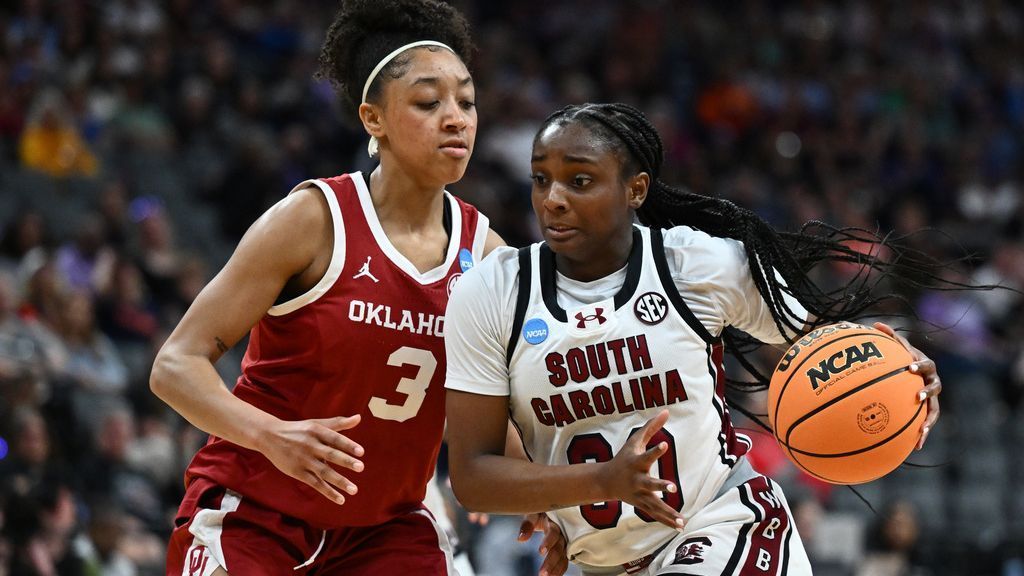
Top-seeded South Carolina has demonstrated overwhelming efficiency, outscoring their initial three opponents by a combined 139 points, securing two 100-point games—a program first. However, analytical focus shifts from these output metrics to underlying strategic integration.
Senior Raven Johnson articulated the team’s internal benchmark, noting “a lot of room to grow.” This suggests the early dominance is viewed contextually, prioritizing peak performance alignment for the final rounds.
Offensive Diversity: The Interior Imperative
Coach Dawn Staley has publicly emphasized the necessity of increasing efficiency in high-percentage shots from the paint. This directive highlights a current tactical vulnerability: an over-reliance on high-volume guard play.
Historically, foundational post scoring serves as the requisite offensive ballast when perimeter efficiency declines against elite defensive schemes. Reinforcing interior presence is critical for ensuring offensive redundancy and mitigating opponent defensive adjustments.
Defensive Execution and Personnel Leverage
Madina Okot’s targeted containment of Oklahoma’s high-usage scorer, Raegan Beers (limiting her to 14 points on low volume), validates the frontcourt’s capacity for executing complex, tailored defensive assignments.
This defensive effectiveness must now be matched by offensive diversification. Sustained success hinges on leveraging established guard production while simultaneously improving interior scoring throughput to avoid predictability against top-tier tournament defenses.
WBIT Ecosystem Value and Benchmarking
The WBIT functions as a crucial secondary indicator for institutional athletic investment, influencing recruiting narratives and donor confidence. Minnesota’s 2025 championship serves as a tangible example of the reputational capital secured by winning a postseason title.
For the semifinalists, exposure on national cable networks validates program stability. The continuous WBIT presence across ESPN properties reinforces a comprehensive content ecosystem, ensuring relevance throughout the women’s college basketball postseason cycle.