
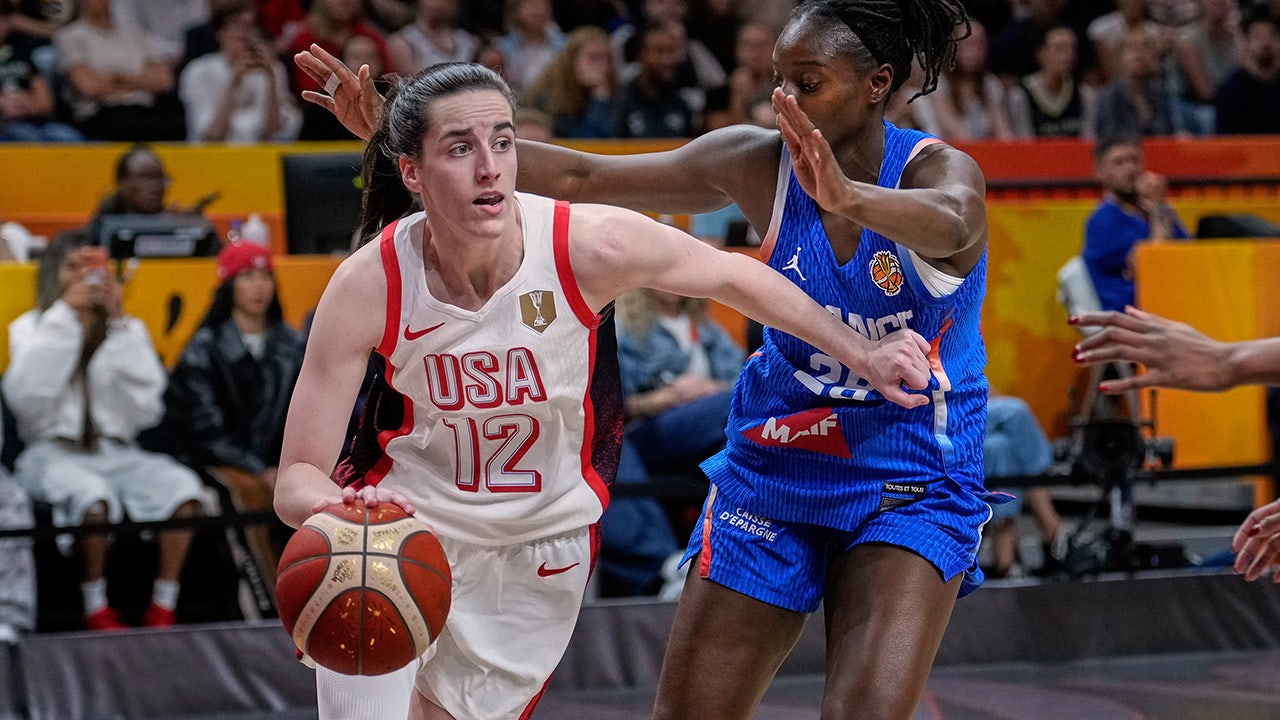
The United States women’s national basketball team has reaffirmed its era of global dominance, securing a fifth consecutive FIBA Women’s Basketball World Cup title. Their 97-79 victory over France marks the program’s twelfth gold medal and extends an unprecedented winning streak to 36 games. This performance was not merely a display of individual talent but a testament to the structural superiority of the American developmental pipeline and its capacity for high-stakes tactical recalibration.
Tactical Recalibration: The 30-12 Third-Quarter Pivot
The final against France served as a rare stress test for the U.S. roster, which trailed by 14 points in the first half. France utilized aggressive defensive schemes and high-tempo transitions to disrupt the American rhythm, exposing early-game vulnerabilities in perimeter communication. However, the U.S. response in the third quarter—outscoring France 30-12—illustrated a superior capacity for mid-game adjustment. By tightening defensive rotations and shifting to a more aggressive interior-focused offense, the Americans dismantled the French momentum, fundamentally altering the game’s operational tempo.
Efficiency Metrics: Breanna Stewart’s Historic Trajectory
Tournament MVP Breanna Stewart delivered a masterclass in high-efficiency scoring, finishing the final with a double-double of 22 points and 10 rebounds. Shooting 70% from the field, Stewart’s performance underscored her role as the team’s primary offensive engine. Beyond the box score, this game carried historical significance: by surpassing Cheryl Miller, Stewart moved into fifth place on the U.S. all-time World Cup scoring list with 268 points. Her ability to anchor both ends of the floor—evidenced by a +8 efficiency rating—provides the institutional stability required to sustain the program’s dominance.
Asymmetric Depth and Bench Integration
The U.S. victory was further catalyzed by the performance of Jackie Young, whose 18 points and team-high +15 rating highlighted the importance of perimeter spacing. Her 4-of-7 accuracy from three-point range forced France to abandon its zone coverage, creating driving lanes for the second unit. The integration of high-ceiling prospects like Caitlin Clark, who contributed high-impact scoring in limited minutes, suggests a seamless transition between the veteran core and the next generation of leadership. This asymmetric depth remains the primary differentiator between the U.S. and the rest of the international field.
Global Implications and Institutional Continuity
While France’s Dominique Malonga impressed with 21 points, her team’s inability to sustain pressure highlights the narrowing but persistent gap in roster depth. For the U.S., the 36-game streak reflects a culture of excellence that has persisted since 2006. This institutional continuity not only secures championships but also bolsters the commercial viability of women’s basketball globally, positioning the World Cup as a premier showcase for the sport’s highest level of execution.