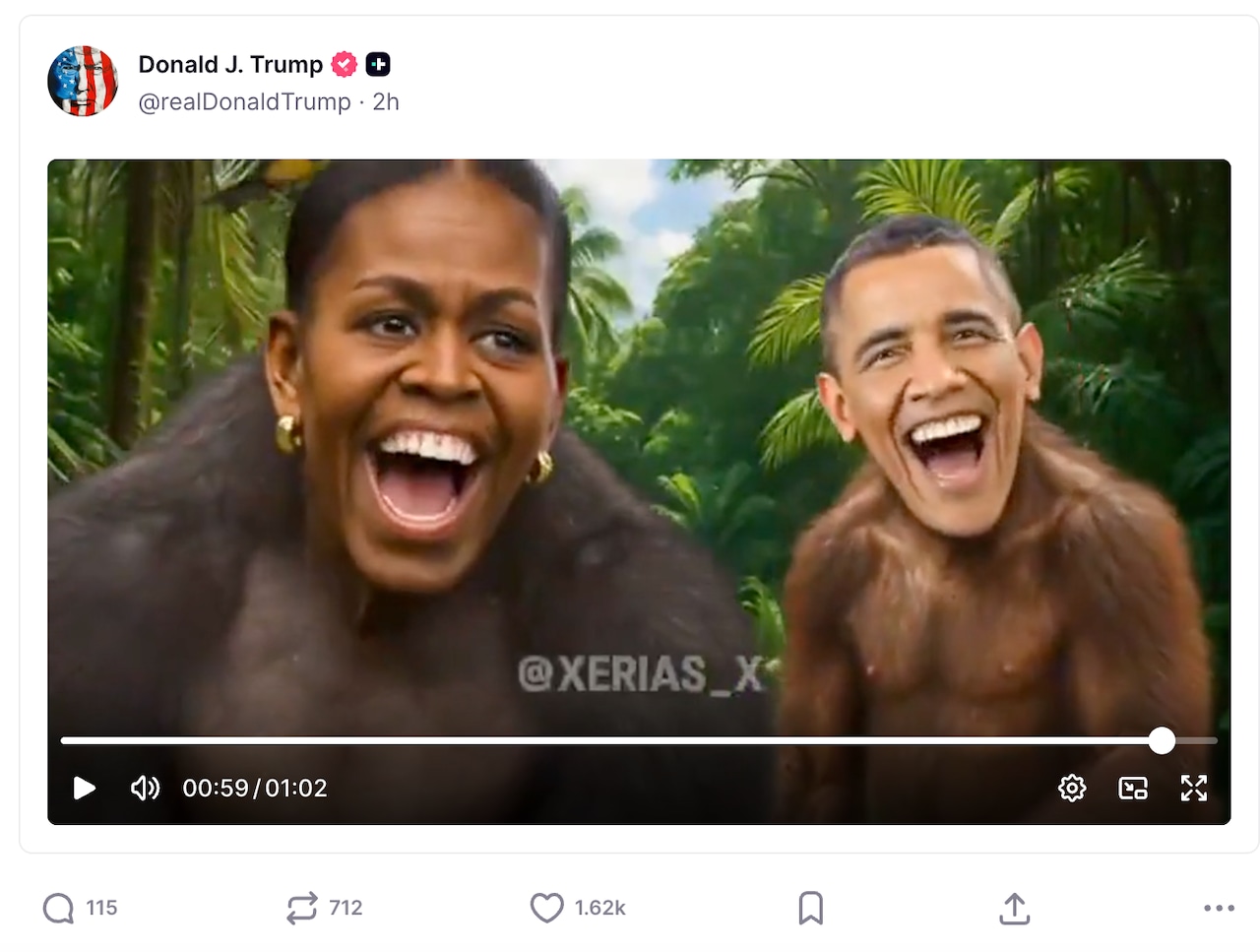
Former President Donald Trump posted an election-related video on the social media platform Truth Social that contained a clip depicting former President Barack Obama and former First Lady Michelle Obama as monkeys. The video, which was shared late Thursday night, was just over a minute in length and reportedly began with a segment before the depiction of the Obamas.
Social Media Post and Content
The video was shared on Donald Trump’s Truth Social account. It featured a visual segment that represented the former President and First Lady with primate imagery. The inclusion of this specific imagery within a political post has been a focal point of public and media attention.
Platform and Dissemination
The platform used for disseminating the video, Truth Social, is a social media service founded by Donald Trump. Its user base primarily consists of individuals who align with his political perspectives, creating an environment where such content can be readily shared and amplified among a specific audience. The act of sharing such a video on a personal, high-profile account implicates the individual’s judgment and the broader discourse occurring on the platform.
Content Analysis and Reception
The specific content of the video, which depicted the Obamas as monkeys, has been widely characterized as offensive and racially charged. This type of imagery has historical associations with racist tropes and has been used to dehumanize Black individuals. The decision to share such content, particularly by a former president, raises questions about the intent behind the post and its potential impact on public discourse and racial sensitivities.
Criticism and Reaction
The sharing of the video has elicited significant criticism. Commentators and the public have condemned the post, with many labeling it as “incredibly racist.” This reaction highlights the perceived severity of the imagery and its implications within the context of political communication. The condemnation underscores a societal standard that views such depictions as unacceptable, particularly when associated with prominent public figures and potentially divisive political messaging.
Broader Implications for Political Discourse
The incident highlights the challenges and controversies surrounding the use of social media in political communication. The amplification of potentially offensive content, even if shared by an individual rather than an official campaign, can have significant repercussions. It can inflame existing social tensions, influence public perception, and impact the general tone of political dialogue. The responsibility of public figures to maintain a certain standard of discourse, especially concerning sensitive issues like race, remains a critical consideration.
Institutional Context and Platform Responsibility
The dissemination of such content also raises broader questions about the role and responsibility of social media platforms themselves. While platforms often maintain policies against hate speech and discriminatory content, the enforcement and interpretation of these policies can be complex. The ability for content like this to be shared, even on a platform associated with a specific political figure, invites scrutiny regarding content moderation practices and the potential for these platforms to become conduits for harmful messaging. The structural incentives for platforms to balance free expression with the need to prevent harm are continually debated within the technology and policy spheres.
Stewardship of Public Discourse
As a former occupant of the highest public office, the actions and statements of an ex-president carry considerable weight. The decision to share content that is widely perceived as inflammatory or offensive can contribute to a coarsening of public discourse and may normalize the use of such imagery in political commentary. This has implications for the overall health of democratic dialogue, which relies on respectful engagement and a shared understanding of basic civility, even amidst political disagreement. The structural challenge lies in how to hold influential figures accountable for their communications in the digital age.
Impact on Stakeholders
The primary stakeholders affected by such a post include the individuals depicted, their families and supporters, and the broader public. For Barack and Michelle Obama, the use of dehumanizing imagery is a direct affront. For their supporters, it can be perceived as an attack on their community and values. For the general public, such content contributes to a polarized and potentially toxic information environment, making constructive dialogue more difficult. The structural impact is a degradation of the norms that support civil political engagement.
The Role of Social Media in Amplification
Social media platforms, by their very design, are built for rapid dissemination and amplification of content. This capacity, while enabling rapid communication, also presents a significant risk for the spread of misinformation, hate speech, and inflammatory material. The algorithms and network effects inherent in these platforms can transform a single post into widespread exposure, thus magnifying its potential impact. The structural incentives within the social media ecosystem often prioritize engagement, which can inadvertently promote sensational or controversial content over substantive discussion.
Defining and Addressing Racist Tropes
The imagery used in the video draws upon a long and deeply harmful history of racist caricatures. Depicting Black individuals with animalistic features has been a recurring motif in racist propaganda designed to strip individuals of their humanity and justify discrimination and violence. The recognition and condemnation of such tropes are crucial for fostering an inclusive and equitable society. Within political discourse, the employment of such imagery represents a severe departure from respectful engagement and can serve to re-traumatize communities historically targeted by these harmful stereotypes.
Future Considerations for Online Political Communication
This incident serves as a case study in the ongoing challenges of regulating and moderating political speech online. It raises critical questions about the responsibilities of individuals, platforms, and potentially regulatory bodies in ensuring that digital spaces do not become conduits for hate and incivility. The debate over how to balance freedom of expression with the imperative to protect against harmful content continues to be a central issue in the evolving landscape of digital communication and political engagement.